Chironomidae
Chironomidae, commonly known as non-biting midges or chironomids, are a family of Nematoceran flies with a global distribution. They are closely related to the families Ceratopogonidae, Simuliidae, and Thaumaleidae. Although many chironomid species superficially resemble mosquitoes, they can be distinguished by the absence of the wing scales and elongated mouthparts characteristic of the Culicidae.

Uncredited · Attribution · via Wikipedia/Commons. May be a photograph of a specimen, or an artist’s reconstruction — an interpretation of a skeleton, since colour and soft tissue are almost never preserved.
On record
Recorded, not inferred- Also called
- non biting midgePBDB
- Sits inside
- ChironomoideaPBDB
- Motility
- actively mobilePBDB, for Arthropoda
- Environment
- terrestrialPBDB, for Insecta
Time the record covers
At least 205 million years on record.
The record covers at least 205.7 Mya to 11.7 ka. No occurrence read is dated outside 211.18 Mya to 0 Mya.
574 occurrences of Chironomidae on record, most of them in the Eocene. The Paleobiology Database records this as a living group. Bar height is expected occurrences, not a count: each fossil is spread across the span it is dated to, so a tall narrow bar means tight dating and a low wide one means loose.
When
574 occurrences- Late Triassicunder 1%
- Early Jurassic1%
- Middle Jurassicunder 1%
- Late Jurassic10%
- Early Cretaceous13%
- Late Cretaceous3%
- Paleoceneunder 1%
- Eocene47%
- Oligocene7%
- Miocene4%
- Pliocene1%
- Pleistocene10%
- Holocene2%
These are dates about fossils, not the animal: the record can only begin after it arose and end before it died out, so either end may reach further. Shares are expected occurrences: a fossil dated to a span is counted partly in each period it straddles. More on what this infers.
Found in
62 formations
- Argiles d'lignite du Soissonnais Formation30
- Rott Formation26
- Kap København Formation19
- Uda Formation17
- Florissant Formation15
- Glushkovo Formation14
Loading coastlines…
The named rock units Chironomidae has been recovered from, largest first. Drawn where the rock is now, not where it formed. 38 further formations hold fewer occurrences each and are not listed. 297 occurrences have no formation on record, which is common for older literature.
Chironomidae and its relatives
EoceneWhere Chironomidae and its relatives were recorded in the Eocene.
Found in the same rock
6,122 taxa- Curculionidae17 sites
- Coleoptera14 sites
- Formicidae13 sites
- Staphylinidae12 sites
- Diptera11 sites
- Tanypodinae11 sites
- Ulaia communis11 sites
- Chironomus10 sites
- Orthocladiinae10 sites
- Podonominae10 sites
- Bibionidae9 sites
- Bledius9 sites
- Ceratopogonidae9 sites
- Chrysomelidae9 sites
- Elateridae9 sites
- Ichneumonidae9 sites
- Lepidoptera9 sites
- Arachnida8 sites
- Bembidion8 sites
- Plecia8 sites
- Thripidae8 sites
- Trichoptera8 sites
- Araneae7 sites
- Carabidae7 sites
The Paleobiology Database records 182 sites for Chironomidae, and this reads all of them. Of that, one read hit the database's own return limit, so every count below is a floor rather than a total. The number is how many of those sites it was catalogued from too. The 24 sharing the most are listed.
This is not a list of everything alive at the time. It is only what has come out of the same ground as this animal and been written down.
Entered from
137 references- Monographie des Cecidomyidae, des Sciaridae, des Mycetophilidae et des Chironomidae de l'ambre de la Baltique59
- Chironomid midges from early Eocene amber of France (Diptera: Chironomidae)30
- Khaoboridy i Komary-zvontsy iz Mezozoya vostochnogo Zabaykal'ya (Diptera: Chaoboridae, Chironomidae)29
- Fossil chironomids (Insecta, Diptera) in Baltic amber28
- Infraorders Psychodomorpha, Tipulomorpha and Culicomorpha28
- A diverse late-glacial (Mackinaw Phase) biota from Leamington, Ontario25
- Palaeoentomology of the Kap København Formation, a Plio-Pleistocene sequence in Peary Land, North Greenland19
- A Report on Some Miocene Diptera from Florissant, Colorado14
- Neue Dipteren (Nematocera) aus dem Oberoligocan von Rott. 1. Teil 6. Familie: Tendipedidae (Zuck- oder Schwarmmucken). 2. Teil 7. Familie: Heleidae (Gnitzen) 3. Teil 8. Familie: Lycoriidae (Trauermucken)14
- First records on non-biting midges (Diptera: Chironomidae) from the Rovno amber13
- Hong, 198113
- Hong, 200212
Each of the 574 occurrences read was entered from one of these publications, ordered by how many each accounts for. This is not a search for papers mentioning the name. 125 further references are not listed. Entries link to doi.org where the Paleobiology Database holds an identifier, and to its own record where it does not. Relayed as the Paleobiology Database holds them, not checked against what they resolve to.
Media and terms
Media content1
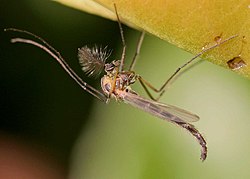
Picture of Chironomidae
- Source
- Wikipedia/Commons
- Credit
- nobody named on the record
- Licence
- Attribution
- Commercial use
- cannot be read from the licence given — check the record
No 3D scan of Chironomidae was found in MorphoSource and Sketchfab.
Smithsonian Open Access was not reached for this taxon, so this list is what the others held rather than everything there is.
The description on this site
- Licence
- CC BY-SA 4.0
This is what the site found, which is not the same as what exists.
Keep going
What may have been alongside itChironomoidea through timeFormations of the EoceneThe world it lived on
Occurrence data from the Paleobiology Database, CC BY 4.0. Macquart 1838