Amazona
Amazon parrots are parrots in the genus Amazona. They are medium-sized, short-tailed parrots native to the Americas, with their range extending from South America to Mexico and the Caribbean. Amazona is one of the 92 genera of parrots that make up the order Psittaciformes and are in the family Psittacidae, one of three families of true parrots. It contains about 30 species. Most amazons are predominantly green, with accenting colors that depend on the species, and they can be quite vivid. They feed primarily on seeds, nuts, and fruits, supplemented by leafy matter.

Beverly Lussier, boazyw, David Oliva, JavAlvarezS · CC BY-SA 4.0 · via Wikipedia/Commons. May be a photograph of a specimen, or an artist’s reconstruction — an interpretation of a skeleton, since colour and soft tissue are almost never preserved.
On record
Recorded, not inferred- Sits inside
- PsittacidaePBDB
- Diet
- granivorePBDB, for Psittacidae
- Life habit
- volantPBDB, for Psittacidae
- Motility
- actively mobilePBDB, for Theropoda
- Environment
- terrestrialPBDB, for Psittacidae
Time the record covers
At most 12 thousand years on record.
Every occurrence read is dated to somewhere between 11.7 ka and 0 Mya, and nothing in the dating separates them, so that window is what the record shows rather than a span.
7 occurrences of Amazona on record, most of them in the Holocene. The Paleobiology Database records this as a living group. Bar height is expected occurrences, not a count: each fossil is spread across the span it is dated to, so a tall narrow bar means tight dating and a low wide one means loose.
When
7 occurrences- Holocene100%
These are dates about fossils, not the animal: the record can only begin after it arose and end before it died out, so either end may reach further. Shares are expected occurrences: a fossil dated to a span is counted partly in each period it straddles. More on what this infers.
Amazona and its relatives
HoloceneWhere Amazona and its relatives were recorded in the Holocene.
Found in the same rock
102 taxa- Ionornis martinica4 sites
- Accipiter striatus2 sites
- Ardea alba2 sites
- Columbidae2 sites
- Gallinula chloropus2 sites
- Leptotila verreauxi2 sites
- Oryzomyini2 sites
- Patagioenas squamosa2 sites
- Phalacrocorax brasilianus2 sites
- Podilymbus podiceps2 sites
- Tyto alba2 sites
- Zenaida aurita2 sites
- Zenaida macroura2 sites
- Accipitridae1 site
- Allenia fusca1 site
- Alsophis1 site
- Ameiva griswoldi1 site
- Anas1 site
- Ara1 site
- Ara militaris1 site
- Ardea cocoi1 site
- Asio clamator1 site
- Aulacorhynchus prasinus1 site
- Aythya affinis1 site
The Paleobiology Database records 6 sites for Amazona, and this reads all of them. The number is how many of those sites it was catalogued from too. The 24 sharing the most are listed.
This is not a list of everything alive at the time. It is only what has come out of the same ground as this animal and been written down.
Entered from
5 references- Prehistoric exploitation of birds on the Pacific coast of Chiapas, Mexico2
- Fossil vertebrates from Antigua, Lesser Antilles: evidence for late Holocene human-caused extinctions in the West Indies2
- A late-Holocene bird community from Hispaniola: Refining the chronology of vertebrate extinction in the West Indies1
- Archaeology of Trants, Montserrat. Part 5. Prehistoric avifauna1
- Pre-Columbian bird remains from Venezuela1
Each of the 7 occurrences read was entered from one of these publications, ordered by how many each accounts for. This is not a search for papers mentioning the name. Each entry links to doi.org. Relayed as the Paleobiology Database holds them, not checked against what they resolve to.
Media and terms
Media content1
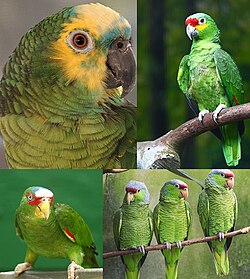
Picture of Amazona
- Source
- Wikipedia/Commons
- Credit
- Beverly Lussier, boazyw, David Oliva, JavAlvarezS
- Licence
- CC BY-SA 4.0
- Commercial use
- the licence allows it
No 3D scan of Amazona was found in Sketchfab.
Smithsonian Open Access and MorphoSource were not reached for this taxon, so this list is what the others held rather than everything there is.
The description on this site
- Licence
- CC BY-SA 4.0
This is what the site found, which is not the same as what exists.
Keep going
What may have been alongside itPsittacidae through timeFormations of the HoloceneThe world it lived on
Occurrence data from the Paleobiology Database, CC BY 4.0. Lesson 1830