Trepospira

via iDigBio · CC0 · via iDigBio. May be a photograph of a specimen, or an artist’s reconstruction — an interpretation of a skeleton, since colour and soft tissue are almost never preserved.
On record
Recorded, not inferred- Sits inside
- GosseletininaePBDB
- Diet
- detritivorePBDB, for Gosseletinidae
- Life habit
- epifaunalPBDB, for Gosseletinidae
- Motility
- slow-movingPBDB, for Gosseletinidae
- Vision
- limitedPBDB, for Gosseletinidae
- Environment
- coastal,marinePBDB, for Murchisoniina
Time the record covers
At least 173 million years on record.
The record covers at least 432.9 Mya to 259.857 Mya. No occurrence read is dated outside 438.6 Mya to 251.902 Mya.
160 occurrences of Trepospira on record, most of them in the Carboniferous. Bar height is expected occurrences, not a count: each fossil is spread across the span it is dated to, so a tall narrow bar means tight dating and a low wide one means loose.
When
160 occurrences- Silurianunder 1%
- Carboniferous96%
- Permian4%
These are dates about fossils, not the animal: the record can only begin after it arose and end before it died out, so either end may reach further. Shares are expected occurrences: a fossil dated to a span is counted partly in each period it straddles. More on what this infers.
Found in
42 formations
- Graham Formation · Cisco Group47
- Wewoka Formation25
- Allegheny Formation8
- Cabaniss Formation · Cherokee Group8
- Wolf Mountain Formation · Canyon Group4
- Glenshaw Formation · Conemaugh Group4
Loading coastlines…
The named rock units Trepospira has been recovered from, largest first. Drawn where the rock is now, not where it formed. 18 further formations hold fewer occurrences each and are not listed. 10 occurrences have no formation on record, which is common for older literature.
Trepospira and its relatives
CarboniferousWhere Trepospira and its relatives were recorded in the Carboniferous.
Found in the same rock
1,134 taxa- Crinoidea76 sites
- Worthenia tabulata59 sites
- Glabrocingulum grayvillense52 sites
- Pseudorthoceras knoxense51 sites
- Crurithyris planoconvexa50 sites
- Ianthinopsis45 sites
- Astartella concentrica44 sites
- Composita subtilita41 sites
- Glabrocingulum40 sites
- Nuculopsis girtyi40 sites
- Meekospira38 sites
- Echinoidea37 sites
- Pharkidonotus percarinatus37 sites
- Euphemites36 sites
- Lophophyllidium35 sites
- Parajuresania nebrascensis35 sites
- Kutorginella lasallensis34 sites
- Euphemites carbonarius33 sites
- Cymatospira montfortianus32 sites
- Straparollus32 sites
- Condrathyris perplexa30 sites
- Chonetinella28 sites
- Derbyia28 sites
- Hustedia mormoni28 sites
The Paleobiology Database records 153 sites for Trepospira, and this reads all of them. The number is how many of those sites it was catalogued from too. The 24 sharing the most are listed.
This is not a list of everything alive at the time. It is only what has come out of the same ground as this animal and been written down.
Entered from
35 references- The surficial geology, paleontology, and paleoecology of the Finis Shale (Pennsylvanian, Lower Virgilian) in Jack County, Texas42
- Marine Communities of a Portion of the Wewoka Formation (Pennsylvanian) in Hughes County, Oklahoma18
- Taxonomy and diversity of slit-band gastropods (Order Pleurotomariida) and some slit bearing Caenogastropoda from the Pennsylvanian of the USA17
- Paleoecology and taphonomy of faunal assemblages in gray "core" (offshore) shales in Midcontinent Pennsylvanian cyclothems16
- Desmoinesian Brachiopoda and Mollusca from southwest Missouri11
- Allegheny fossil invertebrates from eastern Ohio: Gastropoda8
- The fauna of the Wewoka Formation of Oklahoma6
- Brachiopoda and Mollusca from the Productus limestones of the Salt Range5
- Biostratigraphy of the Graford Formation, Missourian, Wise County, Texas4
- Carboniferous Faunal Associations and Stratigraphy, Shasta County, Northern California3
- Geology of Palo Pinto County, Texas3
- A preliminary list of the fauna of the Allegheny and Conemaugh series in western Pennsylvania3
Each of the 160 occurrences read was entered from one of these publications, ordered by how many each accounts for. This is not a search for papers mentioning the name. 23 further references are not listed. Entries link to doi.org where the Paleobiology Database holds an identifier, and to its own record where it does not. Relayed as the Paleobiology Database holds them, not checked against what they resolve to.
Media and terms
Media content2
Picture of Trepospira
- Source
- iDigBio
- Credit
- via iDigBio
- Licence
- CC0
- Commercial use
- the licence allows it
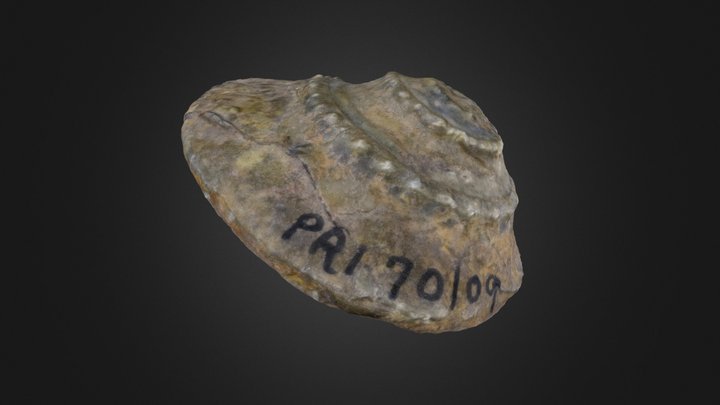
3D model
- Source
- Sketchfab
- Licence
- CC0 Public Domain
- Commercial use
- the licence allows it
This is what the site found, which is not the same as what exists.
Keep going
What may have been alongside itGosseletininae through timeFormations of the CarboniferousThe world it lived on
Occurrence data from the Paleobiology Database, CC BY 4.0. (Ulrich and Scofield 1897)