Tethysaurinae
The Tethysaurinae are a subfamily of mosasaurs, a diverse group of Late Cretaceous marine squamates. Members of the subfamily are informally and collectively known as "tethysaurines" and have been recovered from North America and Africa. Only two tethysaurine genera are known, Pannoniasaurus and Tethysaurus. The genera Yaguarasaurus and Russellosaurus were previously considered tethysaurines until they were grouped with Romeosaurus in the new subfamily Yaguarasaurinae. A possible member of this clade (subfamily) is a mosasaur specimen known from a maxilla fragment, found in 1960 in the Czech Republic, in Dolní Újezd near Litomyšl.

Seth.sorensen · CC BY-SA 3.0 · via Wikipedia/Commons. May be a photograph of a specimen, or an artist’s reconstruction — an interpretation of a skeleton, since colour and soft tissue are almost never preserved.
On record
Recorded, not inferred- Sits inside
- MosasauroideaPBDB
- Motility
- actively mobilePBDB, for Osteichthyes
- Environment
- marinePBDB, for Mosasauroidea
Time the record covers
At least 6.2 million years on record.
The record covers at least 89.8 Mya to 83.6 Mya. No occurrence read is dated outside 93.9 Mya to 72.2 Mya.
9 occurrences of Tethysaurinae on record, most of them in the Late Cretaceous. Bar height is expected occurrences, not a count: each fossil is spread across the span it is dated to, so a tall narrow bar means tight dating and a low wide one means loose.
When
9 occurrences- Late Cretaceous100%
These are dates about fossils, not the animal: the record can only begin after it arose and end before it died out, so either end may reach further. Shares are expected occurrences: a fossil dated to a span is counted partly in each period it straddles. More on what this infers.
Found in
5 formations
- Akrabou Formation1
- Csehbánya Formation1
- Ajka Coal Formation1
- Jizera Formation1
- Schönleiten Formation · Gosau Group1
Loading coastlines…
The named rock units Tethysaurinae has been recovered from, largest first. Drawn where the rock is now, not where it formed. 4 occurrences have no formation on record, which is common for older literature.
Tethysaurinae and its relatives
Late CretaceousWhere Tethysaurinae and its relatives were recorded in the Late Cretaceous.
Found in the same rock
97 taxa- Neosuchia4 sites
- Theropoda4 sites
- Lepisosteus3 sites
- Actinopterygii2 sites
- Albanerpetontidae2 sites
- Anura2 sites
- Dortokidae2 sites
- Eusuchia2 sites
- Gastropoda2 sites
- Iharkutosuchus makadii2 sites
- Lacertilia2 sites
- Lepisosteidae2 sites
- Maniraptora2 sites
- Ostracoda2 sites
- Pannoniasaurus inexpectatus2 sites
- Pycnodontiformes2 sites
- Squamata2 sites
- Tetanurae2 sites
- Unio2 sites
- Abelisauridae1 site
- Ajkaceratops kozmai1 site
- Allodaposuchus1 site
- Ariomphalus sp.1 site
- Aves1 site
The Paleobiology Database records 9 sites for Tethysaurinae, and this reads all of them. The number is how many of those sites it was catalogued from too. The 24 sharing the most are listed.
This is not a list of everything alive at the time. It is only what has come out of the same ground as this animal and been written down.
Entered from
8 references- Freshwater amphibians and squamates from Villeveyrac (lower Campanian; Hérault, France): palaeodiversity, palaeoenvironment and implications for the Late Cretaceous palaeobiogeography of the European herpetofauna2
- A brackish to non-marine aquatic and terrestrial fossil assemblage with vertebrates from the lower Coniacian (Upper Cretaceous) Gosau Group of the Tiefengraben locality near St. Wolfgang im Salzkammergut, Austria1
- Vertebrate remains from the Turonian (Upper Cretaceous) Gosau Group of Gams, Austria1
- Mosasauroid (Squamata) discovery in the Late Cretaceous (Early Campanian) continental deposits of Villeveyrac–L’Olivet, southern France1
- Vertebrate remains from the Upper Cretaceous (Santonian) Ajka Coal Formation, western Hungary1
- Turonian marine amniotes from the Bohemian Cretaceous Basin, Czech Republic1
- The first freshwater mosasauroid (Upper Cretaceous, Hungary) and a new clade of basal mosasauroids1
- A new mosasauroid (Squamata) from the Late Cretaceous (Turonian) of Morocco1
Each of the 9 occurrences read was entered from one of these publications, ordered by how many each accounts for. This is not a search for papers mentioning the name. Each entry links to doi.org. Relayed as the Paleobiology Database holds them, not checked against what they resolve to.
Media and terms
Media content1
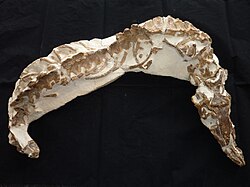
Picture of Tethysaurinae
- Source
- Wikipedia/Commons
- Credit
- Seth.sorensen
- Licence
- CC BY-SA 3.0
- Commercial use
- the licence allows it
No 3D scan of Tethysaurinae was found in Sketchfab.
Smithsonian Open Access and MorphoSource were not reached for this taxon, so this list is what the others held rather than everything there is.
The description on this site
- Licence
- CC BY-SA 4.0
This is what the site found, which is not the same as what exists.
Keep going
What may have been alongside itMosasauroidea through timeFormations of the Late CretaceousThe world it lived on
Occurrence data from the Paleobiology Database, CC BY 4.0. Makádi et al. 2012