Stringocephalus
Stringocephalus is an extinct genus of large brachiopods; between 388.1 to 376.1 million years old they are usually found as fossils in Devonian marine rocks. Several forms of the genus are known; they may be found in western North America, northern Europe, Asia and the Canning Basin of Western Australia. Several different types are known; they share a well-developed, curved structure shaped like a beak. Some of the largest specimens discovered to date have been found in China.

Atamari · CC BY-SA 3.0 · via Wikipedia/Commons. May be a photograph of a specimen, or an artist’s reconstruction — an interpretation of a skeleton, since colour and soft tissue are almost never preserved.
On record
Recorded, not inferred- Sits inside
- StringocephalinaePBDB
- Diet
- suspension feederPBDB, for Terebratulida
- Life habit
- low-level epifaunalPBDB, for Terebratulida
- Motility
- stationaryPBDB, for Terebratulida
- Vision
- blindPBDB, for Rhynchonellata
- Environment
- marinePBDB, for Lophophorata
Time the record covers
At least 5.6 million years on record.
The record covers at least 387.95 Mya to 382.31 Mya. No occurrence read is dated outside 393.47 Mya to 372.15 Mya.
126 occurrences of Stringocephalus on record, most of them in the Devonian. Bar height is expected occurrences, not a count: each fossil is spread across the span it is dated to, so a tall narrow bar means tight dating and a low wide one means loose.
When
126 occurrences- Devonian100%
These are dates about fossils, not the animal: the record can only begin after it arose and end before it died out, so either end may reach further. Shares are expected occurrences: a fossil dated to a span is counted partly in each period it straddles. More on what this infers.
Found in
44 formations
- Donggangling Formation21
- Winnipegosis Formation · Elk Point Group15
- Massenkalk Formation7
- Blacourt Formation6
- Kowala Formation · Set A Group6
- Qiziqiao Formation4
Loading coastlines…
The named rock units Stringocephalus has been recovered from, largest first. Drawn where the rock is now, not where it formed. 20 further formations hold fewer occurrences each and are not listed. 11 occurrences have no formation on record, which is common for older literature.
Stringocephalus and its relatives
DevonianWhere Stringocephalus and its relatives were recorded in the Devonian.
Found in the same rock
495 taxa- Bornhardtina12 sites
- Thamnopora12 sites
- Stromatoporoidea11 sites
- Temnophyllum11 sites
- Alveolites9 sites
- Desquamatia9 sites
- Spinatrypa9 sites
- Athyris8 sites
- Atrypa8 sites
- Crinoidea8 sites
- Cyrtina8 sites
- Gypidula8 sites
- Undispirifer8 sites
- Acanthophyllum7 sites
- Actinostroma6 sites
- Amphipora6 sites
- Dendrostella6 sites
- Emanuella6 sites
- Ostracoda6 sites
- Stromatopora6 sites
- Syringopora6 sites
- Thamnophyllum6 sites
- Aulopora5 sites
- Bryozoa5 sites
The Paleobiology Database records 72 sites for Stringocephalus, and this reads all of them. The number is how many of those sites it was catalogued from too. The 24 sharing the most are listed.
This is not a list of everything alive at the time. It is only what has come out of the same ground as this animal and been written down.
Entered from
53 references- Devonian sections in Guangxi from which pelecypods were collected14
- Devonian rocks of the Lake Winnipegosis - Lake Manitoba outcrop belt, Manitoba14
- The Lali Section: An Excellent Reference Section for Upper Devonian in South China7
- Brachiopod assemblages in the Devonian Kowala Formation of the Holy Cross Mountains7
- Lower and Middle Devonian Brachiopod-Dominated Communities of Nevada, and Their Position in a Biofacies-Province-Realm Model7
- Die Fossilführung des Mitteldevons im Raum Attendorn-Olpe (West-Sauerland; Rechtsrheinisches Schiefergebirge) [Middle Devonian fossils of the Attendorn-Olpe area (western Sauerland; Rhenish Massif]6
- Tong-Dzuy et al., 19885
- Brachiopod assemblages in the Devonian of Ferques (Boulonnais, France). Relations to palaeoenvironments and global eustatic curves.4
- Der Massenkalk (Devon) nördlich von Brilon (Sauerland) [The Devonian Massenkalk north of Brilon (Sauerland)]4
- Ecological characters of Devonian Leimingdong reef complex section in Lianyuan of Hunan (in Chinese)3
- The initial phase of the Hönne Valley Reef at Binolen (northern Rhenish Massif, Middle Devonian)2
- Koch, L. Zur Geologie des Oberen Mitteldevon (Givet-Stufe) im Raum Ennepetal2
Each of the 126 occurrences read was entered from one of these publications, ordered by how many each accounts for. This is not a search for papers mentioning the name. 41 further references are not listed. Entries link to doi.org where the Paleobiology Database holds an identifier, and to its own record where it does not. Relayed as the Paleobiology Database holds them, not checked against what they resolve to.
Media and terms
Media content2

Picture of Stringocephalus
- Source
- Wikipedia/Commons
- Credit
- Atamari
- Licence
- CC BY-SA 3.0
- Commercial use
- the licence allows it
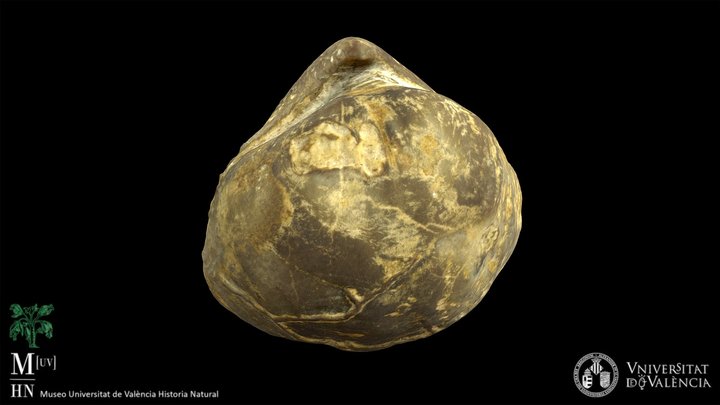
3D model
- Source
- Sketchfab
- Licence
- CC Attribution
- Commercial use
- cannot be read from the licence given — check the record
The description on this site
- Licence
- CC BY-SA 4.0
This is what the site found, which is not the same as what exists.
Keep going
What may have been alongside itStringocephalinae through timeFormations of the DevonianThe world it lived on
Occurrence data from the Paleobiology Database, CC BY 4.0.