Spinosaurus
Spinosaurus is a genus of large spinosaurid theropod dinosaurs that lived in what is now North Africa during the Cenomanian age of the Late Cretaceous period, about 100 to 94 million years ago. The genus was known first from Egyptian remains discovered in 1912 and described by German palaeontologist Ernst Stromer in 1915. The original remains were destroyed in World War II, but additional material came to light in the early 21st century. It is unclear whether one or two species are represented in the fossils reported in the scientific literature. The type species, S. aegyptiacus, is mainly known from the Bahariya Formation in Egypt and the Kem Kem beds in Morocco. The other species, S. mirabilis, is known from the Farak Formation in Niger. Possible junior synonyms include Sigilmassasaurus and the dubious S. maroccanus from the Kem Kem beds and Oxalaia from the Alcântara Formation in Brazil, though the distinction and validity of these taxa have been debated.

3blindMies · CC BY-SA 4.0 · via Wikipedia/Commons. May be a photograph of a specimen, or an artist’s reconstruction — an interpretation of a skeleton, since colour and soft tissue are almost never preserved.
On record
Recorded, not inferred- Sits inside
- SpinosauriniPBDB
- Diet
- carnivorePBDB, for Theropoda
- Life habit
- ground dwelling, solitaryPBDB, for Theropoda
- Motility
- actively mobilePBDB, for Theropoda
- Environment
- terrestrialPBDB, for Theropoda
- Length
- 14 mWikidata
- Mass
- 38000 poundWikidata
Time the record covers
At least 26 million years on record.
The record covers at least 110.1 Mya to 83.6 Mya. No occurrence read is dated outside 143.1 Mya to 72.2 Mya.
44 occurrences of Spinosaurus on record, most of them in the Late Cretaceous. Bar height is expected occurrences, not a count: each fossil is spread across the span it is dated to, so a tall narrow bar means tight dating and a low wide one means loose.
When
44 occurrencesThese are dates about fossils, not the animal: the record can only begin after it arose and end before it died out, so either end may reach further. Shares are expected occurrences: a fossil dated to a span is counted partly in each period it straddles. More on what this infers.
Found in
14 formations
- Gara Sbaa Formation · Kem Kem Group5
- Ifezouane Formation · Kem Kem Group5
- Aïn el Guettar Formation4
- Douira Formation · Kem Kem Group4
- Baharîje Formation3
- Echkar Formation · Tegama Group3
Loading coastlines…
The named rock units Spinosaurus has been recovered from, largest first. Drawn where the rock is now, not where it formed. 9 occurrences have no formation on record, which is common for older literature.
Spinosaurus and its relatives
Late CretaceousWhere Spinosaurus and its relatives were recorded in the Late Cretaceous.
Found in the same rock
124 taxa- Carcharodontosaurus saharicus10 sites
- Theropoda10 sites
- Crocodylia9 sites
- Neoceratodus africanus8 sites
- Testudines8 sites
- Lepidotes5 sites
- Sauropoda5 sites
- Anhangueridae4 sites
- Carcharodontosaurus4 sites
- Dinosauria4 sites
- Onchopristis numidus4 sites
- Protolamna4 sites
- Rebbachisauridae4 sites
- Titanosauria4 sites
- Hybodus3 sites
- Obaichthys africanus3 sites
- Pycnodontiformes3 sites
- Titanosauridae3 sites
- Abelisauridae2 sites
- Abelisauroidea2 sites
- Archosauria2 sites
- Azhdarchidae2 sites
- Bawitius2 sites
- Calamopleurus africanus2 sites
The Paleobiology Database records 35 sites for Spinosaurus, and this reads all of them. The number is how many of those sites it was catalogued from too. The 24 sharing the most are listed.
This is not a list of everything alive at the time. It is only what has come out of the same ground as this animal and been written down.
Entered from
26 references- Calcium isotopes offer clues on resource partitioning among Cretaceous predatory dinosaurs4
- Semiaquatic adaptations in a giant predatory dinosaur4
- Juvenile spinosaurs (Theropoda: Spinosauridae) from the middle Cretaceous of Morocco and implications for spinosaur ecology3
- A reevaluation of Sigilmassasaurus brevicollis (Dinosauria) from the Cretaceous of Morocco3
- Ergebnisse der Forschungsreisen Prof. E. Stromers in den Wüsten Ägyptens. II. Wirbeltier-Reste der Baharîje-Stufe (unterstes Cenoman). 3. Das Original des Theropoden Spinosaurus aegyptiacus nov. gen., nov. spec3
- Scimitar-crested Spinosaurus species from the Sahara caps stepwise spinosaurid radiation2
- Spinosaurus is not an aquatic dinosaur2
- Overabundance of piscivorous dinosaurs (Theropoda: Spinosauridae) in the mid-Cretaceous of North Africa: the Algerian dilemma2
- Oxygen and carbon isotope compositions of middle Cretaceous vertebrates from North Africa and Brazil: Ecological and environmental significance2
- New information on the skull of the enigmatic theropod Spinosaurus, with remarks on its size and affinities2
- Isolated dinosaur bones from the Middle Cretaceous of the Tafilalt, Morocco2
- Aquatic adaptation in the skull of carnivorous dinosaurs (Theropoda: Spinosauridae) and the evolution of aquatic habits in spinosaurids1
Each of the 44 occurrences read was entered from one of these publications, ordered by how many each accounts for. This is not a search for papers mentioning the name. 14 further references are not listed. Entries link to doi.org where the Paleobiology Database holds an identifier, and to its own record where it does not. Relayed as the Paleobiology Database holds them, not checked against what they resolve to.
Media and terms
Media content3
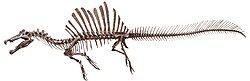
Picture of Spinosaurus
- Source
- Wikipedia/Commons
- Credit
- 3blindMies
- Licence
- CC BY-SA 4.0
- Commercial use
- the licence allows it
Born Digital scan
- Source
- MorphoSource
- Licence
- In Copyright
- Commercial use
- cannot be read from the licence given — check the record
- Specimen
- Spinosaurus aegyptiacus · ucrc:PV170
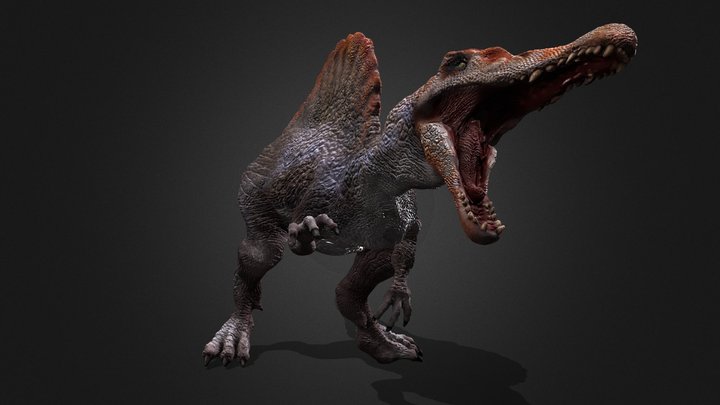
The description on this site
- Source
- Wikipedia, “Spinosaurus”
- Licence
- CC BY-SA 4.0
This is what the site found, which is not the same as what exists.
Keep going
What may have been alongside itSpinosaurini through timeFormations of the Late CretaceousThe world it lived on
Occurrence data from the Paleobiology Database, CC BY 4.0. Stromer 1915