Azhdarchidae
Azhdarchidae is a family of pterosaurs known mostly from the Late Cretaceous. Azhdarchids include the largest flying animals discovered, but smaller cat-size members have also been found. Originally considered a sub-family of Pteranodontidae, Nesov (1984) named the Azhdarchinae to include the pterosaurs Azhdarcho, Quetzalcoatlus, and Titanopteryx. They were among the last known surviving members of the pterosaurs, and were a rather successful group with a worldwide distribution. Previously it was thought that by the end of the Cretaceous, most pterosaur families except for the Azhdarchidae disappeared from the fossil record, but recent studies indicate a wealth of other pterosaurian fauna based on several pteranodontian fossils from the latest Cretaceous period.

Mark Witton · CC BY 4.0 · via Wikipedia/Commons. May be a photograph of a specimen, or an artist’s reconstruction — an interpretation of a skeleton, since colour and soft tissue are almost never preserved.
On record
Recorded, not inferred- Sits inside
- AzhdarchoideaPBDB
- Diet
- piscivorePBDB, for Pterosauria
- Life habit
- volantPBDB, for Pterosauria
- Motility
- actively mobilePBDB, for Osteichthyes
- Environment
- marinePBDB, for Pterosauria
Time the record covers
At least 72 million years on record.
The record covers at least 145.06 Mya to 72.2 Mya. No occurrence read is dated outside 149.2 Mya to 66 Mya.
98 occurrences of Azhdarchidae on record, most of them in the Late Cretaceous. Bar height is expected occurrences, not a count: each fossil is spread across the span it is dated to, so a tall narrow bar means tight dating and a low wide one means loose.
When
98 occurrencesThese are dates about fossils, not the animal: the record can only begin after it arose and end before it died out, so either end may reach further. Shares are expected occurrences: a fossil dated to a span is counted partly in each period it straddles. More on what this infers.
Found in
49 formations
- Javelina Formation · Tornillo Group10
- Couche III Formation4
- Two Medicine Formation · Montana Group3
- Zhirkindek Formation3
- Densuș-Ciula Formation3
- Rybushka Formation3
Loading coastlines…
The named rock units Azhdarchidae has been recovered from, largest first. Drawn where the rock is now, not where it formed. 25 further formations hold fewer occurrences each and are not listed. 15 occurrences have no formation on record, which is common for older literature.
Azhdarchidae and its relatives
Late CretaceousWhere Azhdarchidae and its relatives were recorded in the Late Cretaceous.
Found in the same rock
589 taxa- Theropoda14 sites
- Dromaeosauridae11 sites
- Hadrosauridae11 sites
- Dinosauria10 sites
- Abelisauridae7 sites
- Ankylosauria7 sites
- Lepisosteidae7 sites
- Ornithomimidae7 sites
- Testudines7 sites
- Albanerpetontidae6 sites
- Anura6 sites
- Gastropoda6 sites
- Lacertilia6 sites
- Nodosauridae6 sites
- Quetzalcoatlus northropi6 sites
- Troodontidae6 sites
- Tyrannosauridae6 sites
- Crocodyliformes5 sites
- Pterodactyloidea5 sites
- Rhabdodon5 sites
- Solemys5 sites
- Squamata5 sites
- Acynodon iberoccitanus4 sites
- Alanqa saharica4 sites
The Paleobiology Database records 90 sites for Azhdarchidae, and this reads all of them. The number is how many of those sites it was catalogued from too. The 24 sharing the most are listed.
This is not a list of everything alive at the time. It is only what has come out of the same ground as this animal and been written down.
Entered from
69 references- New records of azhdarchids (Pterosauria, Azhdarchidae) from the Late Cretaceous of Russia, Kazakhstan, and Central Asia9
- Morphology and taxonomy of Quetzalcoatlus Lawson 1975 (Pterodactyloidea: Azhdarchoidea)8
- A new pterosaur (Pterodactyloidea: Azharchidae) from the Upper Cretaceous of Morocco4
- Late Maastrichtian pterosaurs from North Africa and mass extinction of Pterosauria at the Cretaceous-Paleogene boundary3
- Flying reptiles of the Jurassic and Cretaceous of the USSR and the significance of their remains for the reconstruction of paleogeographic conditions3
- Cryodrakon boreas, gen. et sp. nov., a Late Cretaceous Canadian azhdarchid pterosaur2
- New pterosaur specimens from the Kem Kem beds (Upper Cretaceous, Cenomanian) of Morocco2
- Navajodactylus boerei, n. gen., n. sp. (Pterosauria, ? Azhdarchidae) from the Upper Cretaceous Kirtland Formation (upper Campanian) of New Mexico2
- The first discovery of pterosaurs from the Upper Cretaceous of Mongolia2
- First evidence of azhdarchid pterosaurs from the Late Cretaceous of Hungary2
- Taphonomy of the Late Cretaceous dinosaur-bearing beds of the Lano Quarry (Iberian Peninsula)2
- Could pterosaurs fly?2
Each of the 98 occurrences read was entered from one of these publications, ordered by how many each accounts for. This is not a search for papers mentioning the name. 57 further references are not listed. Entries link to doi.org where the Paleobiology Database holds an identifier, and to its own record where it does not. Relayed as the Paleobiology Database holds them, not checked against what they resolve to.
Media and terms
Media content2
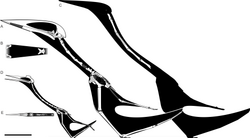
Picture of Azhdarchidae
- Source
- Wikipedia/Commons
- Credit
- Mark Witton
- Licence
- CC BY 4.0
- Commercial use
- the licence allows it
Structured light scan
- Source
- MorphoSource
- Licence
- not stated by the source
- Commercial use
- cannot be read from the licence given — check the record
- Specimen
- Azhdarchidae indet. · wam:60.57
Smithsonian Open Access was not reached for this taxon, so this list is what the others held rather than everything there is.
The description on this site
- Licence
- CC BY-SA 4.0
This is what the site found, which is not the same as what exists.
Keep going
What may have been alongside itAzhdarchoidea through timeFormations of the Late CretaceousThe world it lived on
Occurrence data from the Paleobiology Database, CC BY 4.0. (Nessov 1984)