Hybodus
Hybodus is an extinct genus of hybodont. Numerous species have been assigned to Hybodus spanning a large period of time, and it is currently considered a wastebasket taxon that is 'broadly polyphyletic' and requires reexamination. It has been suggested that Hybodus sensu stricto only consists of two species, the type species H. reticulatus and H. hauffianus, both known from the Early Jurassic of Europe, with H. obtusus from the Middle-Late Jurassic of Europe possibly also being a true species of Hybodus.

Gasmasque · CC BY-SA 4.0 · via Wikipedia/Commons. May be a photograph of a specimen, or an artist’s reconstruction — an interpretation of a skeleton, since colour and soft tissue are almost never preserved.
On record
Recorded, not inferred- Sits inside
- HybodontinaePBDB
- Diet
- carnivorePBDB, for Chondrichthyes
- Life habit
- nektonicPBDB, for Chondrichthyes
- Motility
- actively mobilePBDB, for Chondrichthyes
Time the record covers
At least 221 million years on record.
The record covers at least 293.52 Mya to 72.2 Mya. No occurrence read is dated outside 303.7 Mya to 66 Mya.
381 occurrences of Hybodus on record, most of them in the Late Cretaceous. Bar height is expected occurrences, not a count: each fossil is spread across the span it is dated to, so a tall narrow bar means tight dating and a low wide one means loose.
When
381 occurrences- Carboniferousunder 1%
- Permian3%
- Early Triassic6%
- Middle Triassic14%
- Late Triassic12%
- Early Jurassic16%
- Middle Jurassic4%
- Late Jurassic5%
- Early Cretaceous12%
- Late Cretaceous28%
These are dates about fossils, not the animal: the record can only begin after it arose and end before it died out, so either end may reach further. Shares are expected occurrences: a fossil dated to a span is counted partly in each period it straddles. More on what this infers.
Found in
145 formations
- Cañete Formation13
- Bahariya Formation10
- Westbury Formation · Penarth Group7
- Aguja Formation6
- Masuk Formation6
- Judith River Formation · Montana Group5
Loading coastlines…
The named rock units Hybodus has been recovered from, largest first. Drawn where the rock is now, not where it formed. 121 further formations hold fewer occurrences each and are not listed. 122 occurrences have no formation on record, which is common for older literature.
Hybodus and its relatives
Late CretaceousWhere Hybodus and its relatives were recorded in the Late Cretaceous.
Found in the same rock
2,078 taxa- Theropoda31 sites
- Lepidotes27 sites
- Polyacrodus26 sites
- Crocodylia23 sites
- Testudines23 sites
- Archaeolamna kopingensis22 sites
- Ischyrhiza mira21 sites
- Hadrosauridae19 sites
- Scapanorhynchus texanus19 sites
- Squalicorax kaupi19 sites
- Lissodus15 sites
- Osteichthyes15 sites
- Stephanodus14 sites
- Actinopterygii13 sites
- Anura13 sites
- Cretalamna appendiculata13 sites
- Lepisosteidae13 sites
- Pycnodontidae13 sites
- Saurichthys13 sites
- Acrodus12 sites
- Carcharias holmdelensis12 sites
- Squatina (Cretascyllium) hassei12 sites
- Trionychidae12 sites
- Anomoeodus phaseolus11 sites
The Paleobiology Database records 328 sites for Hybodus, and this reads 240 of them. The number is how many of those sites it was catalogued from too. The 24 sharing the most are listed.
This is not a list of everything alive at the time. It is only what has come out of the same ground as this animal and been written down.
Entered from
212 references- Catalogue of the Fossil Fishes in the British Museum (Natural History) Part 120
- The dentition of Hybodus hauffianus Fraas, 1895 (Toarcian, Early Jurassic)18
- The Chondrichthyan Fauna from the Middle Triassic (Ladinian)of the Iberian Range (Spain)13
- Ergebnisse der Forschungsreisen Prof. E. Stromers in den Wüsten Ägyptens II. Wirbeltier-Reste der Baharîje-Stufe (unterstes Cenoman) 9. Die Plagiostomen, mit einem Anhang über käno- und mesozoische Rückenflossenstacheln von Elasmobranchiern9
- L'Infralias dans la Franche-Comté [The Lower Lias of Franche-Comté]8
- Chondrichthyens du Sinémurien de Belgique6
- Stratigraphic revision of Campanian (Upper Cretaceous) rocks in the Henry Basin, Utah6
- Die Selachier aus dem oberen Muschelkalk lothringens6
- Les sélaciens des terrains néocrétacés and paléocènes de Belgique and des contrées limitrophes. Eléments d'une biostratigraphie intercontinentale5
- On the Zone of Avicula contorta, and the Lower Lias of the South of England5
- A new Pliensbachian elasmobranch (Vertebrata, Chondrichthyes) assemblage from Europe, and its contribution to the understanding of late Early Jurassic elasmobranch diversity and distributional patterns4
- The Lower Triassic System in the Abrek Bay area, south Primorye, Russia4
Each of the 381 occurrences read was entered from one of these publications, ordered by how many each accounts for. This is not a search for papers mentioning the name. 200 further references are not listed. Entries link to doi.org where the Paleobiology Database holds an identifier, and to its own record where it does not. Relayed as the Paleobiology Database holds them, not checked against what they resolve to.
Media and terms
Media content1
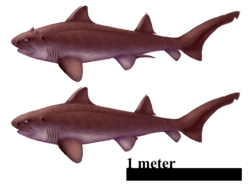
Picture of Hybodus
- Source
- Wikipedia/Commons
- Credit
- Gasmasque
- Licence
- CC BY-SA 4.0
- Commercial use
- the licence allows it
No 3D scan was found. Smithsonian Open Access, MorphoSource and Sketchfab were all searched.
The description on this site
- Source
- Wikipedia, “Hybodus”
- Licence
- CC BY-SA 4.0
This is what the site found, which is not the same as what exists.
Keep going
What may have been alongside itHybodontinae through timeFormations of the Late CretaceousThe world it lived on
Occurrence data from the Paleobiology Database, CC BY 4.0. Agassiz 1834