Solenopora
The extinct Solenoporaceae have traditionally been interpreted as a group of red algae ancestral to the Corallinales.

Hectonichus · CC BY-SA 3.0 · via Wikipedia/Commons. May be a photograph of a specimen, or an artist’s reconstruction — an interpretation of a skeleton, since colour and soft tissue are almost never preserved.
On record
Recorded, not inferred- Sits inside
- SolenoporaceaePBDB
- Diet
- "photoautotroph"PBDB, for Rhodophyceae
- Life habit
- epifaunalPBDB, for Rhodophyceae
- Motility
- stationaryPBDB, for Rhodophyceae
- Environment
- coastal,inner shelf,marinePBDB, for Rhodophyceae
Time the record covers
At least 430 million years on record.
The record covers at least 468 Mya to 37.71 Mya. No occurrence read is dated outside 477.1 Mya to 33.9 Mya.
307 occurrences of Solenopora on record, most of them in the Ordovician. Bar height is expected occurrences, not a count: each fossil is spread across the span it is dated to, so a tall narrow bar means tight dating and a low wide one means loose.
When
307 occurrences- Ordovician33%
- Silurian6%
- Devonian4%
- Carboniferous2%
- Permian6%
- Middle Triassic11%
- Late Triassic22%
- Early Jurassicunder 1%
- Late Jurassic8%
- Early Cretaceous3%
- Late Cretaceous3%
- Paleoceneunder 1%
- Eoceneunder 1%
These are dates about fossils, not the animal: the record can only begin after it arose and end before it died out, so either end may reach further. Shares are expected occurrences: a fossil dated to a span is counted partly in each period it straddles. More on what this infers.
Found in
102 formations
- Qingyan Formation19
- Benbolt Formation19
- Wardell Formation8
- Dachstein Formation7
- Lianglitag Formation7
- Korallenoolith Formation5
Loading coastlines…
The named rock units Solenopora has been recovered from, largest first. Drawn where the rock is now, not where it formed. 78 further formations hold fewer occurrences each and are not listed. 96 occurrences have no formation on record, which is common for older literature.
Solenopora and its relatives
OrdovicianWhere Solenopora and its relatives were recorded in the Ordovician.
Found in the same rock
2,249 taxa- Girvanella52 sites
- Gastropoda45 sites
- Bryozoa43 sites
- Bivalvia38 sites
- Crinoidea31 sites
- Tetradium30 sites
- Brachiopoda29 sites
- Parachaetetes26 sites
- Ostracoda25 sites
- Bacinella irregularis22 sites
- Chasmatopora22 sites
- Shamovella obscura21 sites
- Echinoidea20 sites
- Glyptorthis bellarugosa20 sites
- Oepikina minnesotensis20 sites
- Cayeuxia19 sites
- Diholkorhynchia sinensis19 sites
- Encrinus liliiformis19 sites
- Graptodictya19 sites
- Mentzelia subspherica19 sites
- Spirorbis19 sites
- Strophomena19 sites
- Weixiserpula19 sites
- Cassianella18 sites
The Paleobiology Database records 220 sites for Solenopora, and this reads all of them. The number is how many of those sites it was catalogued from too. The 24 sharing the most are listed.
This is not a list of everything alive at the time. It is only what has come out of the same ground as this animal and been written down.
Entered from
145 references- Stratigraphy of the Lower Middle Ordovician of Tazewell County, Virginia28
- Fossilvergesellschaftungen, Paläoökologie und paläosynökologische Entwicklung im Oberen Anisium (Mittlere Trias) von Qingyan, insbesondere Bangtoupo, Provinz Guizhou, Südwestchina19
- Distributional Patterns of Calcareous Algae within Upper Triassic Patch Reef Structures of the Northern Calcareous Alps (Salzburg)16
- Zonation of the Middle and Upper Ordovician strata in northwestern Georgia15
- Silurian Reefs of Gotland8
- Pre-Chattanooga stratigraphy in Central Tennessee7
- Windward and leeward margins of an Upper Ordovician carbonate platform in the Central Tarim Uplift, Xinjiang, northwestern China6
- Calcareous algae from the Triassic (Anisian reef boulders and Norian reef limestones) of Karaburun, western Turkey6
- Ecosystem structure and stability: middle Upper Ordovician of central Kentucky, USA4
- Classification and correlation of Triassic limestones in Sikhote-Alin on the basis of corals4
- Fossil algae from the Cretaceous of Varagur, Tiruchirapalli District, Tamil Nadu4
- The Upper Triassic Pantokrator Limestone of Hydra (Greece): An Example of a Prograding Reef Complex4
Each of the 307 occurrences read was entered from one of these publications, ordered by how many each accounts for. This is not a search for papers mentioning the name. 133 further references are not listed. Entries link to doi.org where the Paleobiology Database holds an identifier, and to its own record where it does not. Relayed as the Paleobiology Database holds them, not checked against what they resolve to.
Media and terms
Media content2
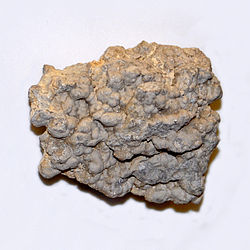
Picture of Solenopora
- Source
- Wikipedia/Commons
- Credit
- Hectonichus
- Licence
- CC BY-SA 3.0
- Commercial use
- the licence allows it
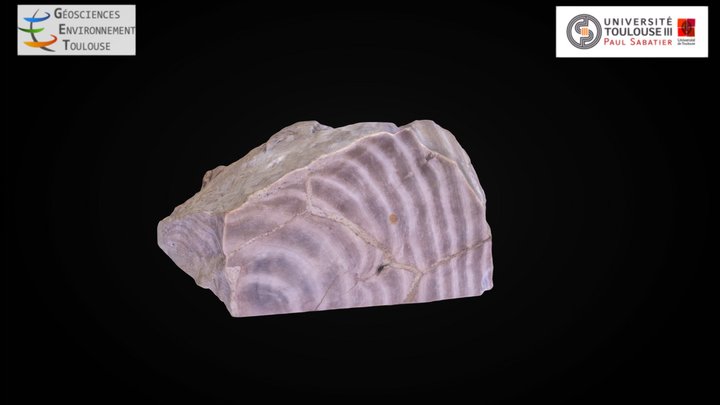
3D model
- Source
- Sketchfab
- Credit
- Marc de RAFELIS
- Licence
- CC Attribution
- Commercial use
- cannot be read from the licence given — check the record
Smithsonian Open Access and MorphoSource were not reached for this taxon, so this list is what the others held rather than everything there is.
The description on this site
- Source
- Wikipedia, “Solenopora”
- Licence
- CC BY-SA 4.0
This is what the site found, which is not the same as what exists.
Keep going
What may have been alongside itSolenoporaceae through timeFormations of the OrdovicianThe world it lived on
Occurrence data from the Paleobiology Database, CC BY 4.0. Dybowski 1877