Oepikina minnesotensis
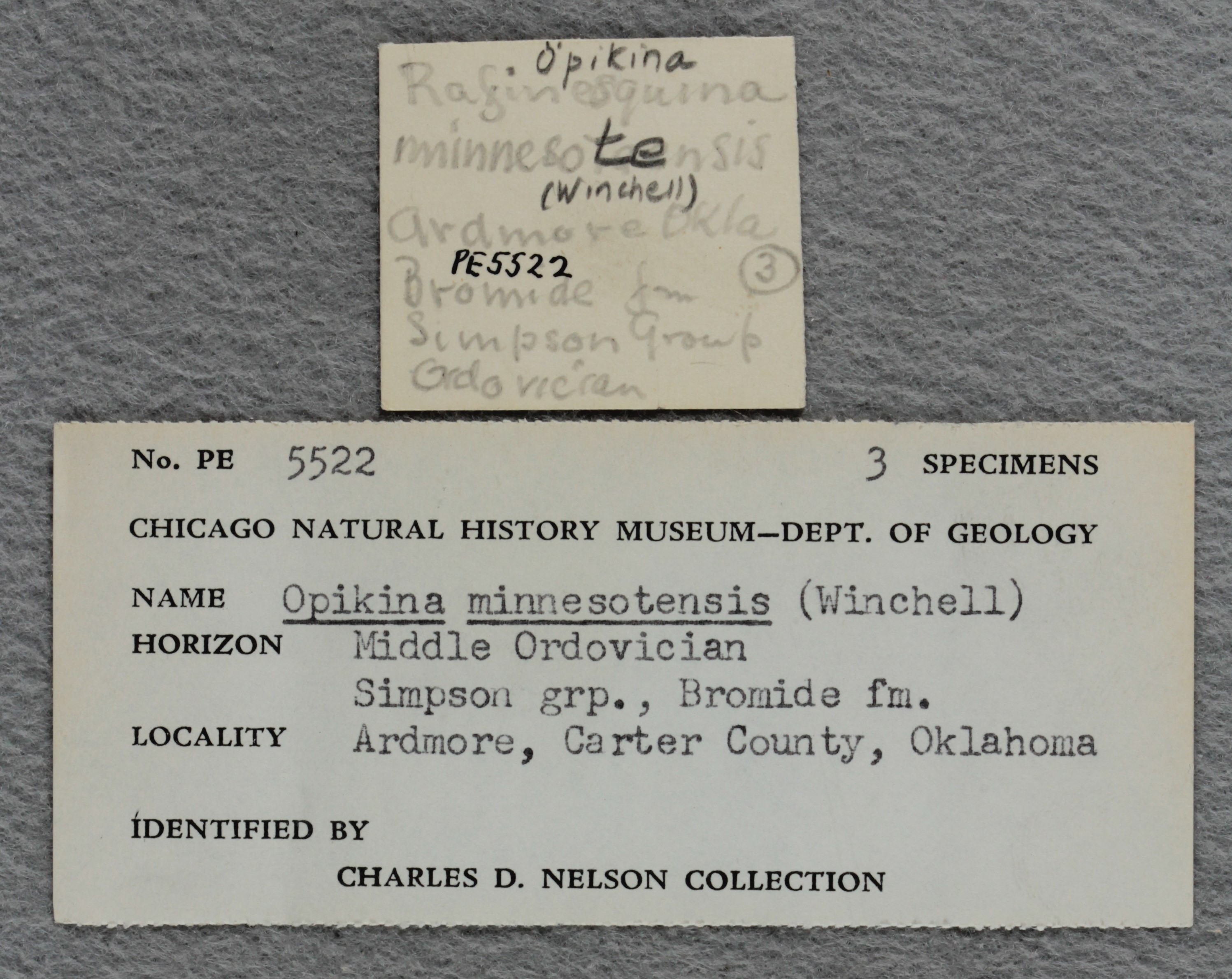
The Field Museum of Natural History · CC0 · via GBIF. May be a photograph of a specimen, or an artist’s reconstruction — an interpretation of a skeleton, since colour and soft tissue are almost never preserved.
On record
Recorded, not inferred- Sits inside
- OepikinaPBDB
- Diet
- suspension feederPBDB, for Strophomenida
- Life habit
- epifaunalPBDB, for Strophomenida
- Motility
- stationaryPBDB, for Strophomenida
- Vision
- blindPBDB, for Strophomenata
- Environment
- marinePBDB, for Lophophorata
Time the record covers
At most 8.7 million years on record.
Every occurrence read is dated to somewhere between 458.2 Mya and 449.5 Mya, and nothing in the dating separates them, so that window is what the record shows rather than a span.
63 occurrences of Oepikina minnesotensis on record, most of them in the Ordovician. Bar height is expected occurrences, not a count: each fossil is spread across the span it is dated to, so a tall narrow bar means tight dating and a low wide one means loose.
When
63 occurrences- Ordovician100%
These are dates about fossils, not the animal: the record can only begin after it arose and end before it died out, so either end may reach further. Shares are expected occurrences: a fossil dated to a span is counted partly in each period it straddles. More on what this infers.
Found in
22 formations
- Benbolt Formation24
- Farr Formation7
- Platteville Formation3
- Camp Nelson Formation3
- Decorah Shale Formation · Galena Group2
- Ion Formation · Galena Group2
Loading coastlines…
The named rock units Oepikina minnesotensis has been recovered from, largest first. Drawn where the rock is now, not where it formed. 5 occurrences have no formation on record, which is common for older literature.
Oepikina minnesotensis and its relatives
OrdovicianWhere Oepikina minnesotensis and its relatives were recorded in the Ordovician.
Found in the same rock
260 taxa- Glyptorthis bellarugosa38 sites
- Rhipidomena tennesseensis24 sites
- Tetradium22 sites
- Hesperorthis tricenaria21 sites
- Dinorthis interstriata20 sites
- Dinorthis transversa20 sites
- Girvanella20 sites
- Mimella globosa20 sites
- Multicostella platys20 sites
- Solenopora20 sites
- Rostricellula minnesotensis18 sites
- Acanthocrania setigera16 sites
- Doleroides16 sites
- Petrocrania16 sites
- Graptodictya15 sites
- Mimella15 sites
- Pionodema15 sites
- Pseudolingula iowensis15 sites
- Chasmatopora14 sites
- Dactylogonia obsoleta14 sites
- Dactylogonia palustris14 sites
- Echinosphaerites aurantium14 sites
- Eospongia14 sites
- Paleocrinus cf. striatus14 sites
The Paleobiology Database records 63 sites for Oepikina minnesotensis, and this reads all of them. The number is how many of those sites it was catalogued from too. The 24 sharing the most are listed.
This is not a list of everything alive at the time. It is only what has come out of the same ground as this animal and been written down.
Entered from
10 references- Stratigraphy of the Lower Middle Ordovician of Tazewell County, Virginia24
- Biostratigraphy of the Middle and Late Ordovician cephalopods of the Upper Mississippi Valley area9
- The Palaeozoic Outlier of Lake Timiskaming, Ontario and Quebec8
- Brachiopods and trilobites of the Sardeson Beds in the Twin Cities6
- Zonation of the Middle and Upper Ordovician strata in northwestern Georgia5
- Some silicifled strophomenacean brachiopods from the Ordovician of Kentucky, with comments on the genus Pionomena3
- Molluscan and brachiopod dominated biofacies in the Platteville Formation (Middle Ordovician), upper Mississippi Valley3
- Palaeozoic geology of the Lake Simcoe Area, Ontario3
- The systematics and biostratigraphy of the Brachiopoda of the Decorah Shale at St. Paul, Minnesota1
- Lower Middle Ordovician stratigraphy of the Shenandoah Valley, Virginia1
Each of the 63 occurrences read was entered from one of these publications, ordered by how many each accounts for. This is not a search for papers mentioning the name. Entries link to doi.org where the Paleobiology Database holds an identifier, and to its own record where it does not. Relayed as the Paleobiology Database holds them, not checked against what they resolve to.
Media and terms
Media content1
Picture of Oepikina minnesotensis
- Source
- GBIF
- Credit
- The Field Museum of Natural History
- Licence
- CC0
- Commercial use
- the licence allows it
No 3D scan was found. Smithsonian Open Access, MorphoSource and Sketchfab were all searched.
This is what the site found, which is not the same as what exists.
Keep going
What may have been alongside itOepikina through timeFormations of the OrdovicianThe world it lived on
Occurrence data from the Paleobiology Database, CC BY 4.0. (Winchell 1881)