Serrasalmidae
The Serrasalmidae (serrasalmids) are a family of characiform fishes native to freshwater habitats of South America. They include more than 90 species. The name means "serrated salmon family", which refers to the serrated keel running along the belly of these fish. Fish classified as Serrasalmidae are also known by these common names: pacu, piranha, and silver dollar. These common names generally designate differing dental characteristics and feeding habits.

Jonas Hansel (jonashansel@gmail.com) · Public Domain · via Wikipedia/Commons. May be a photograph of a specimen, or an artist’s reconstruction — an interpretation of a skeleton, since colour and soft tissue are almost never preserved.
On record
Recorded, not inferred- Sits inside
- CharacoideiPBDB
- Motility
- actively mobilePBDB, for Osteichthyes
- Environment
- freshwaterPBDB, for Characiformes
Time the record covers
At least 52 million years on record.
The record covers at least 56 Mya to 3.6 Mya. No occurrence read is dated outside 59.24 Mya to 2.58 Mya.
16 occurrences of Serrasalmidae on record, most of them in the Miocene. The Paleobiology Database records this as a living group, and the chart stops with its fossils rather than at the present. Bar height is expected occurrences, not a count: each fossil is spread across the span it is dated to, so a tall narrow bar means tight dating and a low wide one means loose.
When
16 occurrencesThese are dates about fossils, not the animal: the record can only begin after it arose and end before it died out, so either end may reach further. Shares are expected occurrences: a fossil dated to a span is counted partly in each period it straddles. More on what this infers.
Found in
7 formations
- Pebas Formation5
- Castilletes Formation3
- Ituzaingo Formation2
- Caujarao Formation2
- San Gregorio Formation2
- Ware Formation1
Loading coastlines…
The named rock units Serrasalmidae has been recovered from, largest first. Drawn where the rock is now, not where it formed.
Serrasalmidae and its relatives
MioceneWhere Serrasalmidae and its relatives were recorded in the Miocene.
Found in the same rock
153 taxa- Alligatoridae6 sites
- Pimelodidae6 sites
- Podocnemididae6 sites
- Callichthyidae5 sites
- Doradidae5 sites
- Siluriformes5 sites
- Cichliformes4 sites
- Characidae3 sites
- Cichlidae3 sites
- Crocodylia3 sites
- Dasyatidae3 sites
- Gavialidae3 sites
- Mylossoma3 sites
- Osteoglossiformes3 sites
- Purussaurus3 sites
- Reptilia3 sites
- Scirrotherium3 sites
- Aves2 sites
- Boidae2 sites
- Caimaninae2 sites
- Carcharhinidae2 sites
- Carcharhinus leucas2 sites
- cf. Eunectes sp.2 sites
- Chelonoidis2 sites
The Paleobiology Database records 11 sites for Serrasalmidae, and this reads all of them. The number is how many of those sites it was catalogued from too. The 24 sharing the most are listed.
This is not a list of everything alive at the time. It is only what has come out of the same ground as this animal and been written down.
Entered from
7 references- A historical vertebrate collection from the Middle Miocene of the Peruvian Amazon5
- A fossil fish assemblage from the middle Miocene of the Cocinetas Basin, northern Colombia2
- A Pliocene–Pleistocene continental biota from Venezuela2
- A new vertebrate continental assemblage from the Tortonian of Venezuela2
- Revised stratigraphy of Neogene strata in the Cocinetas Basin, La Guajira, Colombia2
- Megapiranha paranensis, a new genus and species of Serrasalmidae (Characiformes, Teleostei) from the upper Miocene of Argentina2
- Un nouveau gisement à Mammifères du Tertiaire ancien (Paléocène-Eocène) de Bolivie1
Each of the 16 occurrences read was entered from one of these publications, ordered by how many each accounts for. This is not a search for papers mentioning the name. Entries link to doi.org where the Paleobiology Database holds an identifier, and to its own record where it does not. Relayed as the Paleobiology Database holds them, not checked against what they resolve to.
Media and terms
Media content1
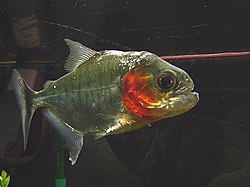
Picture of Serrasalmidae
- Source
- Wikipedia/Commons
- Credit
- Jonas Hansel (jonashansel@gmail.com)
- Licence
- Public Domain
- Commercial use
- the licence allows it
No 3D scan of Serrasalmidae was found in MorphoSource and Sketchfab.
Smithsonian Open Access was not reached for this taxon, so this list is what the others held rather than everything there is.
The description on this site
- Licence
- CC BY-SA 4.0
This is what the site found, which is not the same as what exists.
Keep going
What may have been alongside itCharacoidei through timeFormations of the MioceneThe world it lived on
Occurrence data from the Paleobiology Database, CC BY 4.0. Günther 1864