Dasyatidae
The whiptail stingrays are a family, the Dasyatidae, of rays in the order Myliobatiformes. They are found worldwide in tropical to temperate marine waters, and a number of species have also penetrated into fresh water in Africa, Asia, and Australia. Members of this family have flattened pectoral fin discs that range from oval to diamond-like in shape. Their common name comes from their whip-like tails, which are much longer than the disc and lack dorsal and caudal fins. All whiptail stingrays, except the porcupine ray, have one or more venomous stings near the base of the tail, which is used in defense. In order to sting their victims, they jerk their tails as the stinger falls off and stays in the wound that they have created. The stinger of a whiptail stingray is pointy, sharp with jagged edges. During mating season, males often hold onto females by using teeth which curve towards the corners of their mouths. They range in size from 0.18 to 2.0 m or more across in the case of the smalleye stingray and giant freshwater stingray. Species, being highly electroreceptive, can detect weak electric fields from prey. Electroreception is a product of electroreceptors dispersed across the skin. This network of pores is part of organs known as the ampullae of Lorenzini.

Dan Hershman · CC BY 2.0 · via Wikipedia/Commons. May be a photograph of a specimen, or an artist’s reconstruction — an interpretation of a skeleton, since colour and soft tissue are almost never preserved.
On record
Recorded, not inferred- Also called
- whiptail stingrayPBDB
- Sits inside
- DasyatoideaPBDB
- Diet
- carnivorePBDB, for Myliobatiformes
- Life habit
- nektobenthicPBDB, for Myliobatiformes
- Motility
- actively mobilePBDB, for Myliobatiformes
Time the record covers
At least 154 million years on record.
The record covers at least 154.8 Mya to 11.7 ka. No occurrence read is dated outside 157.9 Mya to 0 Mya.
581 occurrences of Dasyatidae on record, most of them in the Miocene. The Paleobiology Database records this as a living group. Bar height is expected occurrences, not a count: each fossil is spread across the span it is dated to, so a tall narrow bar means tight dating and a low wide one means loose.
When
581 occurrences- Late Jurassicunder 1%
- Early Cretaceousunder 1%
- Late Cretaceous7%
- Paleocene9%
- Eocene32%
- Oligocene6%
- Miocene33%
- Pliocene6%
- Pleistocene6%
- Holoceneunder 1%
These are dates about fossils, not the animal: the record can only begin after it arose and end before it died out, so either end may reach further. Shares are expected occurrences: a fossil dated to a span is counted partly in each period it straddles. More on what this infers.
Found in
166 formations
- Esbarrondadoiro Formation19
- Koobi Fora Formation18
- Matam Formation18
- Qasr el-Sagha Formation14
- Birket Qarun Formation12
- Lagos-Portimão Formation12
Loading coastlines…
The named rock units Dasyatidae has been recovered from, largest first. Drawn where the rock is now, not where it formed. 142 further formations hold fewer occurrences each and are not listed. 158 occurrences have no formation on record, which is common for older literature.
Dasyatidae and its relatives
MioceneWhere Dasyatidae and its relatives were recorded in the Miocene.
Found in the same rock
4,164 taxa- Dasyatis99 sites
- Myliobatis63 sites
- Rhinoptera45 sites
- Hemipristis serra43 sites
- Carcharhinus42 sites
- Otodus megalodon38 sites
- Galeocerdo aduncus35 sites
- Rhinobatos34 sites
- Scyliorhinus32 sites
- Sphyraena29 sites
- Squatina28 sites
- Aetobatus27 sites
- Carcharias27 sites
- Rhizoprionodon26 sites
- Carcharodon hastalis24 sites
- Pristis23 sites
- Raja23 sites
- Squalus23 sites
- Teleostei21 sites
- Aves20 sites
- Carcharias cuspidatus20 sites
- Crocodylia20 sites
- Carcharias acutissimus19 sites
- Rhynchobatus19 sites
The Paleobiology Database records 358 sites for Dasyatidae, and this reads 240 of them. Of that, one read hit the database's own return limit, so every count below is a floor rather than a total. The number is how many of those sites it was catalogued from too. The 24 sharing the most are listed.
This is not a list of everything alive at the time. It is only what has come out of the same ground as this animal and been written down.
Entered from
226 references- Shark and ray faunas in the Middle and Late Eocene of the Fayum Area, Egypt33
- Les Orectolobiformes, Carcharhiniformes et Myliobatiformes (Elasmobranchii, Neoselachii) des bassins à phosphate du Maroc (Maastrichtien-Lutétien basal). Systématique, biostratigraphie, évolution et dynamique des faunes28
- Inventaire des Élasmobranches (requins, raies, chimères) des dépôts molassiques du Sud-Luberon (Miocène supérieur)24
- The selachian fauna (sharks and rays) of the phosphate series of Ndendouri-Ouali Diala (Matam, Western Senegal): Dating and paleoenvironmental interests18
- Peces Myliobatiformes, Rajiformes y Pristiophoriformes en el Plioceno de Guardamar del Segura (Alicante)17
- Nouvelle faunes de sélaciens (Elasmobranchii, Neoselachii) de l'Eocène moyen des Landes (Sud-Ouest, France). Implication dans la connaissance des communautés de sélaciens d'eau profondes13
- Latest Miocene Dasyatidae (Neoselachii, Batomorphii) from the Alvalade Basin, Portugal12
- Vertébrés (crocodiliens, poissons) du Miocène marin de l'Argarve occidentale12
- Koobi Fora Research Project The Fossil Ungulates: Proboscidea, Perissodactyla, Suidae11
- Elasmobranch teeth (Vertebrata, Pisces) from the Dongen Formation (Eocene) in The Netherlands9
- Les sélaciens du Pliocène de la région d'Alba (Piémont, Italie Nord-Ouest)7
- Sélaciens du Miocène terminal du bassin d'Alvalade (Portugal) Essai de synthèse7
Each of the 581 occurrences read was entered from one of these publications, ordered by how many each accounts for. This is not a search for papers mentioning the name. 214 further references are not listed. Entries link to doi.org where the Paleobiology Database holds an identifier, and to its own record where it does not. Relayed as the Paleobiology Database holds them, not checked against what they resolve to.
Media and terms
Media content1
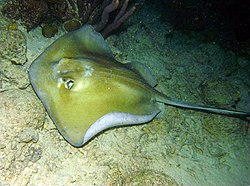
Picture of Dasyatidae
- Source
- Wikipedia/Commons
- Credit
- Dan Hershman
- Licence
- CC BY 2.0
- Commercial use
- the licence allows it
No 3D scan of Dasyatidae was found in Sketchfab.
Smithsonian Open Access and MorphoSource were not reached for this taxon, so this list is what the others held rather than everything there is.
The description on this site
- Licence
- CC BY-SA 4.0
This is what the site found, which is not the same as what exists.
Keep going
What may have been alongside itDasyatoidea through timeFormations of the MioceneThe world it lived on
Occurrence data from the Paleobiology Database, CC BY 4.0. Jordan and Gilbert 1879