Chelonoidis
Chelonoidis is a genus of turtles in the tortoise family erected by Leopold Fitzinger in 1835. They are found in South America and the Galápagos Islands, and formerly had a wide distribution in the West Indies.

Maarten Sepp · CC BY-SA 4.0 · via Wikipedia/Commons. May be a photograph of a specimen, or an artist’s reconstruction — an interpretation of a skeleton, since colour and soft tissue are almost never preserved.
On record
Recorded, not inferred- Sits inside
- GeocheloniniPBDB
- Diet
- herbivore, herbivorePBDB, for Testudinidae
- Life habit
- ground dwellingPBDB, for Testudinidae
- Motility
- actively mobilePBDB, for Osteichthyes
- Environment
- terrestrialPBDB, for Testudinidae
Time the record covers
At least 20 million years on record.
The record covers at least 21 Mya to 11.7 ka. No occurrence read is dated outside 29 Mya to 0 Mya.
152 occurrences of Chelonoidis on record, most of them in the Miocene. The Paleobiology Database records this as a living group. Bar height is expected occurrences, not a count: each fossil is spread across the span it is dated to, so a tall narrow bar means tight dating and a low wide one means loose.
When
152 occurrences- Oligoceneunder 1%
- Miocene57%
- Pliocene7%
- Pleistocene29%
- Holocene5%
These are dates about fossils, not the animal: the record can only begin after it arose and end before it died out, so either end may reach further. Shares are expected occurrences: a fossil dated to a span is counted partly in each period it straddles. More on what this infers.
Found in
32 formations
- Collon Cura Formation31
- Huayquerías Formation22
- Monte Hermoso Formation7
- Sarmiento Formation7
- Tunuyán Formation7
- Collón Cura Formation3
Loading coastlines…
The named rock units Chelonoidis has been recovered from, largest first. Drawn where the rock is now, not where it formed. 8 further formations hold fewer occurrences each and are not listed. 42 occurrences have no formation on record, which is common for older literature.
Chelonoidis and its relatives
MioceneWhere Chelonoidis and its relatives were recorded in the Miocene.
Found in the same rock
844 taxa- Crocodylus rhombifer8 sites
- Protypotherium6 sites
- Anolis5 sites
- Cervidae5 sites
- Notiomastodon platensis5 sites
- Pampatherium5 sites
- Serpentes5 sites
- Tupinambis5 sites
- Acarechimys4 sites
- Acarechimys minutus4 sites
- Acratocnus4 sites
- Anura4 sites
- Celestus4 sites
- Chelidae4 sites
- Crocodylia4 sites
- Geocapromys4 sites
- Glyptodon4 sites
- Glyptodon reticulatus4 sites
- Leiocephalus4 sites
- Megalonychidae4 sites
- Nesophontes4 sites
- Plagiodontia aedium4 sites
- Prolagostomus4 sites
- Propalaehoplophoridae4 sites
The Paleobiology Database records 141 sites for Chelonoidis, and this reads all of them. The number is how many of those sites it was catalogued from too. The 24 sharing the most are listed.
This is not a list of everything alive at the time. It is only what has come out of the same ground as this animal and been written down.
Entered from
61 references- Tortoises and turtles from Huayquerías del Este (late Miocene–early Pliocene), Mendoza, Argentina29
- Morphology of the mid-sized tortoises (Testudines: Testudinidae) from the Middle Miocene of Northwestern Chubut27
- Contribution to the diversity of the fossil record of turtles (Testudinidata) from Chubut province (Argentina) and its significance in understanding the evolution of turtles in southern South America8
- Les tortues fossiles d'Argentine: synthese [The fossil turtles of Argentina: synthesis]7
- A new species of extinct Late Quaternary giant tortoise from Hispaniola6
- Revision of the fossil land tortoises (Testudines: Testudinidae) from Hispaniola with the description of a new species, Dominican Republic3
- New middle Miocene (Langhian - Serravallian) vertebrate localities in northwestern Patagonia, Argentina: A contribution to high latitude south american land mammal ages sequence3
- A review of the fossil record of the South American turtles of the clade Pan-Testudinoidea3
- Biostratigraphy and biochronology of the Monte Hermoso Formation (early Pliocene) at its type locality, Buenos Aires Province, Argentina3
- A new fossil tortoise from Mona Island, West-Indies, and a tentative arrangement of the tortoises of the world3
- Extinct tortoises from the Turks and Caicos Islands2
- Vertebrate continental assemblage from the Last Interglacial in southern South America (Entre Ríos, Argentina). Biostratigraphy and paleoenvironment2
Each of the 152 occurrences read was entered from one of these publications, ordered by how many each accounts for. This is not a search for papers mentioning the name. 49 further references are not listed. Entries link to doi.org where the Paleobiology Database holds an identifier, and to its own record where it does not. Relayed as the Paleobiology Database holds them, not checked against what they resolve to.
Media and terms
Media content2

Picture of Chelonoidis
- Source
- Wikipedia/Commons
- Credit
- Maarten Sepp
- Licence
- CC BY-SA 4.0
- Commercial use
- the licence allows it
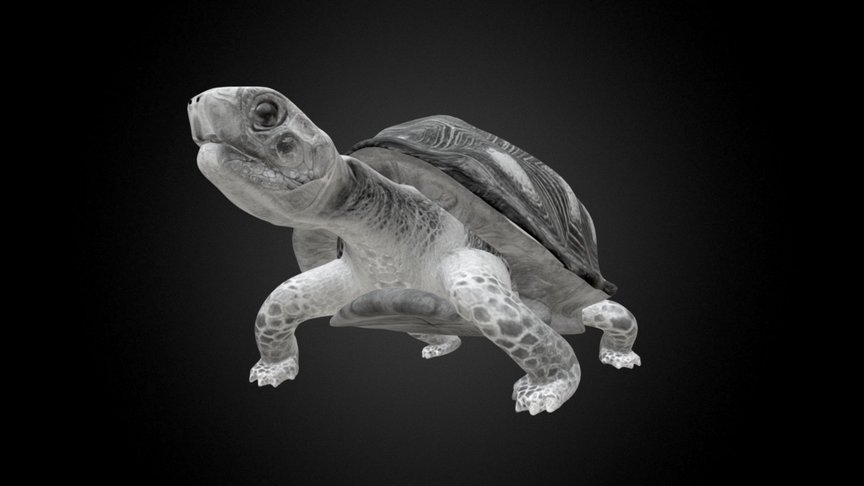
3D model
- Source
- Sketchfab
- Credit
- cheli_sanjuan
- Licence
- CC Attribution
- Commercial use
- cannot be read from the licence given — check the record
Smithsonian Open Access and MorphoSource were not reached for this taxon, so this list is what the others held rather than everything there is.
The description on this site
- Source
- Wikipedia, “Chelonoidis”
- Licence
- CC BY-SA 4.0
This is what the site found, which is not the same as what exists.
Keep going
What may have been alongside itGeochelonini through timeFormations of the MioceneThe world it lived on
Occurrence data from the Paleobiology Database, CC BY 4.0. (Fitzinger 1835)