Saldidae
Saldidae, also known as shore bugs, are a family of insects in the order Hemiptera. They are oval-shaped and measure 2–8 mm (0.08–0.31 in) when mature. Typically they are found near shorelines or the marginal growths near freshwater bodies, estuaries, and sea coasts. They can flee by leaping or taking flight. There are about 350 recognized species with the majority from the Nearctic and Palearctic. Many species are found in the intertidal zone and both adults and nymphs of some species like Saldula pallipes can tolerate submergence at high-tide. Saldidae are predators and scavengers. They pass the winter through egg or adult diapause.

James K. Lindsey · CC BY-SA 3.0 · via Wikipedia/Commons. May be a photograph of a specimen, or an artist’s reconstruction — an interpretation of a skeleton, since colour and soft tissue are almost never preserved.
On record
Recorded, not inferred- Also called
- shore bugPBDB
- Sits inside
- SaldoideaPBDB
- Motility
- actively mobilePBDB, for Arthropoda
- Environment
- terrestrialPBDB, for Insecta
Time the record covers
At least 140 million years on record.
The record covers at least 141 Mya to 129 ka. No occurrence read is dated outside 145.06 Mya to 11.7 ka.
96 occurrences of Saldidae on record, most of them in the Early Cretaceous. The Paleobiology Database records this as a living group. Bar height is expected occurrences, not a count: each fossil is spread across the span it is dated to, so a tall narrow bar means tight dating and a low wide one means loose.
When
96 occurrences- Late Jurassicunder 1%
- Early Cretaceous83%
- Eocene3%
- Oligocene3%
- Miocene2%
- Pleistocene8%
These are dates about fossils, not the animal: the record can only begin after it arose and end before it died out, so either end may reach further. Shares are expected occurrences: a fossil dated to a span is counted partly in each period it straddles. More on what this infers.
Found in
23 formations
- Laiyang Formation24
- Yixian Formation · Jehol Group15
- Huachi-Huanhe Formation · Zhidan Group7
- Gurvan-Eren Formation5
- Mogotuin Formation5
- Lulworth Formation · Purbeck Group4
Loading coastlines…
The named rock units Saldidae has been recovered from, largest first. Drawn where the rock is now, not where it formed. 10 occurrences have no formation on record, which is common for older literature.
Saldidae and its relatives
Early CretaceousWhere Saldidae and its relatives were recorded in the Early Cretaceous.
Found in the same rock
2,168 taxa- Mesolygaeus laiyangensis46 sites
- Coptoclava longipoda10 sites
- Bledius7 sites
- Chironomaptera gregaria7 sites
- Bembidion6 sites
- Diptera6 sites
- Elateridae6 sites
- Helophorus6 sites
- Quedius6 sites
- Schizopteryx shandongensis6 sites
- Stenus6 sites
- Trichoptera6 sites
- Aphodius5 sites
- Baissotea infanta5 sites
- Chironomaptera vesca5 sites
- Dyschirius5 sites
- Enicocorinae5 sites
- Formicidae5 sites
- Mongolocoris tibialis5 sites
- Patrobus stygicus5 sites
- Acidota crenata4 sites
- Aleocharinae4 sites
- Carabidae4 sites
- Catops4 sites
The Paleobiology Database records 78 sites for Saldidae, and this reads all of them. The number is how many of those sites it was catalogued from too. The 24 sharing the most are listed.
This is not a list of everything alive at the time. It is only what has come out of the same ground as this animal and been written down.
Entered from
38 references- Fossil insects from the Laiyang Basin, Shandong Province14
- The Mesozoic family Archegocimicidae and phylogeny of the infraorder Leptopodomorpha (Hemiptera)9
- New Saldidae–Enicocorinae (Heteroptera: Leptopodomorpha) from the Lower Cretaceous of Siberia and Mongolia7
- Archegocimicidae (Insecta: Heteroptera) from the Purbeck Limestone Group (Lower Cretaceous: Berriasian) of southern England5
- New saldoid bugs of the family Enicocoridae (Hemiptera: Heteroptera: Leptopodomorpha) from the Lower Cretaceous of Mongolia4
- Fossil insects of the southern Ordos Basin4
- Peloridiina (= Coleorrhyncha) and Cimicina (= Heteroptera), in Nasekomye v rannemelovykh ekosistemakh zapadnoy Mongolii4
- Fossil Beetle Evidence for a Short Warm Interval near 40,000 yr B.P. at Titusville, Pennsylvania3
- Fossil insects of the northern Ordos Basin3
- Insecta3
- Geocorisae (Landwanzen) aus den Oberoligocanen Ablagerungen von Rott3
- The paleoenvironment of the Olympia beds based on fossil beetles from Discovery Park, Seattle, Washington, U.S.A.2
Each of the 96 occurrences read was entered from one of these publications, ordered by how many each accounts for. This is not a search for papers mentioning the name. 26 further references are not listed. Entries link to doi.org where the Paleobiology Database holds an identifier, and to its own record where it does not. Relayed as the Paleobiology Database holds them, not checked against what they resolve to.
Media and terms
Media content1
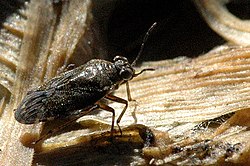
Picture of Saldidae
- Source
- Wikipedia/Commons
- Credit
- James K. Lindsey
- Licence
- CC BY-SA 3.0
- Commercial use
- the licence allows it
No 3D scan of Saldidae was found in Smithsonian Open Access and Sketchfab.
MorphoSource was not reached for this taxon, so this list is what the others held rather than everything there is.
The description on this site
- Source
- Wikipedia, “Saldidae”
- Licence
- CC BY-SA 4.0
This is what the site found, which is not the same as what exists.
Keep going
What may have been alongside itSaldoidea through timeFormations of the Early CretaceousThe world it lived on
Occurrence data from the Paleobiology Database, CC BY 4.0. Amyot and Audinet-Serville 1843