Rhea americana

Uncredited · via Wikidata/Commons. May be a photograph of a specimen, or an artist’s reconstruction — an interpretation of a skeleton, since colour and soft tissue are almost never preserved.
On record
Recorded, not inferred- Also called
- greater rheaPBDB
- Sits inside
- RheaPBDB
- Diet
- herbivorePBDB, for Rhea
- Life habit
- ground dwellingPBDB, for Rhea
- Motility
- actively mobilePBDB, for Theropoda
- Environment
- terrestrialPBDB, for Rhea
- Mass
- 600 gWikidata
Time the record covers
At most 129 thousand years on record.
Every occurrence read is dated to somewhere between 129 ka and 0 Mya, and nothing in the dating separates them, so that window is what the record shows rather than a span.
5 occurrences of Rhea americana on record, most of them in the Holocene. The Paleobiology Database records this as a living group. Bar height is expected occurrences, not a count: each fossil is spread across the span it is dated to, so a tall narrow bar means tight dating and a low wide one means loose.
When
5 occurrences- Pleistocene20%
- Holocene80%
These are dates about fossils, not the animal: the record can only begin after it arose and end before it died out, so either end may reach further. Shares are expected occurrences: a fossil dated to a span is counted partly in each period it straddles. More on what this infers.
Found in
1 formation
Loading coastlines…
The named rock units Rhea americana has been recovered from, largest first. Drawn where the rock is now, not where it formed. 4 occurrences have no formation on record, which is common for older literature.
Rhea americana and its relatives
HoloceneWhere Rhea americana and its relatives were recorded in the Holocene.
Found in the same rock
74 taxa- Ctenomys3 sites
- Lagostomus maximus3 sites
- Zaedyus pichiy3 sites
- Anas2 sites
- Chaetophractus villosus2 sites
- Lama guanicoe2 sites
- Ozotoceros bezoarticus2 sites
- Anura1 site
- Aves1 site
- Boidae1 site
- Bufo1 site
- Calomys1 site
- Canidae1 site
- Canis1 site
- Cavia aperea1 site
- Caviinae1 site
- Ceratophrys1 site
- Cervidae1 site
- Chaetophractus vellerosus1 site
- Chelonoidis chilensis1 site
- Coccyzus1 site
- Colubrinae1 site
- Columbidae1 site
- Crotalidae1 site
The Paleobiology Database records 5 sites for Rhea americana, and this reads all of them. The number is how many of those sites it was catalogued from too. The 24 sharing the most are listed.
This is not a list of everything alive at the time. It is only what has come out of the same ground as this animal and been written down.
Entered from
5 references- No se les escapó la tortuga. Uso antrópico de Chelonoidis chilensis en un sitio de la región chaco-santiagueña (provincia de Santiago del Estero)1
- Late Cenozoic mammal bio-chronostratigraphy in southwestern Buenos Aires Province, Argentina1
- Le site paléo-indien de Piedra Museo (Patagonie). Sa contribution au débat sur le premier peuplement du continent amérlcaln1
- Asociación cultural con fauna extinguida en el sitio arqueologico Cueva Tixi, provincia de Buenos Aires, Argentina1
- The Eocene to Pleistocene vertebrates of Bolivia and their stratigraphic context: a review1
Each of the 5 occurrences read was entered from one of these publications, ordered by how many each accounts for. This is not a search for papers mentioning the name. Each entry links to the Paleobiology Database's own record for the work.
Media and terms
Media content2
Picture of Rhea americana
- Source
- Wikidata/Commons
- Credit
- nobody named on the record
- Licence
- not stated by the source
- Commercial use
- cannot be read from the licence given — check the record
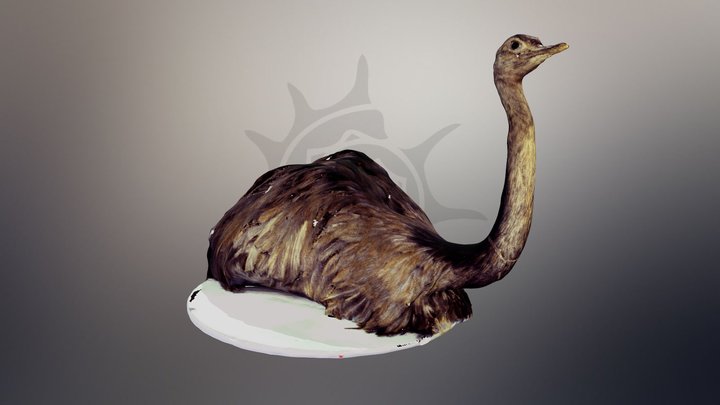
3D model
- Source
- Sketchfab
- Credit
- darwinmuseum.ru
- Licence
- CC Attribution-NonCommercial
- Commercial use
- the licence does not allow it
Smithsonian Open Access and MorphoSource were not reached for this taxon, so this list is what the others held rather than everything there is.
This is what the site found, which is not the same as what exists.
Keep going
What may have been alongside itRhea through timeFormations of the HoloceneThe world it lived on
Occurrence data from the Paleobiology Database, CC BY 4.0. (Linnaeus 1758)