Coccyzus
Coccyzus is a genus of cuckoos which occur in the Americas. The genus name is from Ancient Greek kokkuzo, which means to call like a common cuckoo. The genus includes the lizard cuckoos that were formerly included in the genus Saurothera.

Wolfgang Wander (colors adjusted by Skiessi) · CC BY-SA 2.5 · via Wikipedia/Commons. May be a photograph of a specimen, or an artist’s reconstruction — an interpretation of a skeleton, since colour and soft tissue are almost never preserved.
On record
Recorded, not inferred- Sits inside
- CuculidaePBDB
- Diet
- insectivorePBDB, for Cuculidae
- Life habit
- volantPBDB, for Cuculidae
- Motility
- actively mobilePBDB, for Theropoda
- Environment
- terrestrialPBDB, for Cuculidae
Time the record covers
At least 1.7 million years on record.
The record covers at least 1.8 Mya to 11.7 ka. No occurrence read is dated outside 2.58 Mya to 0 Mya.
22 occurrences of Coccyzus on record, most of them in the Pleistocene. The Paleobiology Database records this as a living group. Bar height is expected occurrences, not a count: each fossil is spread across the span it is dated to, so a tall narrow bar means tight dating and a low wide one means loose.
When
22 occurrences- Pleistocene60%
- Holocene40%
These are dates about fossils, not the animal: the record can only begin after it arose and end before it died out, so either end may reach further. Shares are expected occurrences: a fossil dated to a span is counted partly in each period it straddles. More on what this infers.
Found in
1 formation
Loading coastlines…
The named rock units Coccyzus has been recovered from, largest first. Drawn where the rock is now, not where it formed. 21 occurrences have no formation on record, which is common for older literature.
Coccyzus and its relatives
PleistoceneWhere Coccyzus and its relatives were recorded in the Pleistocene.
Found in the same rock
641 taxa- Patagioenas leucocephala11 sites
- Porzana carolina9 sites
- Athene cunicularia8 sites
- Columbina passerina8 sites
- Patagioenas squamosa8 sites
- Tyrannus dominicensis8 sites
- Tyto alba8 sites
- Falco sparverius7 sites
- Zenaida aurita7 sites
- Corvus nasicus5 sites
- Mimus polyglottos5 sites
- Petrochelidon fulva5 sites
- Saurothera merlini5 sites
- Zenaida macroura5 sites
- Accipiter striatus4 sites
- Colaptes auratus4 sites
- Columbidae4 sites
- Gallinago4 sites
- Geotrygon chrysia4 sites
- Mimus gundlachii4 sites
- Patagioenas inornata4 sites
- Psittacus leucocephalus4 sites
- Sturnella magna4 sites
- Tiaris bicolor4 sites
The Paleobiology Database records 17 sites for Coccyzus, and this reads all of them. The number is how many of those sites it was catalogued from too. The 24 sharing the most are listed.
This is not a list of everything alive at the time. It is only what has come out of the same ground as this animal and been written down.
Entered from
14 references- Fossil birds from the Dominican Republic6
- The late Quaternary bird community of New Providence, Bahamas2
- Fossil and subfossil birds from the Bahamas2
- Bird remains from the caves of Porto Rico2
- Holocene vertebrates from a dry cave on Eleuthera Island, Commonwealth of The Bahamas1
- The diversity and biogeography of late Pleistocene birds from the lowland Neotropics1
- A late-Holocene bird community from Hispaniola: Refining the chronology of vertebrate extinction in the West Indies1
- Avian community, climate, and sea-level changes in the Plio-Pleistocene of the Florida Peninsula1
- Late Quaternary fossil vertebrates from the Cayman Islands1
- The Cuban Crocodile, Crocodylus rhombifer, from Late Quaternary Fossil Deposits on Grand Cayman1
- The Eocene to Pleistocene vertebrates of Bolivia and their stratigraphic context: a review1
- Studies on Fossil and Extant Vertebrates from San Salvador (Watling's) Island, Bahamas1
Each of the 22 occurrences read was entered from one of these publications, ordered by how many each accounts for. This is not a search for papers mentioning the name. 2 further references are not listed. Entries link to doi.org where the Paleobiology Database holds an identifier, and to its own record where it does not. Relayed as the Paleobiology Database holds them, not checked against what they resolve to.
Media and terms
Media content1
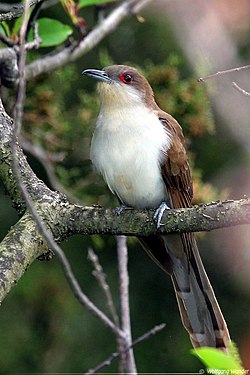
Picture of Coccyzus
- Source
- Wikipedia/Commons
- Credit
- Wolfgang Wander (colors adjusted by Skiessi)
- Licence
- CC BY-SA 2.5
- Commercial use
- the licence allows it
No 3D scan of Coccyzus was found in Sketchfab.
Smithsonian Open Access and MorphoSource were not reached for this taxon, so this list is what the others held rather than everything there is.
The description on this site
- Source
- Wikipedia, “Coccyzus”
- Licence
- CC BY-SA 4.0
This is what the site found, which is not the same as what exists.
Keep going
What may have been alongside itCuculidae through timeFormations of the PleistoceneThe world it lived on
Occurrence data from the Paleobiology Database, CC BY 4.0. Viellot 1816