Receptaculites
Receptaculites is the name-bearing genus for an extinct group of conspicuous benthic marine genera, the receptaculitids, that lived from the Early Ordovician through the Permian period, peaking in the Middle Ordovician. The group's phylogenetic origin has long been obscure, with some arguing that they were calcareous algae, probably of the order Dasycladales. Receptaculitids lived in warm, shallow seas, but consensus disagreeing. They have been described from all continents except Antarctica. In some areas they were important reef-formers, and they also occur as isolated specimens.

Mark A. Wilson (Department of Geology, The College of Wooster) [1] · Public Domain · via Wikipedia/Commons. May be a photograph of a specimen, or an artist’s reconstruction — an interpretation of a skeleton, since colour and soft tissue are almost never preserved.
On record
Recorded, not inferred- Sits inside
- ReceptaculitidaePBDB
- Diet
- "photoautotroph"PBDB, for Receptaculitidae
- Life habit
- epifaunalPBDB, for Receptaculitidae
- Motility
- stationary, attachedPBDB, for Receptaculitidae
- Environment
- marinePBDB, for Receptaculitidae
Time the record covers
At least 96 million years on record.
The record covers at least 471.3 Mya to 375.2 Mya. No occurrence read is dated outside 486.85 Mya to 358.86 Mya.
120 occurrences of Receptaculites on record, most of them in the Ordovician. Bar height is expected occurrences, not a count: each fossil is spread across the span it is dated to, so a tall narrow bar means tight dating and a low wide one means loose.
When
120 occurrences- Ordovician83%
- Silurian3%
- Devonian14%
These are dates about fossils, not the animal: the record can only begin after it arose and end before it died out, so either end may reach further. Shares are expected occurrences: a fossil dated to a span is counted partly in each period it straddles. More on what this infers.
Found in
37 formations
- Bad Cache Rapids Formation19
- Wardell Formation14
- Amadjuak Formation · Bad Cache Rapids Group9
- Portage Chute Formation · Bad Cache Rapids Group5
- Bobcaygeon Formation · Simcoe Group4
- Cliffield Formation4
Loading coastlines…
The named rock units Receptaculites has been recovered from, largest first. Drawn where the rock is now, not where it formed. 13 further formations hold fewer occurrences each and are not listed. 24 occurrences have no formation on record, which is common for older literature.
Receptaculites and its relatives
OrdovicianWhere Receptaculites and its relatives were recorded in the Ordovician.
Found in the same rock
978 taxa- Batostoma17 sites
- Girvanella17 sites
- Carabocrinus15 sites
- Catenipora15 sites
- Maclurites14 sites
- Maclurina manitobensis12 sites
- Strophomena12 sites
- Trochonema12 sites
- Solenopora11 sites
- Calapoecia10 sites
- Eoleperditia10 sites
- Pachydictya10 sites
- Rafinesquina10 sites
- Cleiocrinus9 sites
- Columnaria9 sites
- Echinodermata9 sites
- Endoceras9 sites
- Glyptorthis9 sites
- Grewingkia robusta9 sites
- Hesperorthis9 sites
- Illaenus9 sites
- Lambeoceras9 sites
- Lichenaria9 sites
- Streptelasma9 sites
The Paleobiology Database records 109 sites for Receptaculites, and this reads all of them. The number is how many of those sites it was catalogued from too. The 24 sharing the most are listed.
This is not a list of everything alive at the time. It is only what has come out of the same ground as this animal and been written down.
Entered from
42 references- Ordovician cephalopod fauna of Baffin Island20
- Stratigraphy of the Lower Middle Ordovician of Tazewell County, Virginia18
- Ordovician megafauna, Melville Peninsula, southeastern District of Franklin16
- Introduction5
- Ordovician paleontology of the Northern Hudson Bay lowland5
- Palaeozoic geology of the Lake Simcoe Area, Ontario4
- Lower Ordovician detailed stratigraphic sections for western Utah4
- Map and table describing fossil collections and related samples in the Ketchikan and Prince Rupert Quadrangles, southeastern Alaska3
- Ecological associations in a regressive sequence: the latest Ordovician of the Oslo-Asker district, Norway3
- Stratigraphy and structure, Death Valley, California3
- Phénomènes récifaux dans le Dévonien d'Afghanistan (Montagnes Centrales) - Analyse et systématique des Stromatopores2
- Geology of the Bristol and Wallace quadrangles, Virginia2
Each of the 120 occurrences read was entered from one of these publications, ordered by how many each accounts for. This is not a search for papers mentioning the name. 30 further references are not listed. Entries link to doi.org where the Paleobiology Database holds an identifier, and to its own record where it does not. Relayed as the Paleobiology Database holds them, not checked against what they resolve to.
Media and terms
Media content2

Picture of Receptaculites
- Source
- Wikipedia/Commons
- Credit
- Mark A. Wilson (Department of Geology, The College of Wooster) [1]
- Licence
- Public Domain
- Commercial use
- the licence allows it
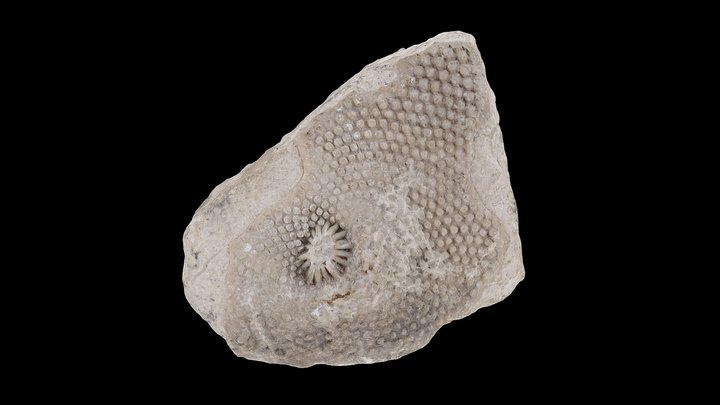
3D model
- Source
- Sketchfab
- Credit
- rocksandminerals
- Licence
- CC Attribution
- Commercial use
- cannot be read from the licence given — check the record
Smithsonian Open Access and MorphoSource were not reached for this taxon, so this list is what the others held rather than everything there is.
The description on this site
- Licence
- CC BY-SA 4.0
This is what the site found, which is not the same as what exists.
Keep going
What may have been alongside itReceptaculitidae through timeFormations of the OrdovicianThe world it lived on
Occurrence data from the Paleobiology Database, CC BY 4.0. Defrance 1827