Endoceras
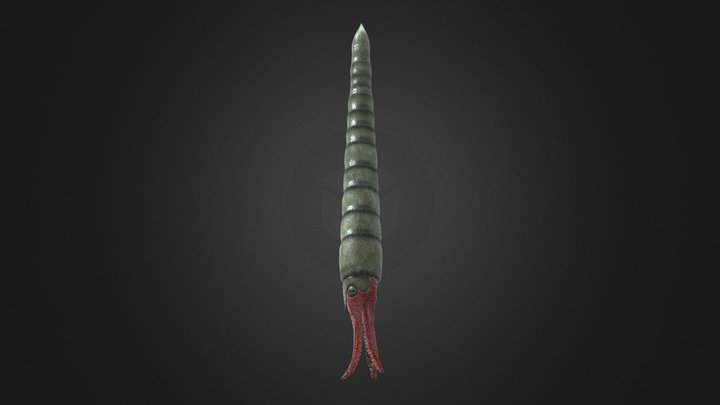
Endoceras, from Ancient Greek ἔνδον (éndon), meaning "inside", and κέρας (kéras), meaning "horn", is an extinct genus of large, straight-shelled cephalopods that gives its name to the Nautiloid order Endocerida. The genus lived during the middle and upper Ordovician 470 to 443 million years ago. The cross section in the mature portion is slightly wider than high, but is narrower laterally in the young. Sutures are straight and transverse. Endoceras has a large siphuncle, located close to the ventral margin, composed of concave segments, especially in the young but which may be tubular in the adult stage. Endocones are simple, subcircular in cross section, and penetrated by a narrow tube which may contain diaphragms reminiscent of the Ellesmerocerid ancestor.

Ghedoghedo · CC BY-SA 3.0 · via Wikipedia/Commons. May be a photograph of a specimen, or an artist’s reconstruction — an interpretation of a skeleton, since colour and soft tissue are almost never preserved.
On record
Recorded, not inferred- Sits inside
- EndoceratidaePBDB
- Diet
- carnivorePBDB, for Endocerida
- Life habit
- nektobenthicPBDB, for Endocerida
- Motility
- actively mobilePBDB, for Endocerida
- Vision
- well-developedPBDB, for Cephalopoda
- Environment
- marinePBDB, for Cephalopoda
Time the record covers
At least 38 million years on record.
The record covers at least 481.7 Mya to 443.1 Mya. No occurrence read is dated outside 486.85 Mya to 419.62 Mya.
222 occurrences of Endoceras on record, most of them in the Ordovician. Bar height is expected occurrences, not a count: each fossil is spread across the span it is dated to, so a tall narrow bar means tight dating and a low wide one means loose.
When
222 occurrences- Ordovician100%
- Silurianunder 1%
These are dates about fossils, not the animal: the record can only begin after it arose and end before it died out, so either end may reach further. Shares are expected occurrences: a fossil dated to a span is counted partly in each period it straddles. More on what this infers.
Found in
111 formations
- Dubuque Formation · Galena Group9
- Maquoketa Formation8
- Amadjuak Formation · Bad Cache Rapids Group8
- Denley Limestone Formation · Lower Trenton Group6
- Scales Shale Formation · Maquoketa Group6
- Fillmore Limestone Formation6
Loading coastlines…
The named rock units Endoceras has been recovered from, largest first. Drawn where the rock is now, not where it formed. 87 further formations hold fewer occurrences each and are not listed. 21 occurrences have no formation on record, which is common for older literature.
Endoceras and its relatives
OrdovicianWhere Endoceras and its relatives were recorded in the Ordovician.
Found in the same rock
1,668 taxa- Diestoceras30 sites
- Actinoceras28 sites
- Rafinesquina27 sites
- Spyroceras26 sites
- Ephippiorthoceras25 sites
- Michelinoceras22 sites
- Platystrophia22 sites
- Probillingsites22 sites
- Geisonoceras21 sites
- Westonoceras20 sites
- Prasopora19 sites
- Amplexopora18 sites
- Orthoceras18 sites
- Whitfieldoceras18 sites
- Conularia17 sites
- Ormoceras17 sites
- Charactoceras16 sites
- Ctenodonta16 sites
- Illaenus16 sites
- Kionoceras16 sites
- Strophomena16 sites
- Beloitoceras15 sites
- Centrocyrtoceras15 sites
- Dekayia15 sites
The Paleobiology Database records 188 sites for Endoceras, and this reads all of them. The number is how many of those sites it was catalogued from too. The 24 sharing the most are listed.
This is not a list of everything alive at the time. It is only what has come out of the same ground as this animal and been written down.
Entered from
62 references- Biostratigraphy of the Middle and Late Ordovician cephalopods of the Upper Mississippi Valley area49
- Ordovician cephalopod fauna of Baffin Island28
- Lower Ordovician trilobites from western Utah and eastern Nevadea12
- Locality 9:1 Silurian Sequences at Särghaua Field Station8
- The fossil fauna of the Ordovician in the Cincinnati Region7
- The 'Vaginaten': the dominant cephalopods of the Baltoscandian Mid Ordovician endocerid limestone6
- Fossil Communities of the Middle Trenton Group (Ordovician) of New York State6
- Palaeozoic geology of the Lake Simcoe Area, Ontario6
- Fossil communities of the lower Trenton Group (Middle Ordovician) of central and northwestern New York State5
- The middle ordovician of the Oslo region, Norway 10. Nautiloid Cephalopods5
- The geology of the Baltic Republics4
- Ordovician megafauna, Melville Peninsula, southeastern District of Franklin4
Each of the 222 occurrences read was entered from one of these publications, ordered by how many each accounts for. This is not a search for papers mentioning the name. 50 further references are not listed. Entries link to doi.org where the Paleobiology Database holds an identifier, and to its own record where it does not. Relayed as the Paleobiology Database holds them, not checked against what they resolve to.
Media and terms
Media content2

Picture of Endoceras
- Source
- Wikipedia/Commons
- Credit
- Ghedoghedo
- Licence
- CC BY-SA 3.0
- Commercial use
- the licence allows it
This entry was cached before the site began recording what Smithsonian Open Access and MorphoSource did, so a search that failed cannot be told from one that found nothing.
The description on this site
- Source
- Wikipedia, “Endoceras”
- Licence
- CC BY-SA 4.0
This is what the site found, which is not the same as what exists.
Keep going
What may have been alongside itEndoceratidae through timeFormations of the OrdovicianThe world it lived on
Occurrence data from the Paleobiology Database, CC BY 4.0. Hall 1847