Pseudorca crassidens
The false killer whale is a species of oceanic dolphin that is the only extant representative of the genus Pseudorca. It is found in oceans worldwide but mainly in tropical regions. It was first described in 1846 as a species of porpoise based on a skull, which was revised when the first carcasses were observed in 1861. The name "false killer whale" comes from having a skull similar to the orca or killer whale.

Stefan Thiesen Buntrabe · CC BY 3.0 · via Wikipedia/Commons. May be a photograph of a specimen, or an artist’s reconstruction — an interpretation of a skeleton, since colour and soft tissue are almost never preserved.
On record
Recorded, not inferred- Also called
- false killer whalePBDB
- Sits inside
- PseudorcaPBDB
- Diet
- piscivore, carnivorePBDB, for Delphinidae
- Life habit
- aquatic, depth=surfacePBDB, for Cetacea
- Motility
- actively mobilePBDB, for Cetacea
- Environment
- marine,freshwaterPBDB, for Odontoceti
Time the record covers
At least 117 thousand years on record.
The record covers at least 129 ka to 11.7 ka. No occurrence read is dated outside 774 ka to 0 Mya.
18 occurrences of Pseudorca crassidens on record. The Paleobiology Database records this as a living group. Bar height is expected occurrences, not a count: each fossil is spread across the span it is dated to, so a tall narrow bar means tight dating and a low wide one means loose.
When
18 occurrences- Pleistocene17%
- Holocene83%
These are dates about fossils, not the animal: the record can only begin after it arose and end before it died out, so either end may reach further. Shares are expected occurrences: a fossil dated to a span is counted partly in each period it straddles. More on what this infers.
Found in
1 formation
Loading coastlines…
The named rock units Pseudorca crassidens has been recovered from, largest first. Drawn where the rock is now, not where it formed. 17 occurrences have no formation on record, which is common for older literature.
Found in the same rock
44 taxa- Tursiops truncatus2 sites
- Acipenser1 site
- Aenocyon dirus1 site
- Balaenoptera1 site
- Bison antiquus antiquus1 site
- Bovinae1 site
- Cervus1 site
- Cervus canadensis1 site
- Cetacea1 site
- Delphinus1 site
- Delphinus delphis1 site
- Emys orbicularis1 site
- Equus caballus1 site
- Erethizon dorsatum1 site
- Gadus1 site
- Globicephala macrorhynchus1 site
- Glyptotherium cylindricum1 site
- Grampus griseus1 site
- Gulo gulo1 site
- Hippopotamus major1 site
- Holmesina septentrionalis1 site
- Leuciscus1 site
- Lynx rufus1 site
- Megalonyx jeffersonii1 site
The Paleobiology Database records 18 sites for Pseudorca crassidens, and this reads all of them. The number is how many of those sites it was catalogued from too. The 24 sharing the most are listed.
This is not a list of everything alive at the time. It is only what has come out of the same ground as this animal and been written down.
Entered from
8 references- Cetacean abundance in Hawaiian waters estimated from a summer/fall survey in 200211
- Determining the ages of sub-fossil cetacean remains, found in the Carse of Stirling, Scotland1
- Ancient whale exploitation in the Mediterranean: the archaeological record1
- Taphonomic variation despite catastrophic mortality: Analysis of a mass stranding of false killer whales (Pseudorca crassidens), Gulf of California, Mexico1
- Additions to the Pleistocene Mammal Faunas of South Carolina, North Carolina, and Georgia1
- Fossil atlases of dolphins from the Mawaki Site, Noto Peninsula1
- The vertebrata of the Pliocene deposits of Britain1
- A History of British Fossil Mammals and Birds1
Each of the 18 occurrences read was entered from one of these publications, ordered by how many each accounts for. This is not a search for papers mentioning the name. Entries link to doi.org where the Paleobiology Database holds an identifier, and to its own record where it does not. Relayed as the Paleobiology Database holds them, not checked against what they resolve to.
Media and terms
Media content2

Picture of Pseudorca crassidens
- Source
- Wikipedia/Commons
- Credit
- Stefan Thiesen Buntrabe
- Licence
- CC BY 3.0
- Commercial use
- the licence allows it
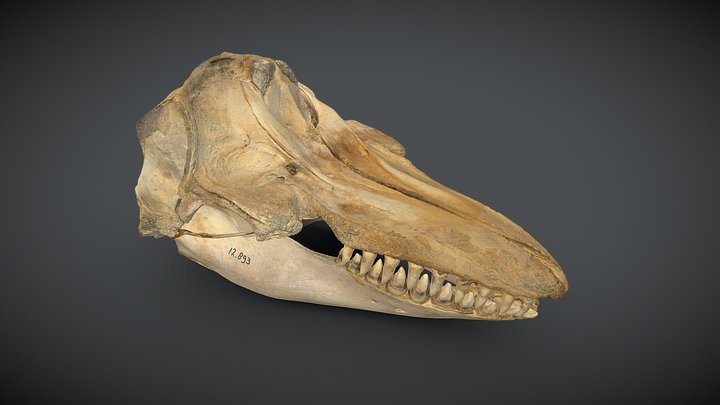
3D model
- Source
- Sketchfab
- Licence
- CC Attribution-NonCommercial-NoDerivs
- Commercial use
- the licence does not allow it
Smithsonian Open Access and MorphoSource were not reached for this taxon, so this list is what the others held rather than everything there is.
The description on this site
- Licence
- CC BY-SA 4.0
This is what the site found, which is not the same as what exists.
Keep going
What may have been alongside itPseudorca through timeThe world it lived on
Occurrence data from the Paleobiology Database, CC BY 4.0. (Owen 1846)