Plesiosauria
Searched as Plesiosauria indet.. The Paleobiology Database treats Plesiosauria as the accepted name.
The Plesiosauria or plesiosaurs are an order or clade of extinct Mesozoic marine reptiles, belonging to the Sauropterygia. Plesiosaurs first appeared in the latest Triassic Period, possibly in the Rhaetian stage, about 203 million years ago. They became especially common during the Jurassic Period, thriving until their disappearance due to the Cretaceous–Paleogene extinction event at the end of the Cretaceous Period, about 66 million years ago. They had a worldwide oceanic distribution, and some species at least partly inhabited freshwater environments.

Kim Alaniz · CC BY 2.0 · via Wikipedia/Commons. May be a photograph of a specimen, or an artist’s reconstruction — an interpretation of a skeleton, since colour and soft tissue are almost never preserved.
On record
Recorded, not inferred- Also called
- plesiosaurPBDB
- Sits inside
- SauropterygiaPBDB
- Diet
- carnivorePBDB
- Life habit
- aquatic, depth=surfacePBDB
- Motility
- actively mobilePBDB
- Environment
- marinePBDB
Time the record covers
At least 148 million years on record.
The record covers at least 221 Mya to 72.2 Mya. No occurrence read is dated outside 227.5 Mya to 66 Mya.
230 occurrences of Plesiosauria on record, most of them in the Late Cretaceous. Bar height is expected occurrences, not a count: each fossil is spread across the span it is dated to, so a tall narrow bar means tight dating and a low wide one means loose.
When
230 occurrences- Late Triassic3%
- Early Jurassic6%
- Middle Jurassic5%
- Late Jurassic8%
- Early Cretaceous16%
- Late Cretaceous63%
These are dates about fossils, not the animal: the record can only begin after it arose and end before it died out, so either end may reach further. Shares are expected occurrences: a fossil dated to a span is counted partly in each period it straddles. More on what this infers.
Found in
103 formations
- Dinosaur Park Formation · Belly River Group11
- Griman Creek Formation · Rolling Downs Group11
- Allen Formation · Malargüe Group8
- Niobrara Formation · Colorado Group7
- Jagua Formation6
- La Colonia Formation6
Loading coastlines…
The named rock units Plesiosauria has been recovered from, largest first. Drawn where the rock is now, not where it formed. 79 further formations hold fewer occurrences each and are not listed. 37 occurrences have no formation on record, which is common for older literature.
Plesiosauria and its relatives
Late CretaceousWhere Plesiosauria and its relatives were recorded in the Late Cretaceous.
Found in the same rock
1,291 taxa- Elasmosauridae44 sites
- Mosasauridae19 sites
- Theropoda19 sites
- Polycotylidae14 sites
- Teleostei14 sites
- Testudines14 sites
- Pliosauridae12 sites
- Cretalamna appendiculata11 sites
- Enchodus11 sites
- Hybodus11 sites
- Ichthyosauria11 sites
- Inoceramus11 sites
- Crocodylia9 sites
- Ostrea9 sites
- Pterosauria9 sites
- Astarte8 sites
- Cretoxyrhina mantelli8 sites
- Elasmosaurus8 sites
- Lepidotes8 sites
- Meristodonoides montanensis8 sites
- Myledaphus bipartitus8 sites
- Ornithocheiridae8 sites
- Plesiosaurus8 sites
- Squalicorax8 sites
The Paleobiology Database records 875 sites for Plesiosauria, and this reads 240 of them. The number is how many of those sites it was catalogued from too. The 24 sharing the most are listed.
This is not a list of everything alive at the time. It is only what has come out of the same ground as this animal and been written down.
Entered from
143 references- The end of the dinosaur era in Patagonia (NatGeo Project)11
- Terrestrial and Freshwater Turtles of Early Cretaceous Australia11
- Turonian marine amniotes from the Bohemian Cretaceous Basin, Czech Republic6
- Large freshwater plesiosaurian from the Cretaceous (Aptian) of Australia6
- First records of plesiosaur remains in the lower Smoky Hill Chalk Member (Upper Coniacian) of the Niobrara Formation in western Kansas6
- Synopsis of Late Jurassic marine reptiles from Cuba6
- Revision of the short-necked Cretaceous plesiosaurians from New Zealand5
- A Late Cretaceous dinosaur and reptile assemblage from South Carolina, USA5
- Reptiles from the Senonian (U Cret) of Scania (S Sweden)5
- El registro fósil de plesiosaurios (Sauropterigia) en Chile4
- Palaeobiological significance of high-latitude Late Cretaceous vertebrate fossils from the James Ross Basin, Antarctica4
- Paleoecology of an estuarine, incised-valley fill in the Dinosaur Park Formation (Judith River Group, Upper Cretaceous) of southern Alberta, Canada4
Each of the 230 occurrences read was entered from one of these publications, ordered by how many each accounts for. This is not a search for papers mentioning the name. 131 further references are not listed. Entries link to doi.org where the Paleobiology Database holds an identifier, and to its own record where it does not. Relayed as the Paleobiology Database holds them, not checked against what they resolve to.
Media and terms
Media content1
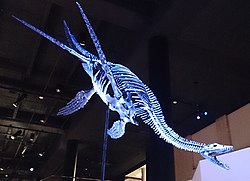
Picture of Plesiosauria
- Source
- Wikipedia/Commons
- Credit
- Kim Alaniz
- Licence
- CC BY 2.0
- Commercial use
- the licence allows it
No 3D scan of Plesiosauria was found in Sketchfab.
Smithsonian Open Access and MorphoSource were not reached for this taxon, so this list is what the others held rather than everything there is.
The description on this site
- Source
- Wikipedia, “Plesiosaur”
- Licence
- CC BY-SA 4.0
This is what the site found, which is not the same as what exists.
Keep going
What may have been alongside itSauropterygia through timeFormations of the Late CretaceousThe world it lived on
Occurrence data from the Paleobiology Database, CC BY 4.0. (de Blainville 1835)