Plesiosaurus
Plesiosaurus is a genus of extinct, large marine sauropterygian reptile that lived during the Early Jurassic. It is known by nearly complete skeletons from the Lias of England. Measuring around 3.5 m (11 ft) long, it is distinguishable by its small head, long and slender neck, broad turtle-like body, a short tail, and two pairs of large, elongated paddles. It lends its name to the order Plesiosauria, of which it is an early, but fairly typical member. It contains only one species, the type, Plesiosaurus dolichodeirus. Other species once assigned to this genus, including P. brachypterygius, P. guilielmiimperatoris, and P. tournemirensis have been reassigned to new genera, such as Hydrorion, Seeleyosaurus and Microcleidus.

the paleobear · CC BY 2.0 · via Wikipedia/Commons. May be a photograph of a specimen, or an artist’s reconstruction — an interpretation of a skeleton, since colour and soft tissue are almost never preserved.
On record
Recorded, not inferred- Sits inside
- PlesiosauroideaPBDB
- Diet
- carnivorePBDB, for Plesiosauria
- Life habit
- aquatic, depth=surfacePBDB, for Plesiosauria
- Motility
- actively mobilePBDB, for Plesiosauria
- Environment
- marinePBDB, for Plesiosauria
- Length
- 3.5 mWikidata
Time the record covers
At least 117 million years on record.
The record covers at least 201.4 Mya to 83.6 Mya. No occurrence read is dated outside 205.7 Mya to 66 Mya.
55 occurrences of Plesiosaurus on record, most of them in the Early Jurassic. Bar height is expected occurrences, not a count: each fossil is spread across the span it is dated to, so a tall narrow bar means tight dating and a low wide one means loose.
When
55 occurrences- Late Triassic12%
- Early Jurassic39%
- Middle Jurassic3%
- Late Jurassic25%
- Early Cretaceous11%
- Late Cretaceous11%
These are dates about fossils, not the animal: the record can only begin after it arose and end before it died out, so either end may reach further. Shares are expected occurrences: a fossil dated to a span is counted partly in each period it straddles. More on what this infers.
Found in
17 formations
- Kimmeridge Clay Formation · Ancholme Group8
- Charmouth Mudstone Formation · Lias Group3
- Westbury Formation · Penarth Group3
- Grès de Mortinsart Formation2
- Argiles de Châtillon Formation2
- Braunjura alpha & Braunjura beta Formation · Braunjura Group1
Loading coastlines…
The named rock units Plesiosaurus has been recovered from, largest first. Drawn where the rock is now, not where it formed. 25 occurrences have no formation on record, which is common for older literature.
Plesiosaurus and its relatives
Early JurassicWhere Plesiosaurus and its relatives were recorded in the Early Jurassic.
Found in the same rock
357 taxa- Plesiosauria8 sites
- Ichthyosaurus6 sites
- Astarte4 sites
- Cucullaea4 sites
- Lima4 sites
- Lissodus minimus4 sites
- Nemacanthus monilifer4 sites
- Pecten4 sites
- Pentacrinites4 sites
- Birgeria acuminata3 sites
- Eurycleidus arcuatus3 sites
- Hybodus3 sites
- Ichthyosauria3 sites
- Lepidotes3 sites
- Ostrea3 sites
- Pliosaurus3 sites
- Pliosaurus brachydeirus3 sites
- Polyacrodus cloacinus3 sites
- Pterosauria3 sites
- Sargodon tomicus3 sites
- Actinopterygii2 sites
- Ammonitida2 sites
- Anomia2 sites
- Colobodus2 sites
The Paleobiology Database records 47 sites for Plesiosaurus, and this reads all of them. The number is how many of those sites it was catalogued from too. The 24 sharing the most are listed.
This is not a list of everything alive at the time. It is only what has come out of the same ground as this animal and been written down.
Entered from
37 references- Report on British fossil reptiles6
- The Mesozoic reptiles of Dorset. Part two5
- Lydekker, 18894
- Recherches sur les reptiles trouvés dans l'étage rhétien des environs d'Autun [Research on the reptiles found in the Rhaetian stage of the environs of Autun]4
- Rhaetian (Upper Triassic) marine faunas from "Le Golfe du Luxembourg" in Belgium (preliminary note)2
- Part I. Sauropterygia2
- Descriptive catalogue of the Fossil organic remains of Reptilia and Pisces contained in the Museum of the Royal College of Surgeons of England2
- Plesiosaur spinal pathology: the first fossil occurrence of Schmorl's nodes1
- Die Gundershoffener Klamm1
- Morphological and taxonomic clarification of the genus Plesiosaurus1
- Reptilia from the Portland Stone (Upper Jurassic) of England: a preliminary survey of the material and the literature1
- Catalogue commente des types et figures de dinosauriens, ichthyosauriens, sauropterygiens, pterosauriens et cheloninens du Musée d'Histoire Naturelle de Boulogne-sur-Mer [Annotated catalogue of the type and figured specimens of dinosaurs, ichthyosaurs, sauropterygians, pterosaurs, and turtles from the Musée d'Histoire Naturelle of Boulogne-sur-Mer]1
Each of the 55 occurrences read was entered from one of these publications, ordered by how many each accounts for. This is not a search for papers mentioning the name. 25 further references are not listed. Entries link to doi.org where the Paleobiology Database holds an identifier, and to its own record where it does not. Relayed as the Paleobiology Database holds them, not checked against what they resolve to.
Media and terms
Media content3

Picture of Plesiosaurus
- Source
- Wikipedia/Commons
- Credit
- the paleobear
- Licence
- CC BY 2.0
- Commercial use
- the licence allows it
Structured light scan
- Source
- MorphoSource
- Licence
- In Copyright
- Commercial use
- cannot be read from the licence given — check the record
- Specimen
- Plesiosaurus dolichodeirus · NHMUK:PAL:PV OR 22656
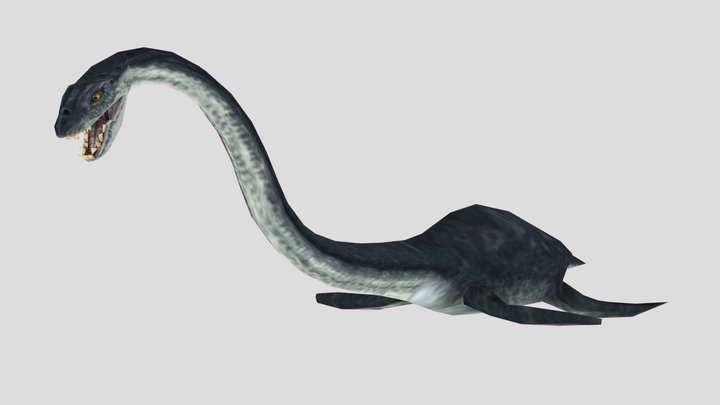
3D model
- Source
- Sketchfab
- Credit
- Ziggertron
- Licence
- CC Attribution
- Commercial use
- cannot be read from the licence given — check the record
The description on this site
- Licence
- CC BY-SA 4.0
This is what the site found, which is not the same as what exists.
Keep going
What may have been alongside itPlesiosauroidea through timeFormations of the Early JurassicThe world it lived on
Occurrence data from the Paleobiology Database, CC BY 4.0. de la Beche and Conybeare 1821