Palaeophycus
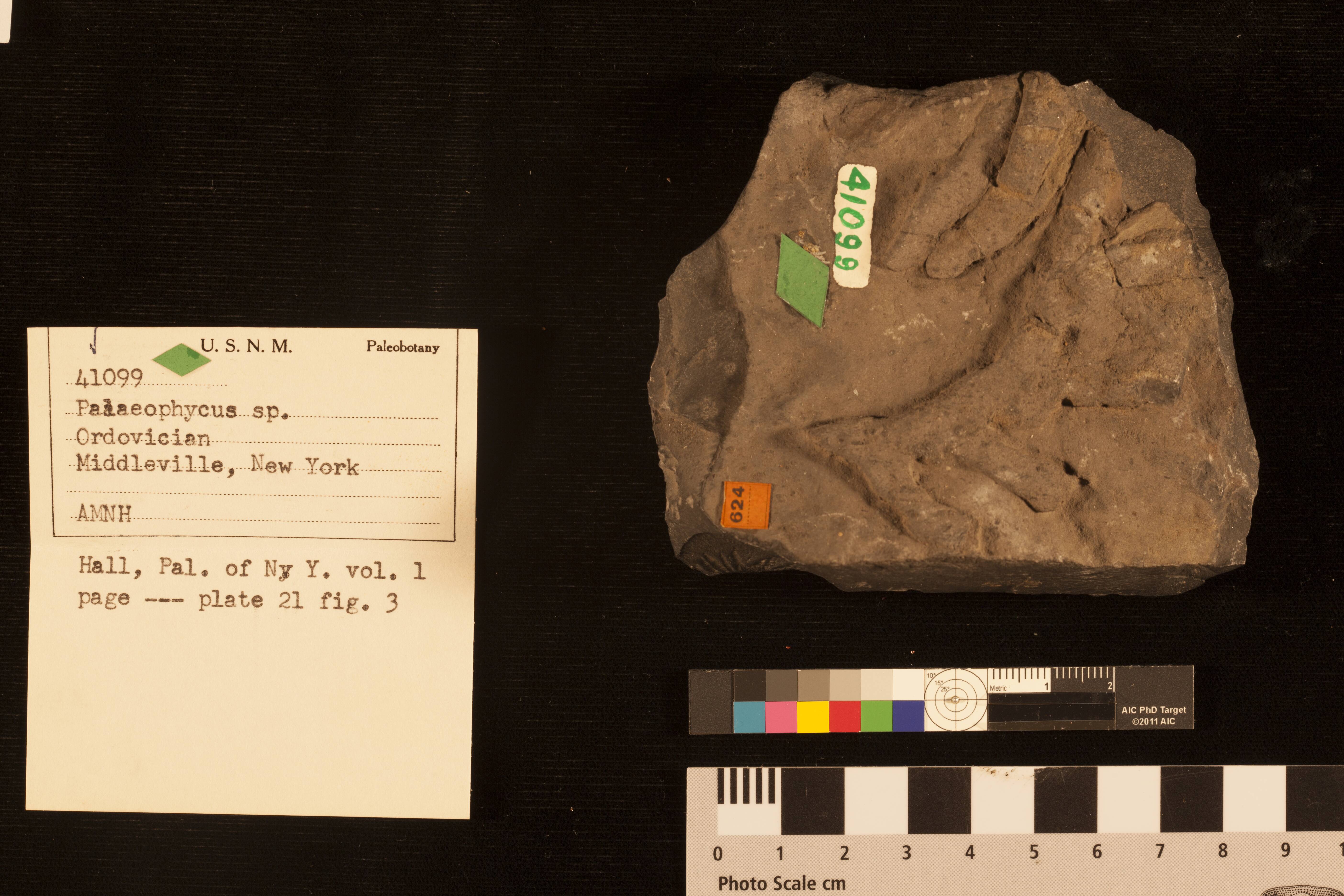
Smithsonian Institution · CC0 · via Smithsonian. May be a photograph of a specimen, or an artist’s reconstruction — an interpretation of a skeleton, since colour and soft tissue are almost never preserved.
On record
Recorded, not inferred- Sits inside
- IchnofossilsPBDB
Time the record covers
At least 518 million years on record.
The record covers at least 538.8 Mya to 20.45 Mya. No occurrence read is dated outside 635 Mya to 15.98 Mya.
92 occurrences of Palaeophycus on record, most of them in the Cambrian. Bar height is expected occurrences, not a count: each fossil is spread across the span it is dated to, so a tall narrow bar means tight dating and a low wide one means loose.
When
92 occurrences- Cambrian34%
- Ordovician11%
- Silurian3%
- Devonian2%
- Carboniferous3%
- Permian3%
- Middle Triassic3%
- Late Triassic2%
- Early Jurassic3%
- Middle Jurassic9%
- Early Cretaceous7%
- Late Cretaceous8%
- Eocene1%
- Miocene3%
These are dates about fossils, not the animal: the record can only begin after it arose and end before it died out, so either end may reach further. Shares are expected occurrences: a fossil dated to a span is counted partly in each period it straddles. More on what this infers.
Found in
57 formations
- Opalinuston Formation8
- Laeso Formation7
- Pedroche Formation6
- Spartan Glacier Formation3
- Puerto Blanco Formation · Fallotaspis Group3
- Hardeberga Formation3
Loading coastlines…
The named rock units Palaeophycus has been recovered from, largest first. Drawn where the rock is now, not where it formed. 33 further formations hold fewer occurrences each and are not listed. 1 occurrence has no formation on record, which is common for older literature.
Palaeophycus and its relatives
CambrianWhere Palaeophycus and its relatives were recorded in the Cambrian.
Found in the same rock
766 taxa- Planolites26 sites
- Bositra buchi8 sites
- Chondrites8 sites
- Skolithos8 sites
- Diplichnites6 sites
- Rusophycus5 sites
- Teichichnus5 sites
- Cruziana4 sites
- Gordia4 sites
- Lockeia4 sites
- Parainoceramya dubia4 sites
- Planolites montanus4 sites
- Thalassinoides4 sites
- Torrowangea4 sites
- Zoophycos4 sites
- Bergaueria3 sites
- Bryozoa3 sites
- Cingentolium (Cingentolium) cingulatum3 sites
- Cochlichnus3 sites
- Cochlichnus anguineus3 sites
- Crinoidea3 sites
- Dimorphichnus obliquus3 sites
- Gastropoda3 sites
- Helminthoidichnites3 sites
The Paleobiology Database records 70 sites for Palaeophycus, and this reads all of them. The number is how many of those sites it was catalogued from too. The 24 sharing the most are listed.
This is not a list of everything alive at the time. It is only what has come out of the same ground as this animal and been written down.
Entered from
51 references- Substrate control of lower cambrian trace fossils from bornholm, Denmark10
- Paläontologische Untersuchungen im unteren Opalinuston der Nordschweiz8
- Trace and soft body fossils from the Pedroche Formation (Ovetian, Lower Cambrian of the Sierra de Córdoba, S Spain) and their relation to the Pedroche event6
- Ichnology of the Upper Cambrian? to Lower Ordovician Bell Island and Wabana groups of eastern Newfoundland, Canada6
- Upper Proterozoic and Cambrian rocks in the Caborca Region, Sonora, Mexico - physical stratigraphy, biostratigraphy, paleocurrent studies, and regional relations5
- Paleontology and stratigraphy of the Miocene Saddleback Valley Limestone, Orange County, Southern California3
- Lithostratigraphy of Upper Jurassic-Lower Cretaceous strata of eastern Alexander Island, Antarctica3
- Type and reference sections of the Middle and Upper Permian of the Volga and Kama River Regions: A Field Guidebook of XVIII International Congress on Carboniferous and Permian2
- First Ediacaran fauna occurrence in northeastern Brazil (Jaibaras Basin, ?Ediacaran-Cambrian): Preliminary results and regional correlation2
- Taphonomy of the Lamy amphibian quarry: A Late Triassic bonebed in New Mexico, U.S.A.2
- Malarguesaurus florenciae gen. et sp. nov., a new titanosauriform (Dinosauria, Sauropoda) from the Upper Cretaceous of Mendoza, Argentina2
- A new species of Strepsodiscus Knight (Gastropoda, Bellerophontoidea) from the Upper Cambrian of Argentina2
Each of the 92 occurrences read was entered from one of these publications, ordered by how many each accounts for. This is not a search for papers mentioning the name. 39 further references are not listed. Entries link to doi.org where the Paleobiology Database holds an identifier, and to its own record where it does not. Relayed as the Paleobiology Database holds them, not checked against what they resolve to.
Media and terms
Media content1
Picture of Palaeophycus
- Source
- Smithsonian
- Credit
- Smithsonian Institution
- Licence
- CC0 — this site’s default, not the record’s
- Commercial use
- the licence allows it
No 3D scan was found. Smithsonian Open Access, MorphoSource and Sketchfab were all searched.
This is what the site found, which is not the same as what exists.
Keep going
What may have been alongside itIchnofossils through timeFormations of the CambrianThe world it lived on
Occurrence data from the Paleobiology Database, CC BY 4.0. Hall 1847