Chondrites
Chondrites is a trace fossil ichnogenus, preserved as small branching burrows of the same diameter that superficially resemble the roots of a plant. The origin of these structures is currently unknown. Chondrites is found in marine sediments from the Cambrian period of the Paleozoic onwards. It is especially common in sediments that were deposited in reduced-oxygen environments.

Eberhard Fraas; digitized by Hl1948 · Public Domain · via Wikipedia/Commons. May be a photograph of a specimen, or an artist’s reconstruction — an interpretation of a skeleton, since colour and soft tissue are almost never preserved.
On record
Recorded, not inferred- Sits inside
- IchnofossilsPBDB
Time the record covers
At least 515 million years on record.
The record covers at least 521 Mya to 5.333 Mya. No occurrence read is dated outside 530.7 Mya to 3.6 Mya.
135 occurrences of Chondrites on record, most of them in the Early Cretaceous. Bar height is expected occurrences, not a count: each fossil is spread across the span it is dated to, so a tall narrow bar means tight dating and a low wide one means loose.
When
135 occurrences- Cambrian4%
- Ordovician5%
- Silurian3%
- Devonian13%
- Carboniferous7%
- Permianunder 1%
- Early Jurassic8%
- Middle Jurassic9%
- Late Jurassic13%
- Early Cretaceous24%
- Late Cretaceous8%
- Eocene1%
- Oligoceneunder 1%
- Miocene2%
- Plioceneunder 1%
These are dates about fossils, not the animal: the record can only begin after it arose and end before it died out, so either end may reach further. Shares are expected occurrences: a fossil dated to a span is counted partly in each period it straddles. More on what this infers.
Found in
57 formations
- Kap Leslie Formation14
- Schrambach Formation13
- Opalinuston Formation11
- Moscow Formation · Hamilton Group6
- Prairie Bluff Formation4
- Mospyne Formation4
Loading coastlines…
The named rock units Chondrites has been recovered from, largest first. Drawn where the rock is now, not where it formed. 33 further formations hold fewer occurrences each and are not listed. 19 occurrences have no formation on record, which is common for older literature.
Chondrites and its relatives
Early CretaceousWhere Chondrites and its relatives were recorded in the Early Cretaceous.
Found in the same rock
1,382 taxa- Planolites34 sites
- Zoophycos24 sites
- Thalassinoides17 sites
- Gastropoda14 sites
- Grammatodon13 sites
- Pleuromya13 sites
- Ammonoidea12 sites
- Astarte12 sites
- Nautiloidea12 sites
- Belemnitida11 sites
- Bivalvia11 sites
- Bositra buchi11 sites
- Camptonectes11 sites
- Entolium orbiculare11 sites
- Buchia mosquensis10 sites
- Modiolus10 sites
- Pinna10 sites
- Planulites10 sites
- Brachiopoda9 sites
- Crinoidea9 sites
- Ostracoda9 sites
- Stomiosphaera9 sites
- Bryozoa8 sites
- Dentalium8 sites
The Paleobiology Database records 122 sites for Chondrites, and this reads all of them. The number is how many of those sites it was catalogued from too. The 24 sharing the most are listed.
This is not a list of everything alive at the time. It is only what has come out of the same ground as this animal and been written down.
Entered from
67 references- Lower Cretaceous Section of the Ternberg Nappe (Northern Calcareous Alps, Upper Austria): facies-changes, biostratigraphy and paleoecology11
- Genesis and environmental significance of Upper Cretaceous shell concentrations from the Cauvery Basin, southern India11
- Paläontologische Untersuchungen im unteren Opalinuston der Nordschweiz11
- Regional variation and paleontology of two coral beds in the Middle Devonian Hamilton Group of Western New York6
- Late Bashkirian ammonoids from the Mospyne Formation of the Donets Basin, Ukraine4
- Trilobite assemblages in the Devonian of the Barrandian area and their relations to palaeoenvironments4
- Upper Cretaceous (Maestrichtian) Mollusca from the Haustator bilira Assemblage Zone in the East Gulf Coastal Plain4
- Unpublished data3
- Les grès verts helvétiques (Aptien moyen-Albien supérieur) de Haute-Savoie, Valais et Vaud (Alpes occidentales franco-suisses)3
- Nowakia Dacryconarids in the Pragian of the Praha Basin (lower Devonian, Czech Republic)3
- Lithostratigraphy of Upper Jurassic-Lower Cretaceous strata of eastern Alexander Island, Antarctica3
- Fossil associations in the High Tor Limestone (Lower Carboniferous) of South Wales3
Each of the 135 occurrences read was entered from one of these publications, ordered by how many each accounts for. This is not a search for papers mentioning the name. 55 further references are not listed. Entries link to doi.org where the Paleobiology Database holds an identifier, and to its own record where it does not. Relayed as the Paleobiology Database holds them, not checked against what they resolve to.
Media and terms
Media content2

Picture of Chondrites
- Source
- Wikipedia/Commons
- Credit
- Eberhard Fraas; digitized by Hl1948
- Licence
- Public Domain
- Commercial use
- the licence allows it
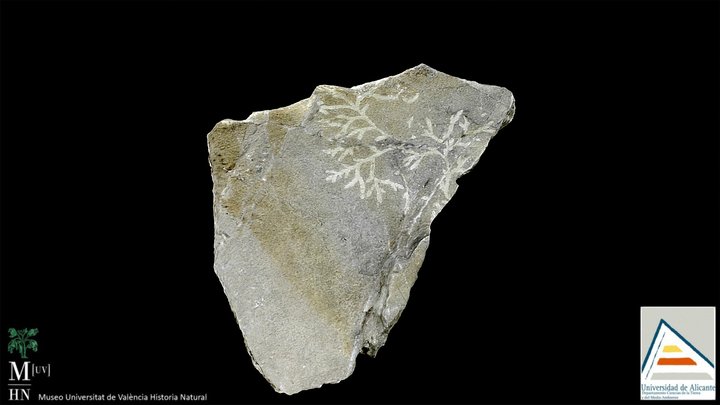
3D model
- Source
- Sketchfab
- Licence
- CC Attribution
- Commercial use
- cannot be read from the licence given — check the record
The description on this site
- Licence
- CC BY-SA 4.0
This is what the site found, which is not the same as what exists.
Keep going
What may have been alongside itIchnofossils through timeFormations of the Early CretaceousThe world it lived on
Occurrence data from the Paleobiology Database, CC BY 4.0. von Sternberg 1833