Teichichnus
Teichichnus is an ichnogenus with a distinctive form produced by the stacking of thin 'tongues' of sediment, atop one another. They are believed to be fodinichnia, with the organism adopting the habit of retracing the same route through varying heights of the sediment, which would allow it to avoid going over the same area. These 'tongues' are often quite sinuous, reflecting perhaps a more nutrient-poor environment in which the feeding animals had to cover a greater area of sediment, in order to acquire sufficient nourishment. Teichichnus is recognized as a series of tightly packed, concave-up or down laminae, and lacks an outside border or lining, which distinguishes Teichichnus from the Diplocraterion ichnogenus. Teichichnus has 18 named species, of which 4 are valid.

Uncredited · via Wikipedia/Commons. May be a photograph of a specimen, or an artist’s reconstruction — an interpretation of a skeleton, since colour and soft tissue are almost never preserved.
On record
Recorded, not inferred- Sits inside
- IchnofossilsPBDB
Time the record covers
At least 515 million years on record.
The record covers at least 521 Mya to 5.333 Mya. No occurrence read is dated outside 538.8 Mya to 3.6 Mya.
32 occurrences of Teichichnus on record, most of them in the Cambrian. Bar height is expected occurrences, not a count: each fossil is spread across the span it is dated to, so a tall narrow bar means tight dating and a low wide one means loose.
When
32 occurrences- Cambrian53%
- Ordovician19%
- Devonian6%
- Carboniferous3%
- Late Jurassic7%
- Early Cretaceous5%
- Late Cretaceous3%
- Pliocene3%
These are dates about fossils, not the animal: the record can only begin after it arose and end before it died out, so either end may reach further. Shares are expected occurrences: a fossil dated to a span is counted partly in each period it straddles. More on what this infers.
Found in
21 formations
- Laeso Formation6
- Mickwitzia Sandstone Formation2
- Ocieseki Sandstone Formation2
- Kap Leslie Formation1
- Bedford Shale Formation1
- File Haidar Formation1
Loading coastlines…
The named rock units Teichichnus has been recovered from, largest first. Drawn where the rock is now, not where it formed. 4 occurrences have no formation on record, which is common for older literature.
Teichichnus and its relatives
CambrianWhere Teichichnus and its relatives were recorded in the Cambrian.
Found in the same rock
291 taxa- Planolites7 sites
- Diplocraterion5 sites
- Cruziana4 sites
- Modiolus4 sites
- Palaeophycus4 sites
- Rusophycus4 sites
- Thalassinoides4 sites
- Volborthella tenuis4 sites
- Camptonectes3 sites
- Chondrites3 sites
- Isocyprina3 sites
- Mickwitzia monilifera3 sites
- Mickwitzia pretiosa3 sites
- Mobergella3 sites
- Paleomerus3 sites
- Protolyellia3 sites
- Spatangopsis3 sites
- Torellella laevigata3 sites
- Anopaea2 sites
- Belemnopsis2 sites
- Bellerophontoidea2 sites
- Buchia mosquensis2 sites
- Cephalopoda2 sites
- Cruziana billingsi2 sites
The Paleobiology Database records 21 sites for Teichichnus, and this reads all of them. The number is how many of those sites it was catalogued from too. The 24 sharing the most are listed.
This is not a list of everything alive at the time. It is only what has come out of the same ground as this animal and been written down.
Entered from
19 references- Substrate control of lower cambrian trace fossils from bornholm, Denmark6
- Ichnology of the Upper Cambrian? to Lower Ordovician Bell Island and Wabana groups of eastern Newfoundland, Canada4
- Predation by early Cambrian trilobites on infaunal worms - evidence from the Swedish Mickwitzia Sandstone3
- The Tommotian phase of the Early Cambrian Agronomic Revolution in the carbonate mud environment of central Siberia2
- Conformable Late Jurassic (Oxfordian) to Early Cretaceous Strata, northern Bowser Basin, British Columbia: a sedimentological and paleontological model2
- Trace fossils in the Lower Cambrian sequence in the Swietokrzyskie Mountains, Central Poland2
- A crinoid fauna and a new species of Pycnocrinus from the Martinsburg Formation (Upper Ordovician), lower Hudson Valley, New York1
- Paleoecology and sedimentology of a vertebrate microfossil assemblage from the easternmost Dinosaur Park Formation (Late Cretaceous, Upper Campanian,) Saskatchewan, Canada: reconstructing diversity in a coastal ecosystem1
- Snapshot of a lower Pliocene Dendropoma reef from Sant Onofre (Baix Ebre Basin, Tarragona, NE Spain)1
- A remarkable illaenid trilobite from the Middle Ordovician of Morocco1
- A diverse ichnofauna from the Cambrian Stage 4 Wulongqing Formation near Kunming (Yunnan Province, South China)1
- Redescription of Holmia inusitata (Trilobita) from the Lower Cambrian of Scandinavia1
Each of the 32 occurrences read was entered from one of these publications, ordered by how many each accounts for. This is not a search for papers mentioning the name. 7 further references are not listed. Entries link to doi.org where the Paleobiology Database holds an identifier, and to its own record where it does not. Relayed as the Paleobiology Database holds them, not checked against what they resolve to.
Media and terms
Media content2

Picture of Teichichnus
- Source
- Wikipedia/Commons
- Credit
- nobody named on the record
- Licence
- not stated by the source
- Commercial use
- cannot be read from the licence given — check the record
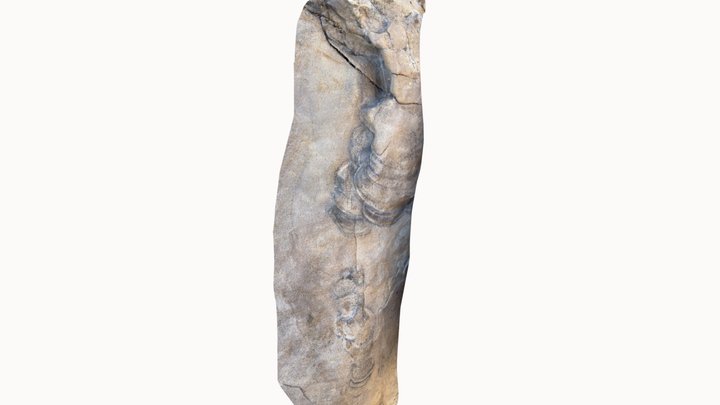
3D model
- Source
- Sketchfab
- Credit
- High Plains Rifter
- Licence
- CC Attribution-NonCommercial-ShareAlike
- Commercial use
- the licence does not allow it
MorphoSource was not reached for this taxon, so this list is what the others held rather than everything there is.
The description on this site
- Source
- Wikipedia, “Teichichnus”
- Licence
- CC BY-SA 4.0
This is what the site found, which is not the same as what exists.
Keep going
What may have been alongside itIchnofossils through timeFormations of the CambrianThe world it lived on
Occurrence data from the Paleobiology Database, CC BY 4.0. Seilacher 1955