Diplichnites
Diplichnites are arthropod trackways with two parallel rows of blunt to elongate, closely spaced tracks oriented approximately perpendicularly to the mid-line of the trackway. The term is more often used for the ichnofossils of this description; however, similar trackways from recent arthropods are sometimes given this name as well.

Michael C. Rygel · CC BY-SA 3.0 · via Wikipedia/Commons. May be a photograph of a specimen, or an artist’s reconstruction — an interpretation of a skeleton, since colour and soft tissue are almost never preserved.
On record
Recorded, not inferred- Sits inside
- IchnofossilsPBDB
Time the record covers
At least 395 million years on record.
The record covers at least 538.8 Mya to 143.1 Mya. No occurrence read is dated outside 635 Mya to 137.05 Mya.
19 occurrences of Diplichnites on record, most of them in the Cambrian. Bar height is expected occurrences, not a count: each fossil is spread across the span it is dated to, so a tall narrow bar means tight dating and a low wide one means loose.
When
19 occurrencesThese are dates about fossils, not the animal: the record can only begin after it arose and end before it died out, so either end may reach further. Shares are expected occurrences: a fossil dated to a span is counted partly in each period it straddles. More on what this infers.
Found in
15 formations
- Nomtsas Formation · Schwarzrand Group2
- Pedroche Formation2
- Beach Formation · Bell Island Group2
- Moenave Formation · Glen Canyon Group2
- Stranger Formation1
- Tal Formation1
Loading coastlines…
The named rock units Diplichnites has been recovered from, largest first. Drawn where the rock is now, not where it formed.
Diplichnites and its relatives
CambrianWhere Diplichnites and its relatives were recorded in the Cambrian.
Found in the same rock
197 taxa- Palaeophycus5 sites
- Phycodes5 sites
- Psammichnites5 sites
- Cochlichnus4 sites
- Dimorphichnus4 sites
- Kouphichnium4 sites
- Treptichnus pedum4 sites
- Bergaueria perata3 sites
- Bilinichnus3 sites
- Dimorphichnus obliquus3 sites
- Diplocraterion parallelum3 sites
- Gordia3 sites
- Helminthopsis3 sites
- Monocraterion3 sites
- Monomorphichnus3 sites
- Palaeophycus alternatus3 sites
- Planolites striatus3 sites
- Psammichnites gigas3 sites
- Rusophycus didymus3 sites
- Skolithos3 sites
- Torrowangea3 sites
- Treptichnus bifurcus3 sites
- Aulichnites2 sites
- Circulichnis2 sites
The Paleobiology Database records 17 sites for Diplichnites, and this reads all of them. The number is how many of those sites it was catalogued from too. The 24 sharing the most are listed.
This is not a list of everything alive at the time. It is only what has come out of the same ground as this animal and been written down.
Entered from
15 references- Ichnology of the Upper Cambrian? to Lower Ordovician Bell Island and Wabana groups of eastern Newfoundland, Canada3
- Lower Jurassic invertebrate ichnofossils from a clastic lake margin, Johnson Farm, southwestern Utah2
- Trace and soft body fossils from the Pedroche Formation (Ovetian, Lower Cambrian of the Sierra de Córdoba, S Spain) and their relation to the Pedroche event2
- Dinosaur tracks from the Jurassic-Cretaceous boundary Tuchengzi Formation (Hebei Province, China) used as building stones in the Chengde imperial summer resort: age, ichnology, and1
- Ichnology of the Early Cambrian Tal Group, Mussoorie Syncline, Lesser Himalaya, India1
- A diverse ichnofauna from the Cambrian Stage 4 Wulongqing Formation near Kunming (Yunnan Province, South China)1
- New finds of skeletal fossils in the terminal Neoproterozoic of the Siberian Platform and Spain1
- Footprints and invertebrate traces from a new site in the Nugget Sandstone (Lower Jurassic) of Idaho: implications for life in the northern reaches of the great Navajo-Nuggest erg system in the western USA1
- Distribution of vertebrate trace fossils, Upper Jurassic Morrison Formation, Bighorn Basin, Wyoming, USA: implications for differentiating paleoecological and preservational bias1
- Early Cambrian trace fossils from the Tal Formation of the Mussoorie Syncline, India1
- Lower Pennsylvanian invertebrate ichnofossils from the Union Chapel Mine, Alabama: A preliminary assessment1
- Ichnology of an Upper Carboniferous fluvio-estuarine paleovalley: The Tonganoxie Sandstone, Buildex Quarry, eastern Kansas, U.S.A1
Each of the 19 occurrences read was entered from one of these publications, ordered by how many each accounts for. This is not a search for papers mentioning the name. 3 further references are not listed. Entries link to doi.org where the Paleobiology Database holds an identifier, and to its own record where it does not. Relayed as the Paleobiology Database holds them, not checked against what they resolve to.
Media and terms
Media content3

Picture of Diplichnites
- Source
- Wikipedia/Commons
- Credit
- Michael C. Rygel
- Licence
- CC BY-SA 3.0
- Commercial use
- the licence allows it
Photogrammetry
- Source
- MorphoSource
- Licence
- not stated by the source
- Commercial use
- cannot be read from the licence given — check the record
- Specimen
- Diplichnites sp. · MST:PALEO:MST-SP-13004
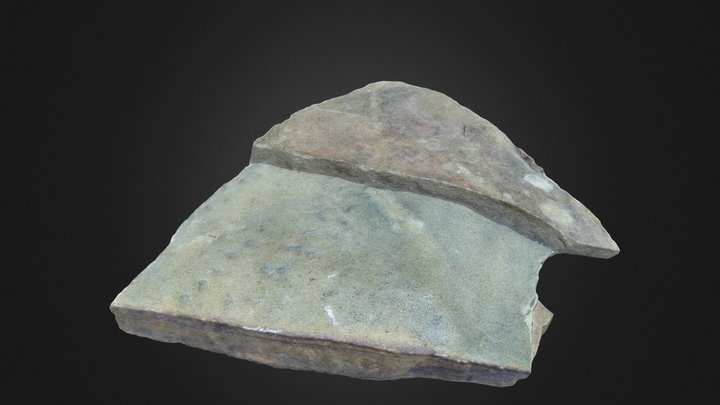
3D model
- Source
- Sketchfab
- Credit
- Jonathan Marcot
- Licence
- CC Attribution-NonCommercial
- Commercial use
- the licence does not allow it
Smithsonian Open Access was not reached for this taxon, so this list is what the others held rather than everything there is.
The description on this site
- Licence
- CC BY-SA 4.0
This is what the site found, which is not the same as what exists.
Keep going
What may have been alongside itIchnofossils through timeFormations of the CambrianThe world it lived on
Occurrence data from the Paleobiology Database, CC BY 4.0. Dawson 1873