Phycodes
Phykodes is a genus of moths in the family Brachodidae.

Thomas de Grey, 6th Baron Walsingham - in 1891 · Public Domain · via Wikipedia/Commons. May be a photograph of a specimen, or an artist’s reconstruction — an interpretation of a skeleton, since colour and soft tissue are almost never preserved.
On record
Recorded, not inferred- Sits inside
- IchnofossilsPBDB
Time the record covers
At least 404 million years on record.
The record covers at least 525.5 Mya to 121.4 Mya. No occurrence read is dated outside 538.8 Mya to 100.5 Mya.
18 occurrences of Phycodes on record, most of them in the Cambrian. Bar height is expected occurrences, not a count: each fossil is spread across the span it is dated to, so a tall narrow bar means tight dating and a low wide one means loose.
When
18 occurrencesThese are dates about fossils, not the animal: the record can only begin after it arose and end before it died out, so either end may reach further. Shares are expected occurrences: a fossil dated to a span is counted partly in each period it straddles. More on what this infers.
Found in
15 formations
- Pedroche Formation2
- Grebes Nest Point Formation · Wabana Group2
- Tal Formation1
- Kessyusa Formation1
- Wulongqing Formation1
- Ocieseki Sandstone Formation1
Loading coastlines…
The named rock units Phycodes has been recovered from, largest first. Drawn where the rock is now, not where it formed. 1 occurrence has no formation on record, which is common for older literature.
Phycodes and its relatives
CambrianWhere Phycodes and its relatives were recorded in the Cambrian.
Found in the same rock
198 taxa- Diplichnites5 sites
- Skolithos5 sites
- Cruziana3 sites
- Dimorphichnus3 sites
- Gordia3 sites
- Monocraterion3 sites
- Palaeophycus3 sites
- Planolites3 sites
- Planolites beverleyensis3 sites
- Planolites montanus3 sites
- Psammichnites3 sites
- Treptichnus pedum3 sites
- Bergaueria perata2 sites
- Bilinichnus2 sites
- Cochlichnus2 sites
- Cosmorhaphe2 sites
- Cylindrichnus concentricus2 sites
- Dactyloidites cabanasi2 sites
- Didymaulichnus lyelli2 sites
- Dimorphichnus obliquus2 sites
- Lemdadella2 sites
- Monomorphichnus2 sites
- Neonereites uniserialis2 sites
- Palaeophycus alternatus2 sites
The Paleobiology Database records 14 sites for Phycodes, and this reads all of them. The number is how many of those sites it was catalogued from too. The 24 sharing the most are listed.
This is not a list of everything alive at the time. It is only what has come out of the same ground as this animal and been written down.
Entered from
13 references- Ichnology of the Upper Cambrian? to Lower Ordovician Bell Island and Wabana groups of eastern Newfoundland, Canada5
- Trace and soft body fossils from the Pedroche Formation (Ovetian, Lower Cambrian of the Sierra de Córdoba, S Spain) and their relation to the Pedroche event2
- Fossil assemblage from the Khok Pha Suam locality of northeastern, Thailand: an overview of vertebrate diversity from the Early Cretaceous Khok Kruat Formation (Aptian-Albian)1
- Trilobites in early Cambrian tidal flats and the landward expansion of the Cambrian explosion1
- A diverse ichnofauna from the Cambrian Stage 4 Wulongqing Formation near Kunming (Yunnan Province, South China)1
- Im Reich der Meerengel. Der Nusplinger Plattenkalk und seine Fossilien1
- Arthrophycus in the Silurian of Alabama (USA) and the problem of compound trace fossils1
- The platyceratacean gastropod Cyclonema (Cyclonema) hiiumaa Teichert, 1928 from the Llandovery (Silurian) of Estonia1
- Integrated approaches to terminal Proterozoic stratigraphy: an example from the Olenek Uplift, northeastern Siberia1
- Trace fossils in the Lower Cambrian sequence in the Swietokrzyskie Mountains, Central Poland1
- Fauna and biogenic structures in Krol-Tal succession (Vendian-Early Cambrian), Lesser Himalaya: their biostratigraphic and palaeoecological significance1
- Trace fossils from the Nama Group (Precambrian-Cambrian) of southwest Africa (Namibia)1
Each of the 18 occurrences read was entered from one of these publications, ordered by how many each accounts for. This is not a search for papers mentioning the name. 1 further reference is not listed. Entries link to doi.org where the Paleobiology Database holds an identifier, and to its own record where it does not. Relayed as the Paleobiology Database holds them, not checked against what they resolve to.
Media and terms
Media content1
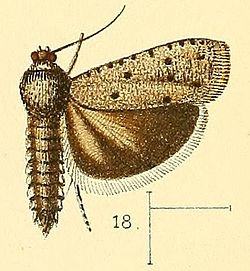
Picture of Phycodes
- Source
- Wikipedia/Commons
- Credit
- Thomas de Grey, 6th Baron Walsingham - in 1891
- Licence
- Public Domain
- Commercial use
- the licence allows it
No 3D scan was found. Smithsonian Open Access, MorphoSource and Sketchfab were all searched.
The description on this site
- Source
- Wikipedia, “Phykodes”
- Licence
- CC BY-SA 4.0
This is what the site found, which is not the same as what exists.
Keep going
What may have been alongside itIchnofossils through timeFormations of the CambrianThe world it lived on
Occurrence data from the Paleobiology Database, CC BY 4.0. Richter 1850