Orycteropus afer
The aardvark is a medium-sized, burrowing, nocturnal mammal native to Africa. The aardvark is the only living member of the genus Orycteropus, the family Orycteropodidae and the order Tubulidentata.

Kelly Abram · CC BY 4.0 · via Wikipedia/Commons. May be a photograph of a specimen, or an artist’s reconstruction — an interpretation of a skeleton, since colour and soft tissue are almost never preserved.
On record
Recorded, not inferred- Also called
- aardvarkPBDB
- Sits inside
- OrycteropusPBDB
- Diet
- insectivorePBDB, for Orycteropus
- Life habit
- semifossorialPBDB, for Orycteropus
- Motility
- actively mobilePBDB, for Osteichthyes
- Environment
- terrestrialPBDB, for Eutheria
- Mass
- 1.9 kgWikidata
Time the record covers
At least 2.5 million years on record.
The record covers at least 2.58 Mya to 11.7 ka. No occurrence read is dated outside 23.04 Mya to 0 Mya.
32 occurrences of Orycteropus afer on record, most of them in the Pleistocene. The Paleobiology Database records this as a living group. Bar height is expected occurrences, not a count: each fossil is spread across the span it is dated to, so a tall narrow bar means tight dating and a low wide one means loose.
When
32 occurrences- Miocene5%
- Pliocene4%
- Pleistocene62%
- Holocene28%
These are dates about fossils, not the animal: the record can only begin after it arose and end before it died out, so either end may reach further. Shares are expected occurrences: a fossil dated to a span is counted partly in each period it straddles. More on what this infers.
Found in
7 formations
- Swartkrans Formation · Transvaal Group2
- Varswater & Bredasdorp Formation1
- Varswater Formation1
- Kapthurin Formation1
- Nubia Formation1
- Makapansgat Formation1
Loading coastlines…
The named rock units Orycteropus afer has been recovered from, largest first. Drawn where the rock is now, not where it formed. 24 occurrences have no formation on record, which is common for older literature.
Orycteropus afer and its relatives
PleistoceneWhere Orycteropus afer and its relatives were recorded in the Pleistocene.
Found in the same rock
416 taxa- Phacochoerus aethiopicus17 sites
- Bovidae16 sites
- Panthera pardus15 sites
- Canis13 sites
- Hystrix africaeaustralis13 sites
- Panthera leo13 sites
- Raphicerus campestris13 sites
- Equus quagga burchelli12 sites
- Mammalia12 sites
- Taurotragus oryx12 sites
- Caracal caracal11 sites
- Lupulella mesomelas11 sites
- Mellivora capensis11 sites
- Potamochoerus porcus10 sites
- Tragelaphus strepsiceros10 sites
- Alcelaphus buselaphus9 sites
- Crocuta crocuta9 sites
- Felis lybica9 sites
- Suidae9 sites
- Sylvicapra grimmia9 sites
- Syncerus caffer9 sites
- Giraffa camelopardalis8 sites
- Hippopotamus amphibius8 sites
- Leporidae8 sites
The Paleobiology Database records 32 sites for Orycteropus afer, and this reads all of them. The number is how many of those sites it was catalogued from too. The 24 sharing the most are listed.
This is not a list of everything alive at the time. It is only what has come out of the same ground as this animal and been written down.
Entered from
21 references- Pleistocene aardvark ( Orycteropus afer ) burrow traces on South Africa’s Cape coast5
- Orycteropus (Tubulidentata, Mammalia) from Langebaanweg and Baard’s Quarry, Early Pliocene of South Africa3
- The Late Prehistory of the Eastern Sahel2
- Taphonomy, Paleoecology, and Hominids of Lainyamok, Kenya2
- The Prehistory of Stone Age Herders in the Cape Province of South Africa2
- Later Stone Age Faunal Samples from Heuningneskrans Shelter (Transvaal) and Leopard's Hill Cave (Zambia)2
- Paleoenvironmental and Cultural Implications of Late Holocene Archaeological Faunas from the Orange Free State and North Central Cape Province, South Africa2
- Macromammalian faunas, biochronology and palaeoecology of the early Pleistocene Main Quarry hominin-bearing deposits of the Drimolen Palaeocave System, South Africa1
- Mid-Pleistocene change in large mammal faunas of East Africa1
- The Swartkrans Palaeontological Research Project in perspective: results and conclusions1
- Late Pleisticene Humans Remains from the Sea Harvest Site, Saldanha Bay, South Africa1
- Proximal femur of Australopithecus africanus from Member 4, Makapansgat, South Africa1
Each of the 32 occurrences read was entered from one of these publications, ordered by how many each accounts for. This is not a search for papers mentioning the name. 9 further references are not listed. Entries link to doi.org where the Paleobiology Database holds an identifier, and to its own record where it does not. Relayed as the Paleobiology Database holds them, not checked against what they resolve to.
Media and terms
Media content3

Picture of Orycteropus afer
- Source
- Wikipedia/Commons
- Credit
- Kelly Abram
- Licence
- CC BY 4.0
- Commercial use
- the licence allows it
Structured light scan
- Source
- MorphoSource
- Credit
- AMNH Mammal Collections
- Licence
- not stated by the source
- Commercial use
- cannot be read from the licence given — check the record
- Specimen
- Orycteropus afer · amnh:mammals:51235
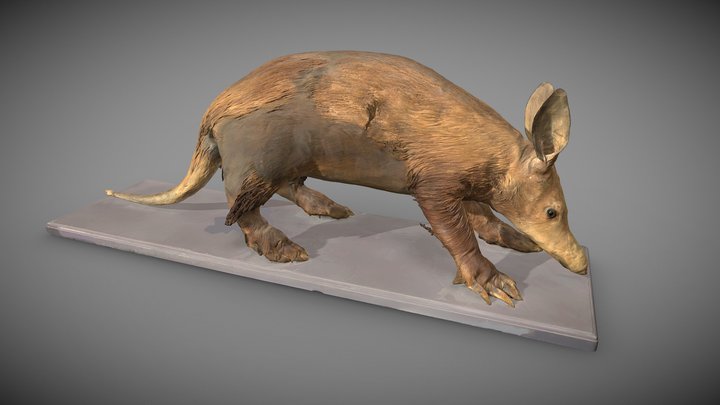
3D model
- Source
- Sketchfab
- Licence
- CC Attribution-NonCommercial-NoDerivs
- Commercial use
- the licence does not allow it
Smithsonian Open Access was not reached for this taxon, so this list is what the others held rather than everything there is.
The description on this site
- Source
- Wikipedia, “Aardvark”
- Licence
- CC BY-SA 4.0
This is what the site found, which is not the same as what exists.
Keep going
What may have been alongside itOrycteropus through timeFormations of the PleistoceneThe world it lived on
Occurrence data from the Paleobiology Database, CC BY 4.0. (Pallas 1766)