Taurotragus oryx
The common eland, also known as the southern eland or eland antelope, is a large savannah and plains antelope found in East and Southern Africa. An adult male is around 1.6 m (5.2 ft) tall at the shoulder and can weigh up to 942 kg (2,077 lb) with a typical range of 500–600 kg (1,100–1,300 lb). Females are around 1.4 m (4.6 ft) tall and weigh 340–445 kg (750–981 lb). It was scientifically described by Peter Simon Pallas in 1766.

Yathin S Krishnappa · CC BY-SA 4.0 · via Wikipedia/Commons. May be a photograph of a specimen, or an artist’s reconstruction — an interpretation of a skeleton, since colour and soft tissue are almost never preserved.
On record
Recorded, not inferred- Also called
- common elandPBDB
- Sits inside
- TaurotragusPBDB
- Diet
- grazer, browserPBDB, for Bovidae
- Life habit
- ground dwellingPBDB, for Bovidae
- Motility
- actively mobilePBDB, for Osteichthyes
- Environment
- terrestrialPBDB, for Artiodactyla
- Mass
- 30 kgWikidata
Time the record covers
At least 2.5 million years on record.
The record covers at least 2.58 Mya to 11.7 ka. No occurrence read is dated outside 5.333 Mya to 0 Mya.
57 occurrences of Taurotragus oryx on record, most of them in the Pleistocene. The Paleobiology Database records this as a living group. Bar height is expected occurrences, not a count: each fossil is spread across the span it is dated to, so a tall narrow bar means tight dating and a low wide one means loose.
When
57 occurrences- Pliocene3%
- Pleistocene72%
- Holocene25%
These are dates about fossils, not the animal: the record can only begin after it arose and end before it died out, so either end may reach further. Shares are expected occurrences: a fossil dated to a span is counted partly in each period it straddles. More on what this infers.
Found in
7 formations
- Swartkrans Formation · Transvaal Group4
- Mbuga Clays Formation1
- Sterkfontein Formation · Transvaal Group1
- Rietputs Formation1
- Kromdraai Formation1
- Makapansgat Formation1
Loading coastlines…
The named rock units Taurotragus oryx has been recovered from, largest first. Drawn where the rock is now, not where it formed. 47 occurrences have no formation on record, which is common for older literature.
Taurotragus oryx and its relatives
PleistoceneWhere Taurotragus oryx and its relatives were recorded in the Pleistocene.
Found in the same rock
386 taxa- Hystrix africaeaustralis30 sites
- Lupulella mesomelas30 sites
- Equus quagga burchelli27 sites
- Hippopotamus amphibius25 sites
- Phacochoerus aethiopicus24 sites
- Bovidae23 sites
- Panthera pardus23 sites
- Procavia capensis23 sites
- Syncerus caffer23 sites
- Alcelaphus buselaphus21 sites
- Connochaetes21 sites
- Raphicerus campestris21 sites
- Tragelaphus strepsiceros21 sites
- Equus capensis20 sites
- Felis lybica20 sites
- Mellivora capensis20 sites
- Panthera leo19 sites
- Redunca arundinum19 sites
- Papio ursinus18 sites
- Caracal caracal17 sites
- Oreotragus oreotragus17 sites
- Crocuta crocuta16 sites
- Mammalia16 sites
- Redunca fulvorufula16 sites
The Paleobiology Database records 56 sites for Taurotragus oryx, and this reads all of them. The number is how many of those sites it was catalogued from too. The 24 sharing the most are listed.
This is not a list of everything alive at the time. It is only what has come out of the same ground as this animal and been written down.
Entered from
43 references- Paleoenvironmental and Cultural Implications of Late Holocene Archaeological Faunas from the Orange Free State and North Central Cape Province, South Africa5
- Later Stone Age Faunal Samples from Heuningneskrans Shelter (Transvaal) and Leopard's Hill Cave (Zambia)3
- The Prehistory of Eastern Zambia3
- Taphonomy, Paleoecology, and Hominids of Lainyamok, Kenya2
- The Prehistory of Stone Age Herders in the Cape Province of South Africa2
- Faunal Evidence for Early Stockkeeping in the Central Rift Valley of Kenya: Preliminary Findings2
- Re-interpretation of the Swartkrans site and its remains2
- The Mammalian Fauna of the Klasies River Mouth Sites, Southern Cape Province, South Africa2
- Quaternary vertebrate fossil sites in the south-western Cape Province2
- Variables versus models of early Pleistocene hominid land use1
- Swartkrans: A Cave's Chronicle of Early Man1
- Late Pleisticene Humans Remains from the Sea Harvest Site, Saldanha Bay, South Africa1
Each of the 57 occurrences read was entered from one of these publications, ordered by how many each accounts for. This is not a search for papers mentioning the name. 31 further references are not listed. Entries link to doi.org where the Paleobiology Database holds an identifier, and to its own record where it does not. Relayed as the Paleobiology Database holds them, not checked against what they resolve to.
Media and terms
Media content2

Picture of Taurotragus oryx
- Source
- Wikipedia/Commons
- Credit
- Yathin S Krishnappa
- Licence
- CC BY-SA 4.0
- Commercial use
- the licence allows it
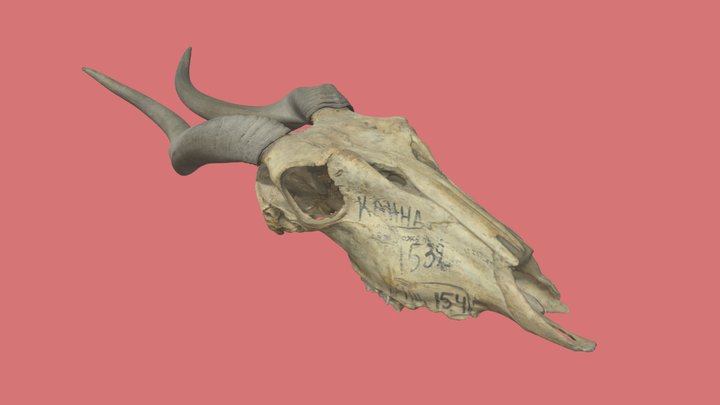
3D model
- Source
- Sketchfab
- Credit
- SchmalhausenEvolMorph
- Licence
- CC Attribution
- Commercial use
- cannot be read from the licence given — check the record
Smithsonian Open Access and MorphoSource were not reached for this taxon, so this list is what the others held rather than everything there is.
The description on this site
- Licence
- CC BY-SA 4.0
This is what the site found, which is not the same as what exists.
Keep going
What may have been alongside itTaurotragus through timeFormations of the PleistoceneThe world it lived on
Occurrence data from the Paleobiology Database, CC BY 4.0. (Pallas 1766)