Ophiuroidea
Searched as Ophiuroidea indet.. The Paleobiology Database treats Ophiuroidea as the accepted name.
Brittle stars, serpent stars, or ophiuroids are echinoderms in the class Ophiuroidea. They crawl across the sea floor using their flexible arms for locomotion. The ophiuroids generally have five long, slender, whip-like arms which may reach up to 60 cm (24 in) in length on the largest specimens.

Hans Hillewaert · CC BY-SA 4.0 · via Wikipedia/Commons. May be a photograph of a specimen, or an artist’s reconstruction — an interpretation of a skeleton, since colour and soft tissue are almost never preserved.
On record
Recorded, not inferred- Also called
- brittle starPBDB
- Sits inside
- AsterozoaPBDB
- Diet
- detritivore, suspension feederPBDB
- Life habit
- low-level epifaunalPBDB
- Motility
- slow-movingPBDB
- Vision
- blindPBDB
- Environment
- marinePBDB
Time the record covers
At least 452 million years on record.
The record covers at least 459.7 Mya to 7.246 Mya. No occurrence read is dated outside 468 Mya to 5.333 Mya.
165 occurrences of Ophiuroidea on record, most of them in the Carboniferous. The Paleobiology Database records this as a living group, and the chart stops with its fossils rather than at the present. Bar height is expected occurrences, not a count: each fossil is spread across the span it is dated to, so a tall narrow bar means tight dating and a low wide one means loose.
When
165 occurrences- Ordovician2%
- Silurian3%
- Devonian6%
- Carboniferous21%
- Early Triassic10%
- Middle Triassic6%
- Late Triassic7%
- Early Jurassic2%
- Middle Jurassic18%
- Late Jurassic4%
- Early Cretaceous6%
- Late Cretaceous5%
- Paleoceneunder 1%
- Eocene5%
- Oligocene1%
- Miocene1%
These are dates about fossils, not the animal: the record can only begin after it arose and end before it died out, so either end may reach further. Shares are expected occurrences: a fossil dated to a span is counted partly in each period it straddles. More on what this infers.
Found in
60 formations
- Bangor Limestone Formation27
- Szin Marl Formation8
- Cassian Formation7
- Lochkov Formation3
- Borden Formation2
- Traveston Formation2
Loading coastlines…
The named rock units Ophiuroidea has been recovered from, largest first. Drawn where the rock is now, not where it formed. 36 further formations hold fewer occurrences each and are not listed. 57 occurrences have no formation on record, which is common for older literature.
Ophiuroidea and its relatives
CarboniferousWhere Ophiuroidea and its relatives were recorded in the Carboniferous.
Found in the same rock
2,761 taxa- Echinoidea45 sites
- Fenestella35 sites
- Cornulites31 sites
- Cleiothyridina29 sites
- Fistulipora28 sites
- Pentremites27 sites
- Anthracospirifer leidyi26 sites
- Composita26 sites
- Dichocrinus26 sites
- Orthotetes26 sites
- Rhabdomeson25 sites
- Camptocrinus24 sites
- Spirorbis24 sites
- Aphelacrinus sp.23 sites
- Eumetria23 sites
- Productida23 sites
- Torynifer23 sites
- Archimedes22 sites
- Paladin22 sites
- Phanocrinus22 sites
- Ramulocrinus22 sites
- Tabulipora22 sites
- Bivalvia21 sites
- Crinoidea21 sites
The Paleobiology Database records 584 sites for Ophiuroidea, and this reads 240 of them. The number is how many of those sites it was catalogued from too. The 24 sharing the most are listed.
This is not a list of everything alive at the time. It is only what has come out of the same ground as this animal and been written down.
Entered from
77 references- Palaeoenvironmental interpretation of echinoderm assemblages from Bathonian ore-bearing clays at Gnaszyn (Kraków-Silesia Homocline, Poland)28
- The Paleontology and Paleoecology of the Lower Bangor Limestone (Chesterian, Mississippian)in northwestern Alabama27
- Environmental controls on the post-Permian recovery of benthic, tropical marine ecosystems in western Palaeotethys (Aggtelek Karst, Hungary)9
- Palaeoecology of tropical marine invertebrate assemblages from the Late Triassic of Misurina, Dolomites, Italy5
- Les Goniasteridae (Asteroidea, Echinodermata) jurassiques et crétacés de France. Taphonomie, systématique, biostratigraphie, paléobiogéographie, évolution.4
- Survey of echinoderms and a new ophiocistioid Branzoviella talpa gen. et sp. n. (Echinodermata, Ophiocistioidea) in the Lower Devonian, Lochkov Formation of the Barrandian area, Czech Republic3
- Recherches géologiques sur le Crétacé inférieur de l'Estremadura (Portugal)3
- Holothurien-Sklerite und Conodonten aus der Mittel- und Obertrias von Köveskál (Balatonhochland, Ungarn)3
- Ordovician edrioasteroids from Morocco: faunal exchanges across the Rheic Ocean2
- Late Cretaceous environments and communities as recorded at Chrtníky (Bohemian Cretaceous Basin, Czech Republic)2
- Early Triassic Ophiuroids: their paleoecology, taphonomy and distribution2
- Middle Triassic biostromes from the Liard Formation, British Columbia, Canada: oldest examples from the Mesozoic of NW Pangea2
Each of the 165 occurrences read was entered from one of these publications, ordered by how many each accounts for. This is not a search for papers mentioning the name. 65 further references are not listed. Entries link to doi.org where the Paleobiology Database holds an identifier, and to its own record where it does not. Relayed as the Paleobiology Database holds them, not checked against what they resolve to.
Media and terms
Media content2

Picture of Ophiuroidea
- Source
- Wikipedia/Commons
- Credit
- Hans Hillewaert
- Licence
- CC BY-SA 4.0
- Commercial use
- the licence allows it
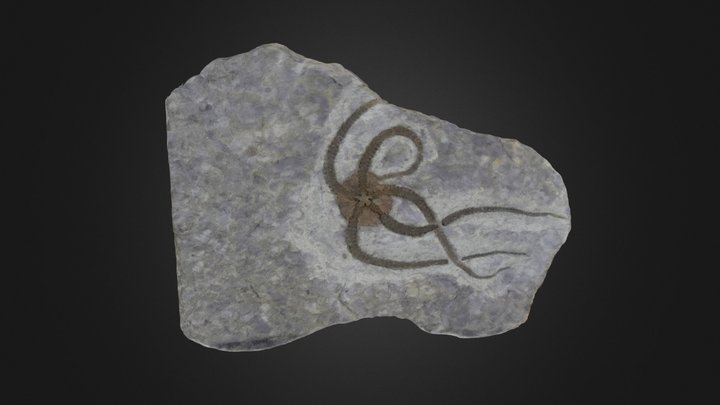
3D model
- Source
- Sketchfab
- Licence
- CC0 Public Domain
- Commercial use
- the licence allows it
Smithsonian Open Access and MorphoSource were not reached for this taxon, so this list is what the others held rather than everything there is.
The description on this site
- Licence
- CC BY-SA 4.0
This is what the site found, which is not the same as what exists.
Keep going
What may have been alongside itAsterozoa through timeFormations of the CarboniferousThe world it lived on
Occurrence data from the Paleobiology Database, CC BY 4.0. (Gray 1840)