Ophiuroidea
Brittle stars, serpent stars, or ophiuroids are echinoderms in the class Ophiuroidea. They crawl across the sea floor using their flexible arms for locomotion. The ophiuroids generally have five long, slender, whip-like arms which may reach up to 60 cm (24 in) in length on the largest specimens.

Hans Hillewaert · CC BY-SA 4.0 · via Wikipedia/Commons. May be a photograph of a specimen, or an artist’s reconstruction — an interpretation of a skeleton, since colour and soft tissue are almost never preserved.
On record
Recorded, not inferred- Also called
- brittle starPBDB
- Sits inside
- AsterozoaPBDB
- Diet
- detritivore, suspension feederPBDB
- Life habit
- low-level epifaunalPBDB
- Motility
- slow-movingPBDB
- Vision
- blindPBDB
- Environment
- marinePBDB
Time the record covers
At least 471 million years on record.
The record covers at least 471.3 Mya to 129 ka. No occurrence read is dated outside 477.1 Mya to 11.7 ka.
1,147 occurrences of Ophiuroidea on record, most of them in the Late Cretaceous. The Paleobiology Database records this as a living group. Bar height is expected occurrences, not a count: each fossil is spread across the span it is dated to, so a tall narrow bar means tight dating and a low wide one means loose.
When
1,147 occurrences- Ordovician3%
- Silurian2%
- Devonian11%
- Carboniferous5%
- Permian2%
- Early Triassic3%
- Middle Triassic5%
- Late Triassic4%
- Early Jurassic10%
- Middle Jurassic8%
- Late Jurassic8%
- Early Cretaceous4%
- Late Cretaceous29%
- Paleocene2%
- Eocene2%
- Oligoceneunder 1%
- Miocene2%
- Plioceneunder 1%
- Pleistoceneunder 1%
These are dates about fossils, not the animal: the record can only begin after it arose and end before it died out, so either end may reach further. Shares are expected occurrences: a fossil dated to a span is counted partly in each period it straddles. More on what this infers.
Found in
233 formations
- Gulpen Formation45
- White Chalk Formation38
- Maastricht Formation37
- Bangor Limestone Formation27
- Hunsrück Slate Formation18
- Bìlà Hora Formation17
Loading coastlines…
The named rock units Ophiuroidea has been recovered from, largest first. Drawn where the rock is now, not where it formed. 209 further formations hold fewer occurrences each and are not listed. 456 occurrences have no formation on record, which is common for older literature.
Ophiuroidea and its relatives
Late CretaceousWhere Ophiuroidea and its relatives were recorded in the Late Cretaceous.
Found in the same rock
2,761 taxa- Echinoidea45 sites
- Fenestella35 sites
- Cornulites31 sites
- Cleiothyridina29 sites
- Fistulipora28 sites
- Pentremites27 sites
- Anthracospirifer leidyi26 sites
- Composita26 sites
- Dichocrinus26 sites
- Orthotetes26 sites
- Rhabdomeson25 sites
- Camptocrinus24 sites
- Spirorbis24 sites
- Aphelacrinus sp.23 sites
- Eumetria23 sites
- Productida23 sites
- Torynifer23 sites
- Archimedes22 sites
- Paladin22 sites
- Phanocrinus22 sites
- Ramulocrinus22 sites
- Tabulipora22 sites
- Bivalvia21 sites
- Crinoidea21 sites
The Paleobiology Database records 584 sites for Ophiuroidea, and this reads 240 of them. The number is how many of those sites it was catalogued from too. The 24 sharing the most are listed.
This is not a list of everything alive at the time. It is only what has come out of the same ground as this animal and been written down.
Entered from
304 references- Late Cretaceous-Early Paleocene echinoderms and the K/T boundary in the southeast Netherlands and the northeast Belgium. - part 3: Ophiuroids165
- Campanian-Maastrichtian ophiuroids (Echinodermata) from Tercis les Bains (Landes, France)61
- Echinodermata aus dem Ober-Toarcium und Aalenium Deutschlands II: Ophiuroidea51
- Isolated sclerites of Devonian non−pelmatozoan echinoderms35
- Palaeoenvironmental interpretation of echinoderm assemblages from Bathonian ore-bearing clays at Gnaszyn (Kraków-Silesia Homocline, Poland)28
- The Paleontology and Paleoecology of the Lower Bangor Limestone (Chesterian, Mississippian)in northwestern Alabama27
- Ophiuroid remains from the nearshore environments of the Bohemian Cretaceous basin (Cenomanian - Turonian boundary interval). A preliminary report.26
- Die Ophiuren des englischen Jura22
- Pflanzen im Hunsrueckschiefer17
- Mikropaläontologische Untersuchungen an Ophiuren. V. Die Ophiuren aus dem Argovien (unteres Ober-Oxford) von Guldenthal (Kt. Solothurn) und von Savigna (Dépt. Jura)15
- Early Devonian echinoderms from South Africa14
- Mikropaläontologische Untersuchungen an Ophiuren II. Die Ophiuren aus dem Lias (Pliensbachien-Toarcien) von Seewen (Kt. Solothurn)14
Each of the 1,147 occurrences read was entered from one of these publications, ordered by how many each accounts for. This is not a search for papers mentioning the name. 292 further references are not listed. Entries link to doi.org where the Paleobiology Database holds an identifier, and to its own record where it does not. Relayed as the Paleobiology Database holds them, not checked against what they resolve to.
Media and terms
Media content2

Picture of Ophiuroidea
- Source
- Wikipedia/Commons
- Credit
- Hans Hillewaert
- Licence
- CC BY-SA 4.0
- Commercial use
- the licence allows it
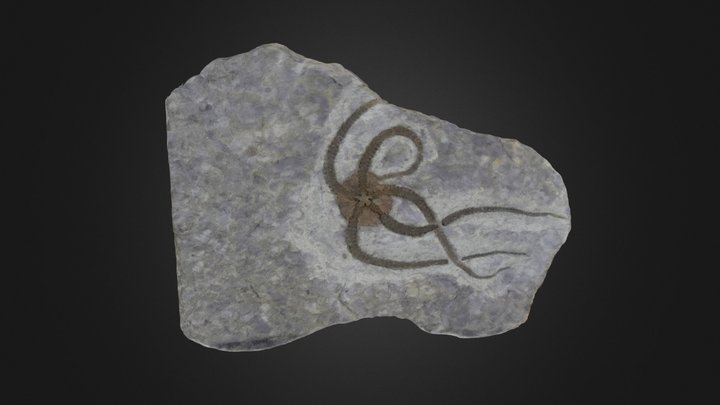
3D model
- Source
- Sketchfab
- Licence
- CC0 Public Domain
- Commercial use
- the licence allows it
Smithsonian Open Access and MorphoSource were not reached for this taxon, so this list is what the others held rather than everything there is.
The description on this site
- Licence
- CC BY-SA 4.0
This is what the site found, which is not the same as what exists.
Keep going
What may have been alongside itAsterozoa through timeFormations of the Late CretaceousThe world it lived on
Occurrence data from the Paleobiology Database, CC BY 4.0. (Gray 1840)