Nuculoidea
Nuculida is an order of small saltwater clams, marine bivalve mollusks, within the subclass Protobranchia. "Nuculida" is sometimes spelled "Nuculoida". This order contains a single superfamily, Nuculoidea, which encompasses two families, the extant Nuculidae and the extinct Praenuculidae. Clams in the family Nuculidae are commonly known as nut clams.

G.-U. Tolkiehn · CC BY-SA 3.0 · via Wikipedia/Commons. May be a photograph of a specimen, or an artist’s reconstruction — an interpretation of a skeleton, since colour and soft tissue are almost never preserved.
On record
Recorded, not inferred- Sits inside
- NuculidaPBDB
- Diet
- deposit feederPBDB
- Life habit
- infaunalPBDB
- Motility
- facultatively mobilePBDB
- Vision
- blindPBDB, for Bivalvia
Time the record covers
At least 477 million years on record.
The record covers at least 477.1 Mya to 11.7 ka. No occurrence read is dated outside 486.85 Mya to 0 Mya.
4,940 occurrences of Nuculoidea on record, most of them in the Late Cretaceous. The Paleobiology Database records this as a living group. Bar height is expected occurrences, not a count: each fossil is spread across the span it is dated to, so a tall narrow bar means tight dating and a low wide one means loose.
When
4,940 occurrences- Ordovician4%
- Silurianunder 1%
- Devonian7%
- Carboniferous7%
- Permian5%
- Early Triassicunder 1%
- Middle Triassic1%
- Late Triassic4%
- Early Jurassic3%
- Middle Jurassic8%
- Late Jurassic2%
- Early Cretaceous3%
- Late Cretaceous14%
- Paleocene4%
- Eocene11%
- Oligocene6%
- Miocene9%
- Pliocene4%
- Pleistocene4%
- Holoceneunder 1%
These are dates about fossils, not the animal: the record can only begin after it arose and end before it died out, so either end may reach further. Shares are expected occurrences: a fossil dated to a span is counted partly in each period it straddles. More on what this infers.
Found in
1005 formations
- Chari Formation175
- Providence Formation77
- Moscow Formation · Hamilton Group77
- Cassian Formation · Wegen Group60
- Moodys Branch Formation · Jackson Group58
- Graham Formation · Cisco Group56
Loading coastlines…
The named rock units Nuculoidea has been recovered from, largest first. Drawn where the rock is now, not where it formed. 981 further formations hold fewer occurrences each and are not listed. 769 occurrences have no formation on record, which is common for older literature.
Nuculoidea and its relatives
Late CretaceousWhere Nuculoidea and its relatives were recorded in the Late Cretaceous.
Found in the same rock
1,830 taxa- Nucula104 sites
- Nuculana77 sites
- Gastropoda64 sites
- Bivalvia43 sites
- Eburneopecten scintillatus41 sites
- Panopea37 sites
- Inoceramus33 sites
- Dentalium32 sites
- Tellinidae32 sites
- Modiolus31 sites
- Pycnodonte vesicularis31 sites
- Myrtaea (Myrtaea) curta30 sites
- Bryozoa28 sites
- Caestocorbula wailesiana28 sites
- Corbula densata28 sites
- Cyprimeria28 sites
- Hipponix28 sites
- Venericardia (Rotundicardia) diversidentata28 sites
- Crinoidea27 sites
- Lima27 sites
- Astarte26 sites
- Cadulus26 sites
- Alveinus minutus25 sites
- Cymbophora25 sites
The Paleobiology Database records at least 1,578 sites for Nuculoidea, and this reads 240 of them. The number is how many of those sites it was catalogued from too. The 24 sharing the most are listed.
This is not a list of everything alive at the time. It is only what has come out of the same ground as this animal and been written down.
Entered from
1,008 references- Unpublished data from Kachchh201
- Unpublished data on Cretaceous-Paleocene molluscan assemblages122
- Upper Cretaceous (Maestrichtian) Mollusca from the Haustator bilira Assemblage Zone in the East Gulf Coastal Plain90
- Resilience of marine invertebrate communities during the early Cenozoic hyperthermals74
- Upper Cretaceous (Maestrichtian) larger invertebrates from the Haustator bilira Assemblage Zone in the Atlantic Coastal Plain with further data for the East Gulf66
- Neogene and Paleogene Molluscan (Bivalvia) Cenozones of Sakhalin and Kurile Islands62
- Die Fauna des marinen Miozäns von Kevelaer (Niederrhein). Band 2 Bivalvia, Scaphopoda, Cephalopoda, Bryozoa, Annelida, Brachiopoda54
- Upper Cretaceous (Maestrichtian) larger invertebrate Fossils from the Haustator bilira Assemblage Zone in the west gulf Coastal Plain49
- The Dynamics of Rapid, Asynchronous Biotic Turnover in the Middle Devonian Appalachian Basin of New York46
- Marine Communities of a Portion of the Wewoka Formation (Pennsylvanian) in Hughes County, Oklahoma44
- Work with Thayer collections, Yale Peabody Accession 7112, published, in part, "New perspectives on transitions between ecological-evolutionary subunits in the "type interval" for coordinated stasis", James J Zambito IV, Carlton E Brett, Gordon C Baird, Sarah E Kolbe, Arnold I Miller; Paleobiology42
- Neogene and Paleogene Molluscan (Bivalvia) Cenozones of the Russian Northeast.42
Each of the 4,940 occurrences read was entered from one of these publications, ordered by how many each accounts for. This is not a search for papers mentioning the name. 996 further references are not listed. Entries link to doi.org where the Paleobiology Database holds an identifier, and to its own record where it does not. Relayed as the Paleobiology Database holds them, not checked against what they resolve to.
Media and terms
Media content1
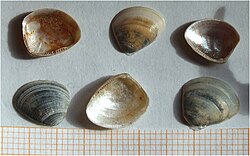
Picture of Nuculoidea
- Source
- Wikipedia/Commons
- Credit
- G.-U. Tolkiehn
- Licence
- CC BY-SA 3.0
- Commercial use
- the licence allows it
No 3D scan was found. Smithsonian Open Access, MorphoSource and Sketchfab were all searched.
The description on this site
- Source
- Wikipedia, “Nuculida”
- Licence
- CC BY-SA 4.0
This is what the site found, which is not the same as what exists.
Keep going
What may have been alongside itNuculida through timeFormations of the Late CretaceousThe world it lived on
Occurrence data from the Paleobiology Database, CC BY 4.0. Gray 1824