Muscardinus

Danielle Schwarz · CC BY-SA 3.0 · via Wikidata/Commons. May be a photograph of a specimen, or an artist’s reconstruction — an interpretation of a skeleton, since colour and soft tissue are almost never preserved.
On record
Recorded, not inferred- Sits inside
- GlirinaePBDB
- Diet
- herbivorePBDB, for Rodentia
- Life habit
- ground dwellingPBDB, for Rodentia
- Motility
- actively mobilePBDB, for Osteichthyes
- Environment
- terrestrialPBDB, for Eutheria
Time the record covers
At least 15 million years on record.
The record covers at least 15.98 Mya to 129 ka. No occurrence read is dated outside 23.04 Mya to 11.7 ka.
105 occurrences of Muscardinus on record, most of them in the Miocene. The Paleobiology Database records this as a living group. Bar height is expected occurrences, not a count: each fossil is spread across the span it is dated to, so a tall narrow bar means tight dating and a low wide one means loose.
When
105 occurrences- Miocene54%
- Pliocene17%
- Pleistocene29%
These are dates about fossils, not the animal: the record can only begin after it arose and end before it died out, so either end may reach further. Shares are expected occurrences: a fossil dated to a span is counted partly in each period it straddles. More on what this infers.
Found in
15 formations
- facies à Congeria Formation7
- Alfambra Formation3
- Ville Formation2
- Edelény Formation2
- Olesa-Les Fonts alluvial system Formation2
- Alcala Formation1
Loading coastlines…
The named rock units Muscardinus has been recovered from, largest first. Drawn where the rock is now, not where it formed. 79 occurrences have no formation on record, which is common for older literature.
Muscardinus and its relatives
MioceneWhere Muscardinus and its relatives were recorded in the Miocene.
Found in the same rock
1,375 taxa- Mimomys24 sites
- Chiroptera23 sites
- Lacerta23 sites
- Sciurus23 sites
- Apodemus21 sites
- Glis minor20 sites
- Petenyia hungarica20 sites
- Beremendia fissidens19 sites
- Prolagus19 sites
- Apodemus sylvaticus17 sites
- Ophisaurus17 sites
- Sorex minutus17 sites
- Spermophilinus bredai17 sites
- Talpa minor17 sites
- Colubrinae16 sites
- Pliomys16 sites
- Testudo16 sites
- Eliomys15 sites
- Myodes15 sites
- Talpa fossilis15 sites
- Allocricetus14 sites
- Eomuscardinus sansaniensis14 sites
- Rana14 sites
- Sorex14 sites
The Paleobiology Database records 95 sites for Muscardinus, and this reads all of them. The number is how many of those sites it was catalogued from too. The 24 sharing the most are listed.
This is not a list of everything alive at the time. It is only what has come out of the same ground as this animal and been written down.
Entered from
63 references- Late Messinian mollusks and vertebrates from Moncucco Torinese, north-western Italy. Paleoecological and paleoclimatological implications7
- Biochronology of the Pleistocene deposits at Betfia (Bihor, Romania)6
- Kleinsäugerstratigraphie in der miozänen Hörnlischüttung (Ostschweiz); (Biostratigraphy of small mammals in the Hörnlischüttung of Miocene age (East Switzerland))5
- Pleistocene vertebrate faunas of Hungary5
- The Pliocene and Pleistocene Gliridae (Mammalia, Rodentia) from Poland5
- Mittelpleistozane Saugetierfaunen aus Mitteleuropa - der Versuch einer biostratigraphischen Zuordnung4
- Neue Ergebnisse zur Stratigraphie der mittleren Serie der Oberen Süßwassermolasse Bayerns (New results on the stratigraphy of the middle series of upper Freshwater Molasse, Bavaria)3
- Decouvertes de faunes de micromammiferes dans les Pyrenees-Orientales (France) de l'Oligocene superieur au Miocene superieur; especes nouvelles et reflexion sur l'etalonnage des echelles continentale et marine. [New upper Oligocene to upper Miocene faunas of micromammals found in the Pyrenees-Orientales (France); new species of rodents and remarks about the calibration of marine and continental biochronological scales.]3
- Rodent faunas of the Mio-Pliocene continental sediments of the Teruel-Alfambra region, Spain3
- Can Pallars i Llobateres: A new hominoid-bearing locality from the late Miocene of the Vallès-Penedès Basin (NE Iberian Peninsula)2
- The micromammals of the Quaternary deposits from Cave A, Loutra Almopias (Pella, Northern Greece): Stratigraphy-Taphonomy-Paleoenvironment2
- Rodents, insectivores and chiropterans (Mammalia) from the late Aragonian of Can Missert (Middle Miocene, Vallès-Penedès Basin, Spain)2
Each of the 105 occurrences read was entered from one of these publications, ordered by how many each accounts for. This is not a search for papers mentioning the name. 51 further references are not listed. Entries link to doi.org where the Paleobiology Database holds an identifier, and to its own record where it does not. Relayed as the Paleobiology Database holds them, not checked against what they resolve to.
Media and terms
Media content3
Picture of Muscardinus
- Source
- Wikidata/Commons
- Credit
- Danielle Schwarz
- Licence
- CC BY-SA 3.0
- Commercial use
- the licence allows it
CT scan
- Source
- MorphoSource
- Licence
- not stated by the source
- Commercial use
- cannot be read from the licence given — check the record
- Specimen
- Muscardinus avellanarius · mnhn:zm:MO-1993-2973
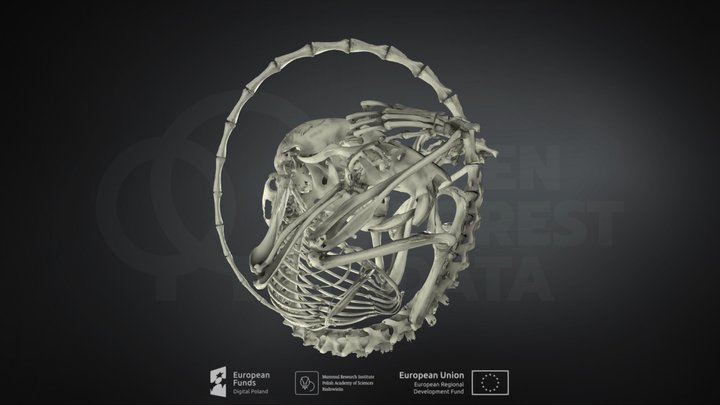
3D model
- Source
- Sketchfab
- Licence
- CC Attribution
- Commercial use
- cannot be read from the licence given — check the record
This is what the site found, which is not the same as what exists.
Keep going
What may have been alongside itGlirinae through timeFormations of the MioceneThe world it lived on
Occurrence data from the Paleobiology Database, CC BY 4.0. Kaup 1829