Mordellidae
The Mordellidae are a family of beetles commonly known as tumbling flower beetles for the typical irregular movements they make when escaping predators, or as pintail beetles due to their elongated abdominal tip. The adults feed on pollen of flowers. Worldwide, there are about 1500 species.

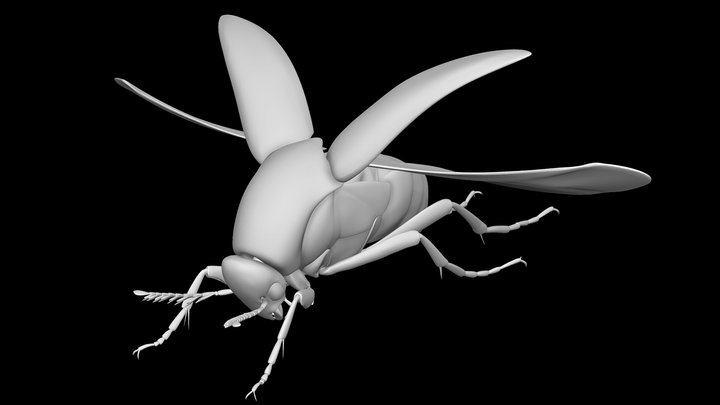
Didier Descouens · CC BY-SA 4.0 · via Wikipedia/Commons. May be a photograph of a specimen, or an artist’s reconstruction — an interpretation of a skeleton, since colour and soft tissue are almost never preserved.
On record
Recorded, not inferred- Also called
- tumbling flower beetlePBDB
- Sits inside
- TenebrionoideaPBDB
- Motility
- actively mobilePBDB, for Arthropoda
- Environment
- terrestrialPBDB, for Insecta
Time the record covers
At least 113 million years on record.
The record covers at least 113.2 Mya to 129 ka. No occurrence read is dated outside 119.57 Mya to 11.7 ka.
54 occurrences of Mordellidae on record, most of them in the Eocene. The Paleobiology Database records this as a living group. Bar height is expected occurrences, not a count: each fossil is spread across the span it is dated to, so a tall narrow bar means tight dating and a low wide one means loose.
When
54 occurrencesThese are dates about fossils, not the animal: the record can only begin after it arose and end before it died out, so either end may reach further. Shares are expected occurrences: a fossil dated to a span is counted partly in each period it straddles. More on what this infers.
Found in
9 formations
- Florissant Formation10
- Green River Formation2
- Rott Formation2
- Campagne-Calavon Formation1
- Escucha Formation1
- Olympia beds Formation1
Loading coastlines…
The named rock units Mordellidae has been recovered from, largest first. Drawn where the rock is now, not where it formed. 34 occurrences have no formation on record, which is common for older literature.
Mordellidae and its relatives
EoceneWhere Mordellidae and its relatives were recorded in the Eocene.
Found in the same rock
2,885 taxa- Coleoptera4 sites
- Stenus4 sites
- Berothidae3 sites
- Cheilotrichia (Empeda) pawlowskii3 sites
- Corneliola avia3 sites
- Dicranomyia (Dicranomyia) lobata3 sites
- Helius similis3 sites
- Mordellistena3 sites
- Mycetobia connexa3 sites
- Neolitochropus bedovoyi3 sites
- Podemacrochile baltica3 sites
- Prosphyracephala succini3 sites
- Sylvicola hoffeinsorum3 sites
- Tanytarsus serafini3 sites
- Tettigoniidae3 sites
- Acalyptratae2 sites
- Aleocharinae2 sites
- Aphodius2 sites
- Araneae2 sites
- Archistempellina falcifera2 sites
- Archistempellina perkovskyi2 sites
- Attagenus hoffeinsorum2 sites
- Bledius2 sites
- Brachycera2 sites
The Paleobiology Database records 23 sites for Mordellidae, and this reads all of them. The number is how many of those sites it was catalogued from too. The 24 sharing the most are listed.
This is not a list of everything alive at the time. It is only what has come out of the same ground as this animal and been written down.
Entered from
31 references- Diversity and morphology of Eocene and Oligocene Mordellidae (Coleoptera)9
- Mordelliden und Scraptiiden aus baltischem Bernstein7
- New Miocene Coleoptera from Florissant3
- Twenty new Coleoptera from the Florissant Shales3
- New family Apotomouridae fam. nov. (Coleoptera: Tenebrionoidea) from lower Cenomanian amber of Myanmar2
- A new species of tumbling fower beetle (Coleoptera: Mordellidae) from Baltic amber2
- Environmental interpretation of fossil insect assemblages from MIS 5 at Ziegler Reservoir, Snowmass Village, Colorado2
- Fossile Mordellidae und Lamellicornia (Coleoptera) aus dem Oberoligozan von Rott2
- Fossil Coleoptera from the Wilson Ranch near Florissant, Colorado2
- The paleoenvironment of the Olympia beds based on fossil beetles from Discovery Park, Seattle, Washington, U.S.A.1
- A new tribe, new genus, and new species of Mordellidae (Coleoptera: Tenebrionoidea) from the Early Cretaceous amber of Spain1
- A new species of tumbling flower beetles of the genus Mordellaria (Insecta: Coleoptera: Mordellidae) from the Baltic amber1
Each of the 54 occurrences read was entered from one of these publications, ordered by how many each accounts for. This is not a search for papers mentioning the name. 19 further references are not listed. Entries link to doi.org where the Paleobiology Database holds an identifier, and to its own record where it does not. Relayed as the Paleobiology Database holds them, not checked against what they resolve to.
Media and terms
Media content2

Picture of Mordellidae
- Source
- Wikipedia/Commons
- Credit
- Didier Descouens
- Licence
- CC BY-SA 4.0
- Commercial use
- the licence allows it
Smithsonian Open Access and MorphoSource were not reached for this taxon, so this list is what the others held rather than everything there is.
The description on this site
- Source
- Wikipedia, “Mordellidae”
- Licence
- CC BY-SA 4.0
This is what the site found, which is not the same as what exists.
Keep going
What may have been alongside itTenebrionoidea through timeFormations of the EoceneThe world it lived on
Occurrence data from the Paleobiology Database, CC BY 4.0. Latreille 1802