Acalyptratae
The Acalyptratae or Acalyptrata are a subsection of the Schizophora, which are a section of the order Diptera, the "true flies". In various contexts the Acalyptratae also are referred to informally as the acalyptrate muscoids, or acalyptrates, as opposed to the Calyptratae. All forms of the name refer to the lack of calypters in the members of this subsection of flies. An alternative name, Acalypterae is current, though in minority usage. It was first used by Pierre-Justin-Marie Macquart in 1835 for a section of his tribe Muscides; he used it to refer to all acalyptrates plus scathophagids and phorids, but excluding Conopidae.

Eric Guinther · CC BY-SA 3.0 · via Wikipedia/Commons. May be a photograph of a specimen, or an artist’s reconstruction — an interpretation of a skeleton, since colour and soft tissue are almost never preserved.
On record
Recorded, not inferred- Sits inside
- SchizophoraPBDB
- Motility
- actively mobilePBDB, for Arthropoda
- Environment
- terrestrialPBDB, for Insecta
Time the record covers
At least 113 million years on record.
The record covers at least 113.2 Mya to 11.7 ka. No occurrence read is dated outside 119.57 Mya to 0 Mya.
124 occurrences of Acalyptratae on record, most of them in the Eocene. The Paleobiology Database records this as a living group. Bar height is expected occurrences, not a count: each fossil is spread across the span it is dated to, so a tall narrow bar means tight dating and a low wide one means loose.
When
124 occurrences- Early Cretaceousunder 1%
- Eocene84%
- Oligocene7%
- Miocene4%
- Plioceneunder 1%
- Pleistoceneunder 1%
- Holocene3%
These are dates about fossils, not the animal: the record can only begin after it arose and end before it died out, so either end may reach further. Shares are expected occurrences: a fossil dated to a span is counted partly in each period it straddles. More on what this infers.
Found in
9 formations
- Bouldnor Formation · Solent Group3
- Rott Formation3
- Florissant Formation2
- Green River Formation1
- Australian Creek Formation1
- Salt Formation1
Loading coastlines…
The named rock units Acalyptratae has been recovered from, largest first. Drawn where the rock is now, not where it formed. 110 occurrences have no formation on record, which is common for older literature.
Acalyptratae and its relatives
EoceneWhere Acalyptratae and its relatives were recorded in the Eocene.
Found in the same rock
3,604 taxa- Prosphyracephala succini17 sites
- Gesomyrmex hoernesi12 sites
- Yantaromyrmex geinitzi12 sites
- Ctenobethylus goepperti10 sites
- Nylanderia pygmaea10 sites
- Prenolepis henschei10 sites
- Lasius schiefferdeckeri9 sites
- Formica flori8 sites
- Pachycondyla succinea8 sites
- Plagiolepis klinsmanni8 sites
- Plagiolepis kuenowi8 sites
- Tetraponera ocellata8 sites
- Tetraponera simplex8 sites
- Yantaromyrmex constrictus8 sites
- Archipseudophasmatidae7 sites
- Balticophasma7 sites
- Balticoroma serafinorum7 sites
- Plectrocnemia lata7 sites
- Yantaromyrmex samlandicus7 sites
- Bradoponera meieri6 sites
- Ceratopogon6 sites
- Dasyhelea6 sites
- Electroleria alacris6 sites
- Eocamponotus mengei6 sites
The Paleobiology Database records 55 sites for Acalyptratae, and this reads all of them. Of that, one read hit the database's own return limit, so every count below is a floor rather than a total. The number is how many of those sites it was catalogued from too. The 24 sharing the most are listed.
This is not a list of everything alive at the time. It is only what has come out of the same ground as this animal and been written down.
Entered from
49 references- Die Acalyptratae des Baltischen Bernsteins23
- Prosphyracephala kerneggeri spec. nov. – a new stalk-eyed fly from Baltic amber15
- New amber fossil Anthomyzidae (Diptera): an unexpected Eocene diversity11
- Clusiomitidae, a new family of Eocene fossil Acalyptratae, with revision of Acartophthalmites Hennig and Clusiomites gen. nov. (Diptera)7
- Contribution à la faune des Helomyzinae de l'ambre de la Baltique5
- Expanding diversity of Acalyptratae (Diptera) in the Eocene Baltic amber forest: new species of Acartophthalmites (Clusiomitidae) and Protanthomyza (Protanthomyzidae stat. nov.)4
- Description of a new species Eopseudopomyza szadziewskii sp. n. and redescription of E. kuehnei Hennig, 1971 from Eocene Baltic amber (Diptera: Pseudopomyzidae)4
- New records of the dipteran genera Triphleba (Phoridae) and Prosphyracephala (Diopsidae) in Rovno and Baltic ambers3
- Fossil flies in Baltic amber - insights in the diversity of Tertiary Acalyptratae (Diptera, Schizophora), with new morphological characters and a key based on 1,000 collected inclusions3
- Neue Dipteren (Brachycera et Cyclorhapha) aus dem Oberoligozän von Rott3
- Protanthomyza grimaldii sp. nov., a further member of the extinct subfamily Protanthomyzinae (Diptera, Anthomyzidae) from Baltic amber2
- A revision of the family Syringogastridae (Diptera: Diopsoidea)2
Each of the 124 occurrences read was entered from one of these publications, ordered by how many each accounts for. This is not a search for papers mentioning the name. 37 further references are not listed. Entries link to doi.org where the Paleobiology Database holds an identifier, and to its own record where it does not. Relayed as the Paleobiology Database holds them, not checked against what they resolve to.
Media and terms
Media content1
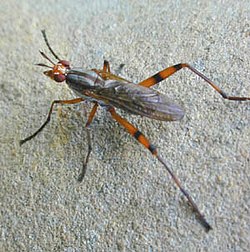
Picture of Acalyptratae
- Source
- Wikipedia/Commons
- Credit
- Eric Guinther
- Licence
- CC BY-SA 3.0
- Commercial use
- the licence allows it
No 3D scan of Acalyptratae was found in MorphoSource and Sketchfab.
Smithsonian Open Access was not reached for this taxon, so this list is what the others held rather than everything there is.
The description on this site
- Licence
- CC BY-SA 4.0
This is what the site found, which is not the same as what exists.
Keep going
What may have been alongside itSchizophora through timeFormations of the EoceneThe world it lived on
Occurrence data from the Paleobiology Database, CC BY 4.0. Macquart 1835