Megalosauroidea
Megalosauroidea is a superfamily of tetanuran theropod dinosaurs that lived from the Middle Jurassic to the Late Cretaceous period. The group is defined as Megalosaurus bucklandii and all taxa sharing a more recent common ancestor with it than with Allosaurus fragilis or Passer domesticus. Members of the group include Spinosaurus, Megalosaurus, and Torvosaurus. They are possibly paraphyletic in nature with respect to Allosauroidea, which is to say some members of this superfamily might be closer to Allosauroids than to each other, which is undesirable in cladistics.

Etemenanki3 · CC BY-SA 4.0 · via Wikipedia/Commons. May be a photograph of a specimen, or an artist’s reconstruction — an interpretation of a skeleton, since colour and soft tissue are almost never preserved.
On record
Recorded, not inferred- Sits inside
- TetanuraePBDB
- Diet
- carnivorePBDB, for Theropoda
- Life habit
- ground dwelling, solitaryPBDB, for Theropoda
- Motility
- actively mobilePBDB, for Theropoda
- Environment
- terrestrialPBDB, for Theropoda
Time the record covers
At least 129 million years on record.
The record covers at least 201.4 Mya to 72.2 Mya. No occurrence read is dated outside 205.7 Mya to 66 Mya.
310 occurrences of Megalosauroidea on record, most of them in the Early Cretaceous. Bar height is expected occurrences, not a count: each fossil is spread across the span it is dated to, so a tall narrow bar means tight dating and a low wide one means loose.
When
310 occurrences- Late Triassicunder 1%
- Early Jurassicunder 1%
- Middle Jurassic14%
- Late Jurassic19%
- Early Cretaceous50%
- Late Cretaceous17%
These are dates about fossils, not the animal: the record can only begin after it arose and end before it died out, so either end may reach further. Shares are expected occurrences: a fossil dated to a span is counted partly in each period it straddles. More on what this infers.
Found in
85 formations
- Morrison Formation16
- Sao Khua Formation · Khorat Group12
- Arcillas de Morella Formation12
- Lourinhã Formation11
- Ifezouane Formation · Kem Kem Group10
- Marnes de Dives Formation7
Loading coastlines…
The named rock units Megalosauroidea has been recovered from, largest first. Drawn where the rock is now, not where it formed. 61 further formations hold fewer occurrences each and are not listed. 60 occurrences have no formation on record, which is common for older literature.
Megalosauroidea and its relatives
Early CretaceousWhere Megalosauroidea and its relatives were recorded in the Early Cretaceous.
Found in the same rock
940 taxa- Theropoda59 sites
- Megalosaurus44 sites
- Spinosauridae44 sites
- Sauropoda35 sites
- Testudines34 sites
- Baryonychinae28 sites
- Crocodylia28 sites
- Lepidotes28 sites
- Iguanodon18 sites
- Spinosaurus aegyptiacus18 sites
- Pterosauria17 sites
- Dinosauria15 sites
- Goniopholis15 sites
- Ornithopoda15 sites
- Osteichthyes15 sites
- Dromaeosauridae14 sites
- Torvosaurus14 sites
- Camarasaurus12 sites
- Megalosauridae12 sites
- Bivalvia11 sites
- Coelurosauria11 sites
- Spinosaurus11 sites
- Testudinata11 sites
- Theriosuchus11 sites
The Paleobiology Database records 281 sites for Megalosauroidea, and this reads 240 of them. The number is how many of those sites it was catalogued from too. The 24 sharing the most are listed.
This is not a list of everything alive at the time. It is only what has come out of the same ground as this animal and been written down.
Entered from
195 references- The phylogeny of Tetanurae (Dinosauria: Theropoda)13
- Torvosaurus gurneyi n. sp., the largest terrestrial predator from Europe, and a proposed terminology of the maxilla anatomy in nonavian theropods7
- El Weald de Munilla (La Rioja) y sus icnitas de dinosaurios. (II) [The Wealden of Munilla (La Rioja) and its dinosaur footprints. (II)]7
- Lydekker, 18887
- El Weald de Igea (Cameros - La Rioja): sedimentologia, bioestratigrafia y paleoicnologia de grandes reptiles (Dinosaurios) [The Wealden of Igea (Cameros – La Rioja: sedimentology, biostratigraphy and paleoichnology of great reptiles (dinosaurs)]6
- Unbalanced food web in a Late Cretaceous dinosaur assemblage5
- An update of the spinosaurid (Dinosauria: Theropoda) fossil record from the Lower Cretaceous of the Iberian Peninsula: distribution, diversity, and evolutionary history4
- Juvenile spinosaurs (Theropoda: Spinosauridae) from the middle Cretaceous of Morocco and implications for spinosaur ecology4
- Calcium isotopes offer clues on resource partitioning among Cretaceous predatory dinosaurs4
- Semiaquatic adaptations in a giant predatory dinosaur4
- Dinosaurs and other fossil vertebrates from the Late Jurassic and Early Cretaceous of the Galve area, NE Spain4
- Benton and Spencer, 19954
Each of the 310 occurrences read was entered from one of these publications, ordered by how many each accounts for. This is not a search for papers mentioning the name. 183 further references are not listed. Entries link to doi.org where the Paleobiology Database holds an identifier, and to its own record where it does not. Relayed as the Paleobiology Database holds them, not checked against what they resolve to.
Media and terms
Media content1
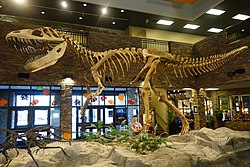
Picture of Megalosauroidea
- Source
- Wikipedia/Commons
- Credit
- Etemenanki3
- Licence
- CC BY-SA 4.0
- Commercial use
- the licence allows it
No 3D scan of Megalosauroidea was found in Sketchfab.
Smithsonian Open Access and MorphoSource were not reached for this taxon, so this list is what the others held rather than everything there is.
The description on this site
- Licence
- CC BY-SA 4.0
This is what the site found, which is not the same as what exists.
Keep going
What may have been alongside itTetanurae through timeFormations of the Early CretaceousThe world it lived on
Occurrence data from the Paleobiology Database, CC BY 4.0. (Nopcsa 1928)