Iguanodon
Iguanodon, named in 1825, is a genus of iguanodontian dinosaur. While many species found worldwide have been classified in the genus Iguanodon, dating from the Late Jurassic to Early Cretaceous, taxonomic revision in the early 21st century has defined Iguanodon to be based on at least one well-substantiated species: Iguanodon bernissartensis, which lived during the Barremian to early Aptian ages of the Early Cretaceous in Belgium, Germany, England, and Spain, between about 126 and 122 million years ago. Iguanodon was a large, bulky herbivore, measuring up to 9–11 metres (30–36 ft) in length and 4.5 metric tons in body mass. Distinctive features include large thumb spikes, which were possibly used for defense against predators, combined with long prehensile fifth fingers able to forage for food.

Ben2 · CC BY-SA 3.0 · via Wikipedia/Commons. May be a photograph of a specimen, or an artist’s reconstruction — an interpretation of a skeleton, since colour and soft tissue are almost never preserved.
On record
Recorded, not inferred- Sits inside
- AnkylopollexiaPBDB
- Diet
- herbivorePBDB, for Ornithopoda
- Life habit
- ground dwelling, gregariousPBDB, for Ornithischia
- Motility
- actively mobilePBDB, for Ornithischia
- Environment
- terrestrialPBDB, for Ornithischia
- Length
- 10 mWikidata
Time the record covers
At least 65 million years on record.
The record covers at least 149.2 Mya to 83.6 Mya. No occurrence read is dated outside 154.8 Mya to 66 Mya.
133 occurrences of Iguanodon on record, most of them in the Early Cretaceous. Bar height is expected occurrences, not a count: each fossil is spread across the span it is dated to, so a tall narrow bar means tight dating and a low wide one means loose.
When
133 occurrencesThese are dates about fossils, not the animal: the record can only begin after it arose and end before it died out, so either end may reach further. Shares are expected occurrences: a fossil dated to a span is counted partly in each period it straddles. More on what this infers.
Found in
28 formations
- Arcillas de Morella Formation16
- Weald Clay Formation · Wealden Group14
- Wessex Formation · Wealden Group13
- Tunbridge Wells Sand Formation · Wealden Group9
- Camarillas Formation9
- Ashdown Formation · Wealden Group6
Loading coastlines…
The named rock units Iguanodon has been recovered from, largest first. Drawn where the rock is now, not where it formed. 4 further formations hold fewer occurrences each and are not listed. 33 occurrences have no formation on record, which is common for older literature.
Iguanodon and its relatives
Early CretaceousWhere Iguanodon and its relatives were recorded in the Early Cretaceous.
Found in the same rock
392 taxa- Theropoda21 sites
- Sauropoda12 sites
- Crocodylia11 sites
- Goniopholis11 sites
- Baryonychinae10 sites
- Dinosauria9 sites
- Lepidotes9 sites
- Pterosauria8 sites
- Osteichthyes7 sites
- Testudines7 sites
- Hypsilophodontidae5 sites
- Mantellisaurus atherfieldensis5 sites
- Megalosaurus5 sites
- Ornithopoda5 sites
- Testudinata5 sites
- Bivalvia4 sites
- Euornithopoda4 sites
- Reptilia4 sites
- Scheenstia mantelli4 sites
- Titanosauriformes4 sites
- Anura3 sites
- Bernissartia3 sites
- Cyrena3 sites
- Dromaeosauridae3 sites
The Paleobiology Database records 124 sites for Iguanodon, and this reads all of them. The number is how many of those sites it was catalogued from too. The 24 sharing the most are listed.
This is not a list of everything alive at the time. It is only what has come out of the same ground as this animal and been written down.
Entered from
87 references- Los yacimientos de vertebrados de la Formación Arcillas de Morella (Aptiense inferior) [The vertebrate localities of the Arcillas Formation of Morella (lower Aptian)]8
- Perinates of a new species of Iguanodon (Ornithischia: Ornithopoda) from the lower Barremian of Galve (Teruel, Spain)4
- Dinosaurios (Saurischia, Ornithischia) en el Barremiense (Cretácico Inferior) de la península Ibérica [Dinosaurs (Saurischia, Ornithischia) in the Barremian (Lower Cretaceous) of the Iberian peninsula]4
- Woodward and Sherborn, 18904
- Lydekker, 18884
- Ornithopod dinosaurs3
- Geologia y Paleontologia (Dinosaurios) de las Capas rojas de Morella (Castellón, España) [Geology and paleontology (Dinosauria) of the Capas Rojas of Morella (Castellón, Spain)]3
- Icnitas de dinosaurios en Bretun (Soria) [Dinosaur footprints in Bretun (Soria)]3
- Blows, 19783
- On the footprint of an Iguanodon, lately found at Hastings3
- New fossils of the Iberian basal styracosternan Iguanodon galvensis: updating its systematics2
- Type, figured and cited specimens in the Museum of Isle of Wight Geology (Isle of Wight, England)2
Each of the 133 occurrences read was entered from one of these publications, ordered by how many each accounts for. This is not a search for papers mentioning the name. 75 further references are not listed. Entries link to doi.org where the Paleobiology Database holds an identifier, and to its own record where it does not. Relayed as the Paleobiology Database holds them, not checked against what they resolve to.
Media and terms
Media content3
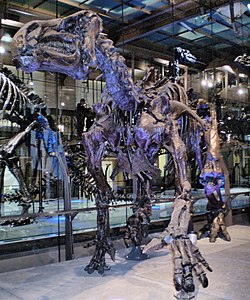
Picture of Iguanodon
- Source
- Wikipedia/Commons
- Credit
- Ben2
- Licence
- CC BY-SA 3.0
- Commercial use
- the licence allows it
Photogrammetry
- Source
- MorphoSource
- Licence
- In Copyright
- Commercial use
- cannot be read from the licence given — check the record
- Specimen
- Iguanodon bernissartensis · AMNH:FARB:6818
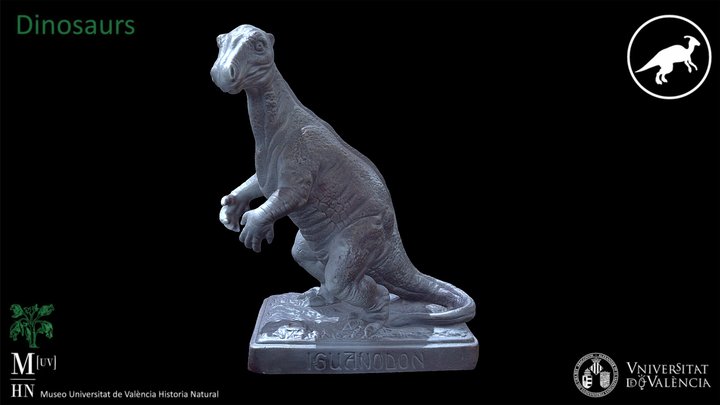
3D model
- Source
- Sketchfab
- Licence
- CC Attribution
- Commercial use
- cannot be read from the licence given — check the record
The description on this site
- Source
- Wikipedia, “Iguanodon”
- Licence
- CC BY-SA 4.0
This is what the site found, which is not the same as what exists.
Keep going
What may have been alongside itAnkylopollexia through timeFormations of the Early CretaceousThe world it lived on
Occurrence data from the Paleobiology Database, CC BY 4.0. Mantell 1825