Hypsilophodontidae
Hypsilophodontidae is a traditionally used family of ornithopod dinosaurs, generally considered invalid today. It historically included many small bodied bipedal neornithischian taxa from around the world, and spanning from the Middle Jurassic until the Late Cretaceous. This inclusive status was supported by some phylogenetic analyses from the 1990s and mid 2000s, although there have also been many finding that the family is an unnatural grouping which should only include the type genus, Hypsilophodon, with the other genera being within clades like Thescelosauridae and Elasmaria. A 2014 analysis by Norman recovered a grouping of Hypsilophodon, Rhabdodontidae and Tenontosaurus, which he referred to as Hypsilophodontia. That clade is formally defined in the PhyloCode as "the smallest clade within Ornithopoda containing Hypsilophodon foxii and Tenontosaurus tilletti provided it does not include Iguanodon bernissartensis". All other analyses from around the same time have instead found these latter taxa to be within Iguanodontia. The family Hypsilophodontidae is formally defined in the PhyloCode by Daniel Madzia and colleagues in 2021 as "the largest clade containing Hypsilophodon foxii, but not Iguanodon bernissartensis and Rhabdodon priscus".

No machine-readable author provided. Casliber assumed (based on copyright claims). · Public Domain · via Wikipedia/Commons. May be a photograph of a specimen, or an artist’s reconstruction — an interpretation of a skeleton, since colour and soft tissue are almost never preserved.
On record
Recorded, not inferred- Also called
- hypsilophodontidPBDB
- Sits inside
- OrnithopodaPBDB
- Diet
- herbivorePBDB, for Ornithopoda
- Life habit
- ground dwelling, gregariousPBDB, for Ornithischia
- Motility
- actively mobilePBDB, for Ornithischia
- Environment
- terrestrialPBDB, for Ornithischia
Time the record covers
At least 93 million years on record.
The record covers at least 165.3 Mya to 72.2 Mya. No occurrence read is dated outside 168.2 Mya to 66 Mya.
79 occurrences of Hypsilophodontidae on record, most of them in the Early Cretaceous. Bar height is expected occurrences, not a count: each fossil is spread across the span it is dated to, so a tall narrow bar means tight dating and a low wide one means loose.
When
79 occurrencesThese are dates about fossils, not the animal: the record can only begin after it arose and end before it died out, so either end may reach further. Shares are expected occurrences: a fossil dated to a span is counted partly in each period it straddles. More on what this infers.
Found in
44 formations
- Griman Creek Formation · Rolling Downs Group7
- Hell Creek Formation · Montana Group5
- Two Medicine Formation · Montana Group4
- Wessex Formation · Wealden Group3
- Cedar Mountain Formation · Dakota Group3
- Ilek Formation3
Loading coastlines…
The named rock units Hypsilophodontidae has been recovered from, largest first. Drawn where the rock is now, not where it formed. 20 further formations hold fewer occurrences each and are not listed. 8 occurrences have no formation on record, which is common for older literature.
Hypsilophodontidae and its relatives
Early CretaceousWhere Hypsilophodontidae and its relatives were recorded in the Early Cretaceous.
Found in the same rock
692 taxa- Theropoda30 sites
- Dromaeosauridae24 sites
- Crocodylia19 sites
- Testudines18 sites
- Lepidotes16 sites
- Osteichthyes13 sites
- Dinosauria12 sites
- Hadrosauridae12 sites
- Sauropoda11 sites
- Bivalvia10 sites
- Coelurosauria10 sites
- Ornithopoda10 sites
- Teleostei10 sites
- Anura9 sites
- Bernissartia9 sites
- Caudata9 sites
- Plesiosauria9 sites
- Pterosauria9 sites
- Testudinata9 sites
- Mammalia8 sites
- Squamata8 sites
- Tyrannosauridae8 sites
- Coniferophyta7 sites
- Crocodyliformes7 sites
The Paleobiology Database records 74 sites for Hypsilophodontidae, and this reads all of them. The number is how many of those sites it was catalogued from too. The 24 sharing the most are listed.
This is not a list of everything alive at the time. It is only what has come out of the same ground as this animal and been written down.
Entered from
61 references- Terrestrial and Freshwater Turtles of Early Cretaceous Australia7
- Fossil Vertebrate Collections5
- Restos directos de dinosaurios en Burgos (Sistema Ibérico): un balance provisional [Dinosaur bone remains of Burgos (Iberian System): a provisional evaluation]3
- Dinosaurs from the Early Cretaceous Ilek Formation in West Siberia, Russia3
- A multidisciplinary study of the Lower Cretaceous Cedar Mountain Formation, Mussentuchit Wash, Utah: a determination of the paleoenvironment and paleoecology of the Eolambia caroljonesa dinosaur quarry2
- Fossil Vertebrate Collections2
- Dinosaurios (Saurischia, Ornithischia) en el Barremiense (Cretácico Inferior) de la península Ibérica [Dinosaurs (Saurischia, Ornithischia) in the Barremian (Lower Cretaceous) of the Iberian peninsula]2
- Dinozavri severnoi Yevrazii: Novye dannye o sostave kompleksov, ekologii i paleobiogeografii [Dinosaurs of northern Eurasia: new data about assemblages, ecology, and paleobiogeography]2
- Depositional environments and taphonomy of the bone-bearing beds of the Lower Cretaceous Kuwajima Formation, Tetori Group, Japan1
- Dos yacimientos excepcionales con vertebrados continentales del Barremiense (Cretácico Inferior) de Teruel: Vallipón y La Cantalera [Two exceptional localities with continental vertebrates in the Barremian (Lower Cretaceous) of Teruel: Vallipón and La Cantalera]1
- Mesozoic continental vertebrates with associated palynostratigraphic dates from the northwestern Ethiopian plateau1
- A dinosaur fauna from the Late Cretaceous (Cenomanian) of northern Sudan1
Each of the 79 occurrences read was entered from one of these publications, ordered by how many each accounts for. This is not a search for papers mentioning the name. 49 further references are not listed. Entries link to doi.org where the Paleobiology Database holds an identifier, and to its own record where it does not. Relayed as the Paleobiology Database holds them, not checked against what they resolve to.
Media and terms
Media content1
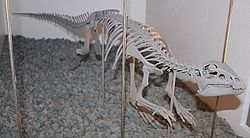
Picture of Hypsilophodontidae
- Source
- Wikipedia/Commons
- Credit
- No machine-readable author provided. Casliber assumed (based on copyright claims).
- Licence
- Public Domain
- Commercial use
- the licence allows it
No 3D scan of Hypsilophodontidae was found in MorphoSource and Sketchfab.
Smithsonian Open Access was not reached for this taxon, so this list is what the others held rather than everything there is.
The description on this site
- Licence
- CC BY-SA 4.0
This is what the site found, which is not the same as what exists.
Keep going
What may have been alongside itOrnithopoda through timeFormations of the Early CretaceousThe world it lived on
Occurrence data from the Paleobiology Database, CC BY 4.0. (Dollo 1882)