Coelurosauria
Coelurosauria from Greek κοῖλος + οὐρά + σαύρα + -ia, meaning "hollow-tailed lizards", is the clade containing all theropod dinosaurs more closely related to birds than to carnosaurs.

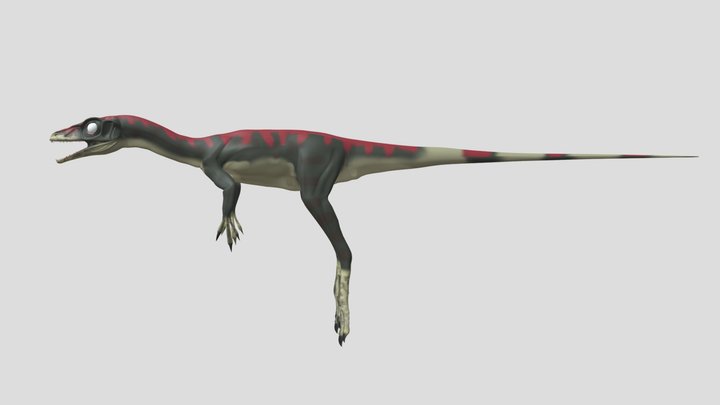
User:Zissoudisctrucker Sam / Olai Ose / Skjaervoy User:Daderot User:Vesta Wendy Kaveney User:Jolanta Dyr · CC BY-SA 4.0 · via Wikipedia/Commons. May be a photograph of a specimen, or an artist’s reconstruction — an interpretation of a skeleton, since colour and soft tissue are almost never preserved.
On record
Recorded, not inferred- Also called
- coelurosaurPBDB
- Sits inside
- TetanuraePBDB
- Diet
- carnivorePBDB
- Life habit
- ground dwelling, solitaryPBDB, for Theropoda
- Motility
- actively mobilePBDB, for Theropoda
- Environment
- terrestrialPBDB, for Theropoda
Time the record covers
At least 201 million years on record.
The record covers at least 201.4 Mya to 11.7 ka. No occurrence read is dated outside 237 Mya to 0 Mya.
12,000+ occurrences of Coelurosauria on record. The Paleobiology Database records this as a living group. Bar height is expected occurrences, not a count: each fossil is spread across the span it is dated to, so a tall narrow bar means tight dating and a low wide one means loose.
When
12,000 occurrences read- Late Triassicunder 1%
- Early Jurassicunder 1%
- Middle Jurassicunder 1%
- Late Jurassicunder 1%
- Early Cretaceous4%
- Late Cretaceous17%
- Paleoceneunder 1%
- Eocene4%
- Oligocene2%
- Miocene8%
- Pliocene5%
- Pleistocene38%
- Holocene21%
These are dates about fossils, not the animal: the record can only begin after it arose and end before it died out, so either end may reach further. Shares are expected occurrences: a fossil dated to a span is counted partly in each period it straddles. The read hit its cap, so every figure above is a floor and the shares are of the occurrences read. More on what this infers.
Found in
at least 730 formations
- Hell Creek Formation · Montana Group286
- Dinosaur Park Formation · Belly River Group213
- San Diego Formation155
- Oldman Formation · Belly River Group142
- Yorktown Formation · Chesapeake Group106
- Lance Formation · Montana Group102
Loading coastlines…
The named rock units Coelurosauria has been recovered from, largest first. Drawn where the rock is now, not where it formed. The read hit its cap, so each count is a floor. 706 further formations hold fewer occurrences each and are not listed. 6,939 occurrences have no formation on record, which is common for older literature.
Found in the same rock
2,998 taxa- Aves63 sites
- Bovidae49 sites
- Reptilia43 sites
- Mammalia42 sites
- Clarias32 sites
- Equus30 sites
- Gazella30 sites
- Amphibia26 sites
- Hipparion26 sites
- Alcelaphini25 sites
- Cercopithecidae25 sites
- Osteichthyes25 sites
- Alcelaphus buselaphus24 sites
- Canis24 sites
- Hyaenidae22 sites
- Struthio22 sites
- Tragelaphus22 sites
- Hippopotamus amphibius21 sites
- Suidae21 sites
- Giraffidae19 sites
- Struthio camelus19 sites
- Trionychidae19 sites
- Giraffa jumae18 sites
- Libytherium maurusium18 sites
The Paleobiology Database records at least 980 sites for Coelurosauria, and this reads 240 of them. The number is how many of those sites it was catalogued from too. The 24 sharing the most are listed.
This is not a list of everything alive at the time. It is only what has come out of the same ground as this animal and been written down.
Entered from
at least 2,258 references- The Quaternary avifauna of Crete, Greece261
- Avian community, climate, and sea-level changes in the Plio-Pleistocene of the Florida Peninsula203
- A remarkable fossil and archaeological avifauna from Marfells Beach, Lake Grassmere, South Island, New Zealand195
- A catalogue of British Pleistocene birds identified by Colin JO Harrison and stored in the Natural History Museum, London, (Department of Palaeontology)163
- Distribution and provenance of fossil avifauna on San Miguel Island162
- The prehistory of vertebrates, especially birds, on Tinian, Aguiguan, and Rota, Northern Mariana Islands157
- The fossil birds of Henderson Island, Pitcairn Group: natural turnover and human impact, a synopsis147
- Fossil birds of the San Diego Formation, Late Pliocene, Blancan, San Diego County, California131
- Late Pleistocene-Holocene non-passerine avifauna of Liang Bua (Flores, Indonesia)124
- Late-Pleistocene avifaunas from Cape Wanbrow, Otago, South Island, New Zealand115
- Miocene and Pliocene birds from the Lee Creek Mine, North Carolina114
- The paleogeographic and stratigraphic distribution of ceratopsids (Ornithischia) in the Upper Judith River Group of western Canada101
Each of the 12,000 occurrences read was entered from one of these publications, ordered by how many each accounts for. This is not a search for papers mentioning the name. That read hit its cap, so each count is a floor. 2,246 further references are not listed. Entries link to doi.org where the Paleobiology Database holds an identifier, and to its own record where it does not. Relayed as the Paleobiology Database holds them, not checked against what they resolve to.
Media and terms
Media content2

Picture of Coelurosauria
- Source
- Wikipedia/Commons
- Credit
- User:Zissoudisctrucker Sam / Olai Ose / Skjaervoy User:Daderot User:Vesta Wendy Kaveney User:Jolanta Dyr
- Licence
- CC BY-SA 4.0
- Commercial use
- the licence allows it
Smithsonian Open Access and MorphoSource were not reached for this taxon, so this list is what the others held rather than everything there is.
The description on this site
- Licence
- CC BY-SA 4.0
This is what the site found, which is not the same as what exists.
Keep going
What may have been alongside itTetanurae through timeThe world it lived on
Occurrence data from the Paleobiology Database, CC BY 4.0. (Huene 1914)