Amphibia
Amphibians are ectothermic, anamniotic, four-limbed vertebrate animals that constitute the class Amphibia. In its broadest sense, it is a paraphyletic group encompassing all tetrapods, but excluding the amniotes. All extant (living) amphibians belong to the monophyletic subclass Lissamphibia, with three living orders: Anura, Urodela (salamanders), and Gymnophiona (caecilians). Evolved to be mostly semiaquatic, amphibians have adapted to inhabit a wide variety of habitats, with most species living in freshwater, wetland or terrestrial ecosystems. Their life cycle typically starts out as aquatic larvae with gills known as tadpoles, but some species have developed behavioural adaptations to bypass this.

User:Froggydarb · CC BY-SA 3.0 · via Wikipedia/Commons. May be a photograph of a specimen, or an artist’s reconstruction — an interpretation of a skeleton, since colour and soft tissue are almost never preserved.
On record
Recorded, not inferred- Sits inside
- TetrapodaPBDB
- Motility
- actively mobilePBDB, for Osteichthyes
- Environment
- brackish,freshwater,terrestrialPBDB, for Tetrapoda
Time the record covers
At least 330 million years on record.
The record covers at least 330.3 Mya to 11.7 ka. No occurrence read is dated outside 358.86 Mya to 0 Mya.
6,317 occurrences of Amphibia on record, most of them in the Pleistocene. The Paleobiology Database records this as a living group. Bar height is expected occurrences, not a count: each fossil is spread across the span it is dated to, so a tall narrow bar means tight dating and a low wide one means loose.
When
6,317 occurrences- Carboniferous2%
- Permian10%
- Early Triassic8%
- Middle Triassic3%
- Late Triassic6%
- Early Jurassicunder 1%
- Middle Jurassic1%
- Late Jurassic1%
- Early Cretaceous3%
- Late Cretaceous19%
- Paleocene2%
- Eocene3%
- Oligocene2%
- Miocene12%
- Pliocene5%
- Pleistocene20%
- Holocene2%
These are dates about fossils, not the animal: the record can only begin after it arose and end before it died out, so either end may reach further. Shares are expected occurrences: a fossil dated to a span is counted partly in each period it straddles. More on what this infers.
Found in
724 formations
- Hell Creek Formation · Montana Group218
- Dinosaur Park Formation · Belly River Group133
- Chinle Formation131
- Alamosa Formation90
- Lance Formation88
- Oldman Formation · Belly River Group88
Loading coastlines…
The named rock units Amphibia has been recovered from, largest first. Drawn where the rock is now, not where it formed. 700 further formations hold fewer occurrences each and are not listed. 2,019 occurrences have no formation on record, which is common for older literature.
Amphibia and its relatives
PleistoceneWhere Amphibia and its relatives were recorded in the Pleistocene.
Found in the same rock
2,897 taxa- Rana40 sites
- Eryops38 sites
- Ambystoma tigrinum37 sites
- Reptilia27 sites
- Aves26 sites
- Anura25 sites
- Dimetrodon23 sites
- Diadectes20 sites
- Geomys20 sites
- Mammalia20 sites
- Osteichthyes20 sites
- Equus19 sites
- Thamnophis19 sites
- Trimerorhachis17 sites
- Bufo16 sites
- Lepisosteus16 sites
- Theropoda16 sites
- Bovidae15 sites
- Ophiacodon15 sites
- Spea bombifrons15 sites
- Trionychidae15 sites
- Equidae13 sites
- Canidae12 sites
- Clarias12 sites
The Paleobiology Database records at least 982 sites for Amphibia, and this reads 240 of them. The number is how many of those sites it was catalogued from too. The 24 sharing the most are listed.
This is not a list of everything alive at the time. It is only what has come out of the same ground as this animal and been written down.
Entered from
1,652 references- Pleistocene Amphibians and Reptiles in Britain and Europe350
- Tetrapod localities from the Triassic of the SE of European Russia205
- Mesozoic and Palaeocene lissamphibian assemblages of North America: a comprehensive review172
- Handbook of Paleoherpetology Part 3A2 Temnospondyli I106
- Middle Pleistocene (late Irvingtonian: Nebraskan) climatic changes in south-central Colorado86
- Late Triassic (Carnian and Norian) Tetrapods from the Southwestern United States79
- Albanerpetontid amphibians from the Upper Cretaceous (Campanian and Maastrichtian) of North America73
- Fossil Vertebrate Collections72
- Vertebrate faunal horizons in the Texas Permo-Carboniferous red beds70
- Vertebrate microsite assemblages (exclusive of mammals) from the Foremost and Oldman Formations of the Judith River Group (Campanian) of southeastern Alberta: an illustrated guide69
- Paleontology of the Judith River Formation (Campanian) of Dinosaur National Park, Alberta, Canada: evidence from vertebrate microfossil locality55
- Pleistocene vertebrate faunas of Hungary53
Each of the 6,317 occurrences read was entered from one of these publications, ordered by how many each accounts for. This is not a search for papers mentioning the name. 1,640 further references are not listed. Entries link to doi.org where the Paleobiology Database holds an identifier, and to its own record where it does not. Relayed as the Paleobiology Database holds them, not checked against what they resolve to.
Media and terms
Media content2
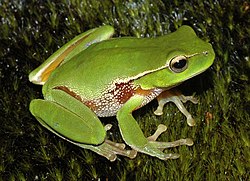
Picture of Amphibia
- Source
- Wikipedia/Commons
- Credit
- User:Froggydarb
- Licence
- CC BY-SA 3.0
- Commercial use
- the licence allows it
Photogrammetry
- Source
- MorphoSource
- Licence
- not stated by the source
- Commercial use
- cannot be read from the licence given — check the record
- Specimen
- amphibia indet. · MST:PALEO:MST-SP-13005
The description on this site
- Source
- Wikipedia, “Amphibian”
- Licence
- CC BY-SA 4.0
This is what the site found, which is not the same as what exists.
Keep going
Everything alive alongside itTetrapoda through timeFormations of the PleistoceneThe world it lived on
Occurrence data from the Paleobiology Database, CC BY 4.0. (Linnaeus 1758)