Iguanodontidae

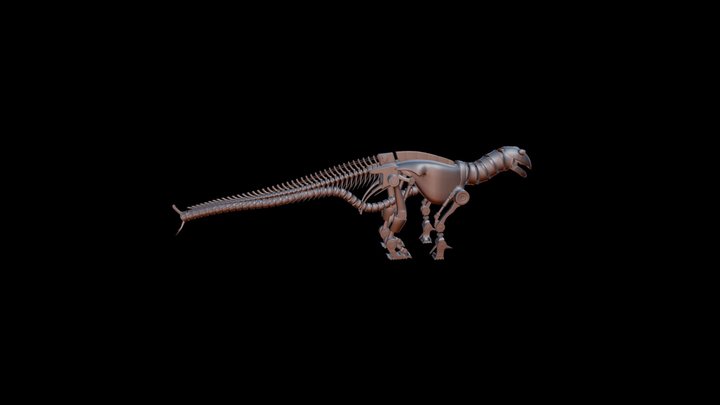
Uncredited · via Wikidata/Commons. May be a photograph of a specimen, or an artist’s reconstruction — an interpretation of a skeleton, since colour and soft tissue are almost never preserved.
On record
Recorded, not inferred- Also called
- iguanodontidPBDB
- Sits inside
- NeoiguanodontiaPBDB
- Diet
- herbivorePBDB, for Ornithopoda
- Life habit
- ground dwelling, gregariousPBDB, for Ornithischia
- Motility
- actively mobilePBDB, for Ornithischia
- Environment
- terrestrialPBDB, for Ornithischia
Time the record covers
At least 102 million years on record.
The record covers at least 174.7 Mya to 72.2 Mya. No occurrence read is dated outside 201.4 Mya to 61.66 Mya.
133 occurrences of Iguanodontidae on record, most of them in the Early Cretaceous. Bar height is expected occurrences, not a count: each fossil is spread across the span it is dated to, so a tall narrow bar means tight dating and a low wide one means loose.
When
133 occurrences- Early Jurassicunder 1%
- Late Jurassic5%
- Early Cretaceous86%
- Late Cretaceous8%
- Paleoceneunder 1%
These are dates about fossils, not the animal: the record can only begin after it arose and end before it died out, so either end may reach further. Shares are expected occurrences: a fossil dated to a span is counted partly in each period it straddles. More on what this infers.
Found in
61 formations
- Durlston Formation · Purbeck Group12
- Cedar Mountain Formation · Dakota Group7
- Ashdown Formation · Wealden Group7
- Wessex Formation · Wealden Group5
- Sousa Formation · Rio do Peixe Group5
- Kuwajima Formation · Tetori Group3
Loading coastlines…
The named rock units Iguanodontidae has been recovered from, largest first. Drawn where the rock is now, not where it formed. 37 further formations hold fewer occurrences each and are not listed. 24 occurrences have no formation on record, which is common for older literature.
Iguanodontidae and its relatives
Early CretaceousWhere Iguanodontidae and its relatives were recorded in the Early Cretaceous.
Found in the same rock
331 taxa- Theropoda36 sites
- Sauropoda18 sites
- Ornithopoda13 sites
- Dinosauria9 sites
- Dromaeosauridae9 sites
- Sinamia7 sites
- Testudines7 sites
- Carnosauria6 sites
- Viviparus6 sites
- Bivalvia5 sites
- Coelurosauria5 sites
- Lepidotes5 sites
- Ostracoda5 sites
- Squamata5 sites
- Unio5 sites
- Anura4 sites
- Barilium dawsoni4 sites
- Crocodylia4 sites
- Gastropoda4 sites
- Hypsilophodontidae4 sites
- Pterosauria4 sites
- Allosauroidea3 sites
- Ankylosauria3 sites
- Choristodera3 sites
The Paleobiology Database records 132 sites for Iguanodontidae, and this reads all of them. The number is how many of those sites it was catalogued from too. The 24 sharing the most are listed.
This is not a list of everything alive at the time. It is only what has come out of the same ground as this animal and been written down.
Entered from
82 references- Annotated localities of ornithopod dinosaurs: implications to Mesozoic paleobiogeography7
- History and bibliography of the study of fossil vertebrate footprints in the British Isles: supplement 1973–19836
- A short history of the discovery of reptilian footprints in the Purbeck Beds of Dorset, with notes on their stratigraphical distribution6
- Terminally resorbed iguanodontid teeth from the Neocomian Tetori Group, Ishikawa and Gifu Prefecture, Japan4
- Annotated Atlas of South America Tetrapod Footprints (Devonian to Holocene) with an Appendix on Mexico and Central America.4
- Worbarrow Bay footprints4
- Nuevas aportaciones al registro paleoicnológico en Cabezón de Cameros (La Rioja. España) [New contributions to the paleoichnological registry in Cabezón de Cameros (La Rioja. Spain)]3
- Restos directos de dinosaurios en Burgos (Sistema Ibérico): un balance provisional [Dinosaur bone remains of Burgos (Iberian System): a provisional evaluation]3
- Dinosaurios (Saurischia, Ornithischia) en el Barremiense (Cretácico Inferior) de la península Ibérica [Dinosaurs (Saurischia, Ornithischia) in the Barremian (Lower Cretaceous) of the Iberian peninsula]3
- Registro de dinosaurios en el sureste de la provincia de Burgos [Register of dinosaurs in the southeast of Burgos province]3
- Stratigraphy, palaeontology and palaeoenvironment of the Wessex Formation (Wealden Group, Lower Cretaceous) at Yaverland, Isle of Wight, southern England3
- Dinosaur footprints in the Wealden at Fairlight, East Sussex3
Each of the 133 occurrences read was entered from one of these publications, ordered by how many each accounts for. This is not a search for papers mentioning the name. 70 further references are not listed. Entries link to doi.org where the Paleobiology Database holds an identifier, and to its own record where it does not. Relayed as the Paleobiology Database holds them, not checked against what they resolve to.
Media and terms
Media content2
Picture of Iguanodontidae
- Source
- Wikidata/Commons
- Credit
- nobody named on the record
- Licence
- not stated by the source
- Commercial use
- cannot be read from the licence given — check the record
Smithsonian Open Access was not reached for this taxon, so this list is what the others held rather than everything there is.
This is what the site found, which is not the same as what exists.
Keep going
What may have been alongside itNeoiguanodontia through timeFormations of the Early CretaceousThe world it lived on
Occurrence data from the Paleobiology Database, CC BY 4.0. (Bonaparte 1850)