Hyolithida
Hyolithida is an extinct order of lophotrochozoans, one of the two of hyoliths, the other being the Orthothecida. Most information on the hyolithids comes from studies on the Hyolitha. Both orders had an operculum that was not hinged to the conch. However, the Hyolithida are distinct from the Orthothecida in having additional paired, curved, tusk-like appendages. The Hyolithida were probably bottom feeders living in shallow water, and had tentacles.

Mark A. Wilson (Department of Geology, The College of Wooster) [1] · Public Domain · via Wikipedia/Commons. May be a photograph of a specimen, or an artist’s reconstruction — an interpretation of a skeleton, since colour and soft tissue are almost never preserved.
On record
Recorded, not inferred- Sits inside
- HyolithaPBDB
- Diet
- suspension feederPBDB
- Life habit
- epifaunalPBDB
- Motility
- facultatively mobilePBDB
- Vision
- blindPBDB, for Hyolitha
- Environment
- marinePBDB, for Hyolitha
Time the record covers
At least 278 million years on record.
The record covers at least 538.8 Mya to 259.857 Mya. No occurrence read is dated outside 635 Mya to 254.14 Mya.
887 occurrences of Hyolithida on record, most of them in the Cambrian. Bar height is expected occurrences, not a count: each fossil is spread across the span it is dated to, so a tall narrow bar means tight dating and a low wide one means loose.
When
887 occurrences- Cambrian68%
- Ordovician18%
- Silurian5%
- Devonian7%
- Carboniferous1%
- Permianunder 1%
These are dates about fossils, not the animal: the record can only begin after it arose and end before it died out, so either end may reach further. Shares are expected occurrences: a fossil dated to a span is counted partly in each period it straddles. More on what this infers.
Found in
257 formations
- Parara Formation54
- Parara Limestone Formation35
- Tannenknock Formation26
- Bastion Formation24
- Burgess Shale Formation · Chancellor Group24
- Gowers Formation18
Loading coastlines…
The named rock units Hyolithida has been recovered from, largest first. Drawn where the rock is now, not where it formed. 233 further formations hold fewer occurrences each and are not listed. 28 occurrences have no formation on record, which is common for older literature.
Hyolithida and its relatives
CambrianWhere Hyolithida and its relatives were recorded in the Cambrian.
Found in the same rock
2,719 taxa- Hyolithes149 sites
- Nuculites40 sites
- Crinoidea37 sites
- Lingulella36 sites
- Lingula29 sites
- Gastropoda27 sites
- Brachiopoda26 sites
- Trilobita25 sites
- Ctenodonta22 sites
- Tentaculites22 sites
- Palaeoneilo21 sites
- Micromitra20 sites
- Bivalvia19 sites
- Michelinoceras19 sites
- Orthoceras18 sites
- Conularia17 sites
- Craniops16 sites
- Serpulites16 sites
- Chancelloria15 sites
- Nautiloidea15 sites
- Orbiculoidea15 sites
- Paterina15 sites
- Microsphaeridiorhynchia nucula14 sites
- Praenucula14 sites
The Paleobiology Database records 589 sites for Hyolithida, and this reads 240 of them. The number is how many of those sites it was catalogued from too. The 24 sharing the most are listed.
This is not a list of everything alive at the time. It is only what has come out of the same ground as this animal and been written down.
Entered from
265 references- The Cambrian biostratigraphy of the Stansbury Basin, South Australia85
- Early Cambrian fossils from South Australia38
- The biostratigraphy of the Ordovician of Bohemia38
- Biostratigraphic potential of Middle Cambrian hyoliths from the eastern Georgina Basin30
- Helcionelloids, stenothecoids and hyoliths from the Tannenknock Formation (traditional lower middle Stage 4/Wuliuan boundary interval) of the Franconian Forest, Germany26
- Paleoecology of the Greater Phyllopod Bed community, Burgess Shale23
- Hyoliths and small shelly fossils from the Lower Cambrian of North−East Greenland21
- Preliminary catalogue and report on the biostratigraphy and palaeogeographic distribution of the Bokkeveld fauna16
- Shelly fossils from the Early Cambrian (Toyonian) Wirrealpa, Arrona Creek, and Ramsay Limestones of South Australia14
- Faunas from the Upper Silurian (Upper Ludlovian) in the Ludlow-Much Wenlock District, England14
- The Lower Palaeozoic fossils of the Northern Shan States, Burma. With a section of Ordovician cystidea by F. A. Bather [q.v.]12
- Ordovician and Silurian hyoliths and gastropods reassigned from the Hyolitha from the Girvan District, Scotland11
Each of the 887 occurrences read was entered from one of these publications, ordered by how many each accounts for. This is not a search for papers mentioning the name. 253 further references are not listed. Entries link to doi.org where the Paleobiology Database holds an identifier, and to its own record where it does not. Relayed as the Paleobiology Database holds them, not checked against what they resolve to.
Media and terms
Media content1
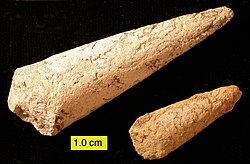
Picture of Hyolithida
- Source
- Wikipedia/Commons
- Credit
- Mark A. Wilson (Department of Geology, The College of Wooster) [1]
- Licence
- Public Domain
- Commercial use
- the licence allows it
No 3D scan of Hyolithida was found in Sketchfab.
Smithsonian Open Access and MorphoSource were not reached for this taxon, so this list is what the others held rather than everything there is.
The description on this site
- Source
- Wikipedia, “Hyolithida”
- Licence
- CC BY-SA 4.0
This is what the site found, which is not the same as what exists.
Keep going
What may have been alongside itHyolitha through timeFormations of the CambrianThe world it lived on
Occurrence data from the Paleobiology Database, CC BY 4.0. Mathew 1962