Hydrochoerinae
Hydrochoerinae is a subfamily of Caviidae, consisting of two living genera, Hydrochoerus, the capybaras, and Kerodon, the rock cavies. In addition, a number of extinct genera related to capybaras should also be placed in this subfamily. The taxonomy of Hydrochoerinae is confused because, until 2005, living capybaras and their extinct relatives were placed in their own family, Hydrochoeridae. Recent molecular phylogenetic studies recognize a close relationship between Hydrochoerus and Kerodon, supporting placement of both genera in a subfamily of Caviidae. The taxonomy of fossil hydrochoerines is in a state of flux. In recent years, the diversity of fossil hydrochoerines has been substantially reduced. This is largely due to the recognition that capybara molar teeth show strong variation in shape over the life of an individual. In one instance, material once referred to four genera and seven species on the basis of differences in molar shape is now thought to represent differently aged individuals of a single species, Cardiatherium paranense.

Adrian Pingstone · Public Domain · via Wikipedia/Commons. May be a photograph of a specimen, or an artist’s reconstruction — an interpretation of a skeleton, since colour and soft tissue are almost never preserved.
On record
Recorded, not inferred- Sits inside
- CaviidaePBDB
- Diet
- herbivorePBDB, for Caviidae
- Life habit
- ground dwellingPBDB, for Caviidae
- Motility
- actively mobilePBDB, for Osteichthyes
- Environment
- terrestrialPBDB, for Eutheria
Time the record covers
At least 7.9 million years on record.
The record covers at least 8 Mya to 11.7 ka. No occurrence read is dated outside 11.63 Mya to 0 Mya.
165 occurrences of Hydrochoerinae on record, most of them in the Pleistocene. The Paleobiology Database records this as a living group. Bar height is expected occurrences, not a count: each fossil is spread across the span it is dated to, so a tall narrow bar means tight dating and a low wide one means loose.
When
165 occurrences- Miocene4%
- Pliocene29%
- Pleistocene60%
- Holocene6%
These are dates about fossils, not the animal: the record can only begin after it arose and end before it died out, so either end may reach further. Shares are expected occurrences: a fossil dated to a span is counted partly in each period it straddles. More on what this infers.
Found in
39 formations
- Monte Hermoso Formation12
- Wando Formation6
- Nuapua Formation4
- Sopas Formation4
- Puerto Belgrano Formation4
- Rancho Viejo Beds Formation3
Loading coastlines…
The named rock units Hydrochoerinae has been recovered from, largest first. Drawn where the rock is now, not where it formed. 15 further formations hold fewer occurrences each and are not listed. 86 occurrences have no formation on record, which is common for older literature.
Hydrochoerinae and its relatives
PleistoceneWhere Hydrochoerinae and its relatives were recorded in the Pleistocene.
Found in the same rock
1,648 taxa- Equus30 sites
- Neochoerus27 sites
- Odocoileus virginianus23 sites
- Neochoerus aesopi20 sites
- Hydrochoerus hydrochaeris19 sites
- Panthera onca19 sites
- Tapirus19 sites
- Procyon lotor17 sites
- Dasypus bellus16 sites
- Holmesina septentrionalis16 sites
- Mammuthus columbi16 sites
- Aenocyon dirus14 sites
- Neochoerus pinckneyi14 sites
- Hydrochoerus13 sites
- Mammut americanum13 sites
- Phugatherium dichroplax13 sites
- Platygonus13 sites
- Hemiauchenia macrocephala12 sites
- Paramylodon harlani12 sites
- Tapirus (Helicotapirus) veroensis12 sites
- Camelidae11 sites
- Gomphotheriidae11 sites
- Lynx rufus11 sites
- Odocoileus11 sites
The Paleobiology Database records 116 sites for Hydrochoerinae, and this reads all of them. The number is how many of those sites it was catalogued from too. The 24 sharing the most are listed.
This is not a list of everything alive at the time. It is only what has come out of the same ground as this animal and been written down.
Entered from
96 references- Additions to the Pleistocene Mammal Faunas of South Carolina, North Carolina, and Georgia11
- Reassesment of the Pliocene-Pleistocene continental time scale of Southern South America. Correlation of the type Chapadmalalan with Bolivian sections8
- Imigrantes em um continente perdido: O registro fossilífero de roedores Caviomorpha (Mammalia: Rodentia: Ctenohystrica) do Cenozoico do Brasil7
- Synonymies and reidentifications of North American fossil mammals6
- New fossil remains of Quaternary capybaras (Rodentia: Caviomorpha: Caviidae) from the intertropical region of Brazil: morphology and taxonomy4
- Biostratigraphy and biochronology of the Monte Hermoso Formation (early Pliocene) at its type locality, Buenos Aires Province, Argentina4
- The fossil mammals collected by Charles Darwin in South America during his travels on board the HMS Beagle4
- Cenozoic vertebrate biostratigraphy of South Carolina, U.S.A. and additions to the fauna3
- Diversity and preservation of Pleistocene tetrapods from caves of southwestern Bahia, Brazil3
- Capybaras (Rodentia, Hydrochoeridae, Hydrochoerinae) and their bearing in the calibration of the late Miocene-Pliocene sequences of South America3
- Capybaras (Rodentia: Hystricognathi: Hydrochoeridae) from the late Pleistocene of southern Brazil3
- A new early Pleistocene tapir (Mammalia: Perissodactyla) from Florida, with a review of Blancan tapirs from around the state3
Each of the 165 occurrences read was entered from one of these publications, ordered by how many each accounts for. This is not a search for papers mentioning the name. 84 further references are not listed. Entries link to doi.org where the Paleobiology Database holds an identifier, and to its own record where it does not. Relayed as the Paleobiology Database holds them, not checked against what they resolve to.
Media and terms
Media content1
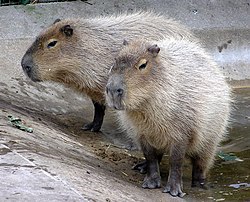
Picture of Hydrochoerinae
- Source
- Wikipedia/Commons
- Credit
- Adrian Pingstone
- Licence
- Public Domain
- Commercial use
- the licence allows it
No 3D scan was found. Smithsonian Open Access, MorphoSource and Sketchfab were all searched.
The description on this site
- Licence
- CC BY-SA 4.0
This is what the site found, which is not the same as what exists.
Keep going
What may have been alongside itCaviidae through timeFormations of the PleistoceneThe world it lived on
Occurrence data from the Paleobiology Database, CC BY 4.0. (Gill 1872)