Euoplocephalus

Nobu Tamura ( http://spinops.blogspot.com ) · CC BY-SA 3.0 · via Wikidata/Commons. May be a photograph of a specimen, or an artist’s reconstruction — an interpretation of a skeleton, since colour and soft tissue are almost never preserved.
On record
Recorded, not inferred- Sits inside
- EuoplocephaliniPBDB
- Diet
- herbivorePBDB, for Ornithischia
- Life habit
- ground dwelling, gregariousPBDB, for Ornithischia
- Motility
- actively mobilePBDB, for Ornithischia
- Environment
- terrestrialPBDB, for Ornithischia
- Length
- 5.5 mWikidata
- Mass
- 2.5 tonneWikidata
Time the record covers
At most 18 million years on record.
Every occurrence read is dated to somewhere between 83.6 Mya and 66 Mya, and nothing in the dating separates them, so that window is what the record shows rather than a span.
18 occurrences of Euoplocephalus on record, most of them in the Late Cretaceous. Bar height is expected occurrences, not a count: each fossil is spread across the span it is dated to, so a tall narrow bar means tight dating and a low wide one means loose.
When
18 occurrences- Late Cretaceous100%
These are dates about fossils, not the animal: the record can only begin after it arose and end before it died out, so either end may reach further. Shares are expected occurrences: a fossil dated to a span is counted partly in each period it straddles. More on what this infers.
Found in
8 formations
- Dinosaur Park Formation · Belly River Group8
- Judith River Formation · Montana Group3
- Two Medicine Formation · Montana Group2
- Horseshoe Canyon Formation · Edmonton Group1
- St. Mary River Formation1
- Bearpaw Shale Formation1
Loading coastlines…
The named rock units Euoplocephalus has been recovered from, largest first. Drawn where the rock is now, not where it formed.
Euoplocephalus and its relatives
Late CretaceousWhere Euoplocephalus and its relatives were recorded in the Late Cretaceous.
Found in the same rock
62 taxa- Ankylosauridae2 sites
- Crocodylia2 sites
- Eodelphis2 sites
- Hadrosauridae2 sites
- Mesodma2 sites
- Ornithomimidae2 sites
- Stegoceras validum2 sites
- Theropoda2 sites
- Acipenser1 site
- Albertosaurus1 site
- Alphadon halleyi1 site
- Alphadontidae1 site
- Avaceratops lammersi1 site
- Aves1 site
- Baenidae1 site
- Belonostomus1 site
- Boremys1 site
- Brachychampsa1 site
- Centrosaurinae1 site
- Centrosaurus1 site
- Ceratopsia1 site
- Champsosaurus1 site
- Chasmosaurus1 site
- Chirostenotes1 site
The Paleobiology Database records 18 sites for Euoplocephalus, and this reads all of them. The number is how many of those sites it was catalogued from too. The 24 sharing the most are listed.
This is not a list of everything alive at the time. It is only what has come out of the same ground as this animal and been written down.
Entered from
11 references- Ankylosaurian tail clubs of middle Campanian to early Maastrichtian age from western North America, with description of a tiny club from Alberta and discussion of tail orientation and tail club function7
- Fossil Vertebrate Collections2
- Revised systematics of the armoured dinosaur Euoplocephalus and its allies1
- The internal cranial morphology of an armoured dinosaur Euoplocephalus corroborated by X-ray computed tomographic reconstruction1
- History of research1
- Two new horned dinosaurs from the upper Cretaceous Two Medicine Formation of Montana; with a phylogenetic analysis of the Centrosaurinae (Ornithischia: Ceratopsidae)1
- The vertebrate fauna from the Judith River Formation (Late Cretaceous) of Wheatland and Golden Valley counties, Montana1
- New data on pachycephalosaurid dinosaurs (Reptilia: Ornithischia) from North America1
- [Stratigraphy of the mammal-bearing Tertiary of the Turfan Basin, Sinkiang]1
- A new species of Corythosaurus with notes on other Belly River Dinosauria1
- New genera and species from the Belly River Series (mid-Cretaceous)1
Each of the 18 occurrences read was entered from one of these publications, ordered by how many each accounts for. This is not a search for papers mentioning the name. Entries link to doi.org where the Paleobiology Database holds an identifier, and to its own record where it does not. Relayed as the Paleobiology Database holds them, not checked against what they resolve to.
Media and terms
Media content3
Picture of Euoplocephalus
- Source
- Wikidata/Commons
- Credit
- Nobu Tamura ( http://spinops.blogspot.com )
- Licence
- CC BY-SA 3.0
- Commercial use
- the licence allows it
Photogrammetry
- Source
- MorphoSource
- Licence
- In Copyright
- Commercial use
- cannot be read from the licence given — check the record
- Specimen
- Euoplocephalus sp. · amnh:farb:5409
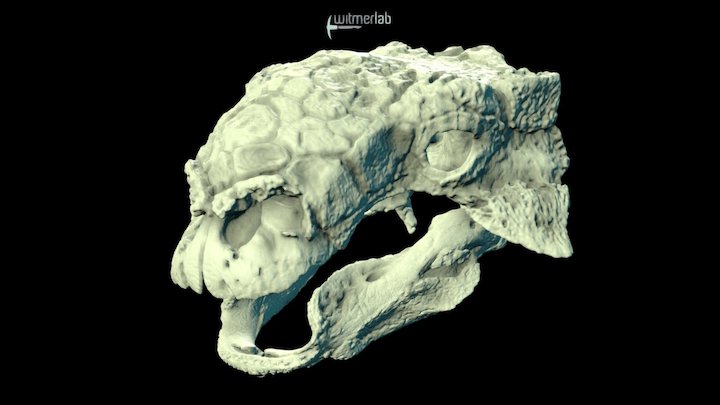
3D model
- Source
- Sketchfab
- Licence
- CC Attribution-NonCommercial-NoDerivs
- Commercial use
- the licence does not allow it
This entry was cached before the site began recording what Smithsonian Open Access did, so a search that failed cannot be told from one that found nothing.
This is what the site found, which is not the same as what exists.
Keep going
What may have been alongside itEuoplocephalini through timeFormations of the Late CretaceousThe world it lived on
Occurrence data from the Paleobiology Database, CC BY 4.0. Lambe 1910