Eubalaena
Right whales are three species of large baleen whales of the genus Eubalaena: the North Atlantic right whale, the North Pacific right whale and the southern right whale. They are classified in the family Balaenidae with the bowhead whale. Right whales have rotund bodies with arching rostrums, V-shaped blowholes and dark gray or black skin. The most distinguishing feature of a right whale is the rough patches of skin on its head, which appear white due to parasitism by whale lice. Right whales are typically 13–17 m (43–56 ft) long and weigh up to 100 short tons or more.

Michaël CATANZARITI · CC BY-SA 3.0 · via Wikipedia/Commons. May be a photograph of a specimen, or an artist’s reconstruction — an interpretation of a skeleton, since colour and soft tissue are almost never preserved.
On record
Recorded, not inferred- Also called
- right whalePBDB
- Sits inside
- BalaenidaePBDB
- Diet
- suspension feederPBDB, for Balaenidae
- Life habit
- aquaticPBDB, for Mysticeti
- Motility
- actively mobilePBDB, for Cetacea
- Environment
- marinePBDB, for Mysticeti
Time the record covers
At least 5.3 million years on record.
The record covers at least 5.333 Mya to 11.7 ka. No occurrence read is dated outside 23.04 Mya to 0 Mya.
54 occurrences of Eubalaena on record. The Paleobiology Database records this as a living group. Bar height is expected occurrences, not a count: each fossil is spread across the span it is dated to, so a tall narrow bar means tight dating and a low wide one means loose.
When
54 occurrences- Miocene7%
- Pliocene15%
- Pleistocene18%
- Holocene61%
These are dates about fossils, not the animal: the record can only begin after it arose and end before it died out, so either end may reach further. Shares are expected occurrences: a fossil dated to a span is counted partly in each period it straddles. More on what this infers.
Found in
12 formations
- Lillo Formation2
- Cromer Forest Bed Formation2
- Purisima Formation2
- Villamagna Formation2
- Las Escobas Formation1
- Santa Vitória Formation1
Loading coastlines…
The named rock units Eubalaena has been recovered from, largest first. Drawn where the rock is now, not where it formed. 38 occurrences have no formation on record, which is common for older literature.
Found in the same rock
144 taxa- Balaena mysticetus7 sites
- Megaptera novaeangliae5 sites
- Balaenidae4 sites
- Balaenoptera acutorostrata3 sites
- Balaenoptera physalus3 sites
- Cetacea3 sites
- Mesoplodon3 sites
- Orcinus orca3 sites
- Balaenoptera2 sites
- Balaenoptera musculus2 sites
- Balaenopteridae2 sites
- Carcharodon2 sites
- Cervus2 sites
- Chondrichthyes2 sites
- Delphinapterus leucas2 sites
- Delphinidae2 sites
- Dihoplus megarhinus2 sites
- Equus2 sites
- Equus caballus2 sites
- Lestodon armatus2 sites
- Mysticeti2 sites
- Ontocetus emmonsi2 sites
- Phocoena phocoena2 sites
- Pogonias cromis2 sites
The Paleobiology Database records 54 sites for Eubalaena, and this reads all of them. The number is how many of those sites it was catalogued from too. The 24 sharing the most are listed.
This is not a list of everything alive at the time. It is only what has come out of the same ground as this animal and been written down.
Entered from
37 references- Determining the ages of sub-fossil cetacean remains, found in the Carse of Stirling, Scotland6
- Late Pleistocene and Holocene whale remains (Cetacea) from Denmark and adjacent countries: Species, distribution, chronology, and trace element concentrations5
- Forgotten Mediterranean calving grounds of grey and North Atlantic right whales: evidence from Roman archaeological records3
- Status of southern right whales (Eubalaena australis) off southern Australia3
- Late Pleistocene and Holocene occurrence of bowhead whales (Balaena mysticetus) along the coasts of Norway2
- Revision of “Balaena” belgica reveals a new right whale species, the possible ancestry of the northern right whale, Eubalaena glacialis, and the ages of divergence for the living right whale species2
- A new marine vertebrate assemblage from the Late Neogene Purisima Formation in Central California, part II: Pinnipeds and Cetaceans2
- Catalog of Living Whales2
- New cetacean fossils from the late Cenozoic of South Africa1
- A new species of Eubalaena (Cetacea: Mysticeti: Balaenidae) from the Gonda Formation (latest Miocene-early Pliocene) of Japan1
- Whales, dorphines [dolphins] and porpoises off Shiretoko1
- I paleositi a vertebrati fossili della Provinia di Pisa1
Each of the 54 occurrences read was entered from one of these publications, ordered by how many each accounts for. This is not a search for papers mentioning the name. 25 further references are not listed. Entries link to doi.org where the Paleobiology Database holds an identifier, and to its own record where it does not. Relayed as the Paleobiology Database holds them, not checked against what they resolve to.
Media and terms
Media content2
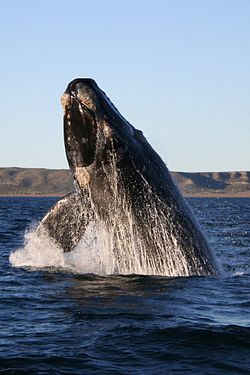
Picture of Eubalaena
- Source
- Wikipedia/Commons
- Credit
- Michaël CATANZARITI
- Licence
- CC BY-SA 3.0
- Commercial use
- the licence allows it
CT scan
- Source
- MorphoSource
- Credit
- LACM Mammalogy
- Licence
- In Copyright
- Commercial use
- cannot be read from the licence given — check the record
- Specimen
- Eubalaena glacialis · LACM:Mammals:54763
Smithsonian Open Access was not reached for this taxon, so this list is what the others held rather than everything there is.
The description on this site
- Source
- Wikipedia, “Right whale”
- Licence
- CC BY-SA 4.0
This is what the site found, which is not the same as what exists.
Keep going
What may have been alongside itBalaenidae through timeThe world it lived on
Occurrence data from the Paleobiology Database, CC BY 4.0. Gray 1864