Entobia
Searched as Entobia sp.. The Paleobiology Database treats Entobia as the accepted name.
via iDigBio · CC BY · via iDigBio. May be a photograph of a specimen, or an artist’s reconstruction — an interpretation of a skeleton, since colour and soft tissue are almost never preserved.
On record
Recorded, not inferred- Sits inside
- ClionaidaePBDB
- Diet
- suspension feederPBDB, for Clionaidae
- Life habit
- boringPBDB, for Clionaidae
- Motility
- stationaryPBDB, for Clionaidae
- Vision
- blindPBDB, for Porifera
Time the record covers
At least 157 million years on record.
The record covers at least 157.9 Mya to 11.7 ka. No occurrence read is dated outside 165.3 Mya to 0 Mya.
72 occurrences of Entobia on record, most of them in the Late Cretaceous. The Paleobiology Database records this as a living group. Bar height is expected occurrences, not a count: each fossil is spread across the span it is dated to, so a tall narrow bar means tight dating and a low wide one means loose.
When
72 occurrences- Middle Jurassicunder 1%
- Late Jurassic15%
- Early Cretaceous7%
- Late Cretaceous31%
- Paleocene3%
- Eocene3%
- Oligocene1%
- Miocene22%
- Pliocene4%
- Pleistocene11%
- Holocene3%
These are dates about fossils, not the animal: the record can only begin after it arose and end before it died out, so either end may reach further. Shares are expected occurrences: a fossil dated to a span is counted partly in each period it straddles. More on what this infers.
Found in
27 formations
- Jagüel Formation · Malargüe Group14
- Falmouth Formation · Coastal Group7
- Grès verts helvétiques Formation5
- Chhasra Formation3
- Choptank Formation · Chesapeake Group3
- Upper Coralline Limestone Formation2
Loading coastlines…
The named rock units Entobia has been recovered from, largest first. Drawn where the rock is now, not where it formed. 3 further formations hold fewer occurrences each and are not listed. 16 occurrences have no formation on record, which is common for older literature.
Entobia and its relatives
Late CretaceousWhere Entobia and its relatives were recorded in the Late Cretaceous.
Found in the same rock
1,121 taxa- Gastrochaenolites7 sites
- Gastropoda7 sites
- Lithophaga7 sites
- Rogerella6 sites
- Caulostrepsis5 sites
- Glycymeris5 sites
- Lima5 sites
- Serpula5 sites
- Spondylus5 sites
- Acesta4 sites
- Amphidonte (Amphidonte) parasitica4 sites
- Arca4 sites
- Barbatia4 sites
- Bryozoa4 sites
- Chlamys4 sites
- Crassatella4 sites
- Echinoidea4 sites
- Modiolus4 sites
- Naticidae4 sites
- Porites4 sites
- Serpulidae4 sites
- Trypanites4 sites
- Veneridae4 sites
- Allocoenia3 sites
The Paleobiology Database records 37 sites for Entobia, and this reads all of them. The number is how many of those sites it was catalogued from too. The 24 sharing the most are listed.
This is not a list of everything alive at the time. It is only what has come out of the same ground as this animal and been written down.
Entered from
33 references- Boring polychaetes associated with Pycnodonte (Phygraea) vesicularis (Lamarck) from the upper Cretaceous of Patagonia. A case of commensalism?14
- Les grès verts helvétiques (Aptien moyen-Albien supérieur) de Haute-Savoie, Valais et Vaud (Alpes occidentales franco-suisses)8
- Macroboring of Pleistocene Coral Communities, Falmouth Formation, Jamaica7
- Late Jurassic coral/microbial reefs from the northern Paris Basin - facies, paleoecology and paleobiogeography4
- Entobian bioerosion of Miocene oysters, Kachchh, Gujarat3
- An unusual Late Cretaceous fauna from an oyster-rich interval in the Santa Cruz Mountains of California3
- Stratigraphy, invertebrate taphonomy and depositional history of the Miocene Calvert and Choptank Formations, Atlantic Coastal Plain3
- The earliest fossil cetacean with Osedax borings: narrowing the spatiotemporal gap between Cretaceous marine reptiles and late Cenozoic whales2
- Snapshot of a lower Pliocene Dendropoma reef from Sant Onofre (Baix Ebre Basin, Tarragona, NE Spain)2
- Le alghe rosse calcaree come indicatori paleoambientali: l'esempio della rampa carbonatica Laziale-Abruzzese (Burdigaliano, Appennino centrale)2
- Palökologische und biofazielle Analyse des Kimmeridge (Oberjura) von Consolacao, Mittelportugal [Paleoecological and biofacies analysis of the Kimmeridgian (Upper Jurassic) of Consolacao, central Portugal]2
- A new coral-associated decapod assemblage from the Upper Miocene (Messinian) Upper Coralline Limestone of Malta (central Mediterranean)1
Each of the 72 occurrences read was entered from one of these publications, ordered by how many each accounts for. This is not a search for papers mentioning the name. 21 further references are not listed. Entries link to doi.org where the Paleobiology Database holds an identifier, and to its own record where it does not. Relayed as the Paleobiology Database holds them, not checked against what they resolve to.
Media and terms
Media content2
Picture of Entobia
- Source
- iDigBio
- Credit
- via iDigBio
- Licence
- CC BY
- Commercial use
- the licence allows it
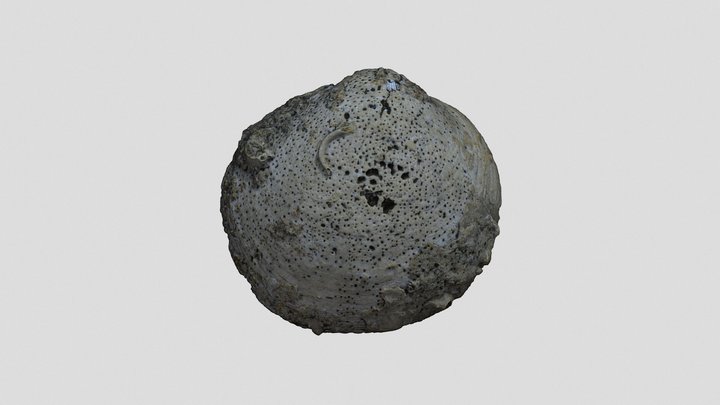
3D model
- Source
- Sketchfab
- Licence
- CC Attribution
- Commercial use
- cannot be read from the licence given — check the record
Smithsonian Open Access was not reached for this taxon, so this list is what the others held rather than everything there is.
This is what the site found, which is not the same as what exists.
Keep going
What may have been alongside itClionaidae through timeFormations of the Late CretaceousThe world it lived on
Occurrence data from the Paleobiology Database, CC BY 4.0. Bronn 1838