Gastrochaenolites
Gastrochaenolites is a trace fossil formed as a clavate (club-shaped) boring in a hard substrate such as a shell, rock or carbonate hardground. The aperture of the boring is narrower than the main chamber and may be circular, oval, or dumb-bell shaped. Gastrochaenolites is most commonly attributed to bioeroding bivalves such as Lithophaga and Gastrochaena. The fossil ranges from the Ordovician to the Recent. The first Lower Jurassic Gastrochaenolites ichnospecies is Gastrochaenolites messisbugi Bassi, Posenato, Nebelsick, 2017. This is the first record of boreholes and their producers in one of the larger bivalves of the globally occurring Lithiotis fauna which is a unique facies in the Lower Jurassic Tethys and Panthalassa.

Wilson44691 · CC0 · via Wikipedia/Commons. May be a photograph of a specimen, or an artist’s reconstruction — an interpretation of a skeleton, since colour and soft tissue are almost never preserved.
On record
Recorded, not inferred- Sits inside
- IchnofossilsPBDB
- Diet
- suspension feederPBDB
- Life habit
- boringPBDB
- Motility
- stationaryPBDB
Time the record covers
At least 318 million years on record.
The record covers at least 318.6 Mya to 11.7 ka. No occurrence read is dated outside 323.4 Mya to 0 Mya.
77 occurrences of Gastrochaenolites on record, most of them in the Late Cretaceous. Bar height is expected occurrences, not a count: each fossil is spread across the span it is dated to, so a tall narrow bar means tight dating and a low wide one means loose.
When
77 occurrences- Carboniferous1%
- Early Jurassic3%
- Middle Jurassic4%
- Late Jurassic17%
- Early Cretaceous16%
- Late Cretaceous25%
- Paleocene5%
- Eocene1%
- Miocene12%
- Pliocene5%
- Pleistocene11%
- Holocene1%
These are dates about fossils, not the animal: the record can only begin after it arose and end before it died out, so either end may reach further. Shares are expected occurrences: a fossil dated to a span is counted partly in each period it straddles. More on what this infers.
Found in
30 formations
- Jagüel Formation · Malargüe Group14
- Grès verts helvétiques Formation7
- Assomada Formation5
- Jaffna Limestone Formation2
- Maastricht Formation2
- Agrio Formation2
Loading coastlines…
The named rock units Gastrochaenolites has been recovered from, largest first. Drawn where the rock is now, not where it formed. 6 further formations hold fewer occurrences each and are not listed. 20 occurrences have no formation on record, which is common for older literature.
Gastrochaenolites and its relatives
Late CretaceousWhere Gastrochaenolites and its relatives were recorded in the Late Cretaceous.
Found in the same rock
618 taxa- Trypanites11 sites
- Entobia9 sites
- Caulostrepsis7 sites
- Bivalvia6 sites
- Gastropoda6 sites
- Plagiostoma6 sites
- Liostrea5 sites
- Lithophaga5 sites
- Plicatula5 sites
- Rogerella sp.5 sites
- Cyathophora4 sites
- Discoides4 sites
- Entobia sp.4 sites
- Isastrea4 sites
- Leymeriella tardefurcata4 sites
- Montlivaltia4 sites
- Pseudolimea4 sites
- Talpina sp.4 sites
- Arca3 sites
- Berenicea3 sites
- Brachiopoda3 sites
- Camptonectes tutorae3 sites
- Clionolithes3 sites
- Entolium membranaceum3 sites
The Paleobiology Database records 39 sites for Gastrochaenolites, and this reads all of them. The number is how many of those sites it was catalogued from too. The 24 sharing the most are listed.
This is not a list of everything alive at the time. It is only what has come out of the same ground as this animal and been written down.
Entered from
35 references- Boring polychaetes associated with Pycnodonte (Phygraea) vesicularis (Lamarck) from the upper Cretaceous of Patagonia. A case of commensalism?14
- Les grès verts helvétiques (Aptien moyen-Albien supérieur) de Haute-Savoie, Valais et Vaud (Alpes occidentales franco-suisses)7
- Late Jurassic coral/microbial reefs from the northern Paris Basin - facies, paleoecology and paleobiogeography6
- What Darwin did not see: Pleistocene fossil assemblages on a high energy coast at Ponta das Bicudas, Santiago, Cape Verde Islands5
- Stratigraphy and Paleobiology of the Upper Cretaceous - Lower Paleogene Sediments from the Trans-Saharan Seaway in Mali4
- Miocene intertidal zonation on a volcanically active shoreline: Porto Santo in the Madeira Archipelago, Portugal4
- Ichonological nomenclature of clavate borings4
- Snapshot of a lower Pliocene Dendropoma reef from Sant Onofre (Baix Ebre Basin, Tarragona, NE Spain)3
- Palaeodromites crypticus, a new early-middle Cenomanian dynomenid crab (Crustacea, Decapoda) from southern Belgium3
- Heydrichia (?) poignantii, sp. nov. (Sporolithaceae, Sporolithales, Rhodophyta), a 100 million year old fossil coralline red alga from north-eastern Brazil, and a new Hauterivian record of Sporolithon from Switzerland2
- Marine benthic invertebrates from the Upper Jurassic of northern Ethiopia and their biogeographic affinities1
- An early Hettangian coral reef in southern France: Implications for the end-Triassic reef crisis1
Each of the 77 occurrences read was entered from one of these publications, ordered by how many each accounts for. This is not a search for papers mentioning the name. 23 further references are not listed. Entries link to doi.org where the Paleobiology Database holds an identifier, and to its own record where it does not. Relayed as the Paleobiology Database holds them, not checked against what they resolve to.
Media and terms
Media content2

Picture of Gastrochaenolites
- Source
- Wikipedia/Commons
- Credit
- Wilson44691
- Licence
- CC0
- Commercial use
- the licence allows it
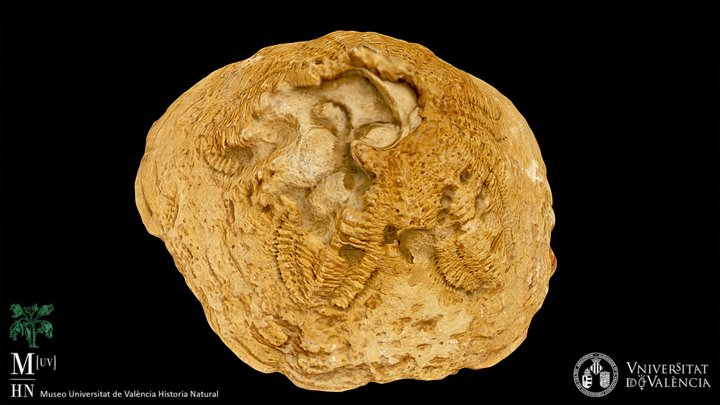
3D model
- Source
- Sketchfab
- Licence
- CC Attribution
- Commercial use
- cannot be read from the licence given — check the record
Smithsonian Open Access and MorphoSource were not reached for this taxon, so this list is what the others held rather than everything there is.
The description on this site
- Licence
- CC BY-SA 4.0
This is what the site found, which is not the same as what exists.
Keep going
What may have been alongside itIchnofossils through timeFormations of the Late CretaceousThe world it lived on
Occurrence data from the Paleobiology Database, CC BY 4.0. Leymerie 1842