Clionolithes
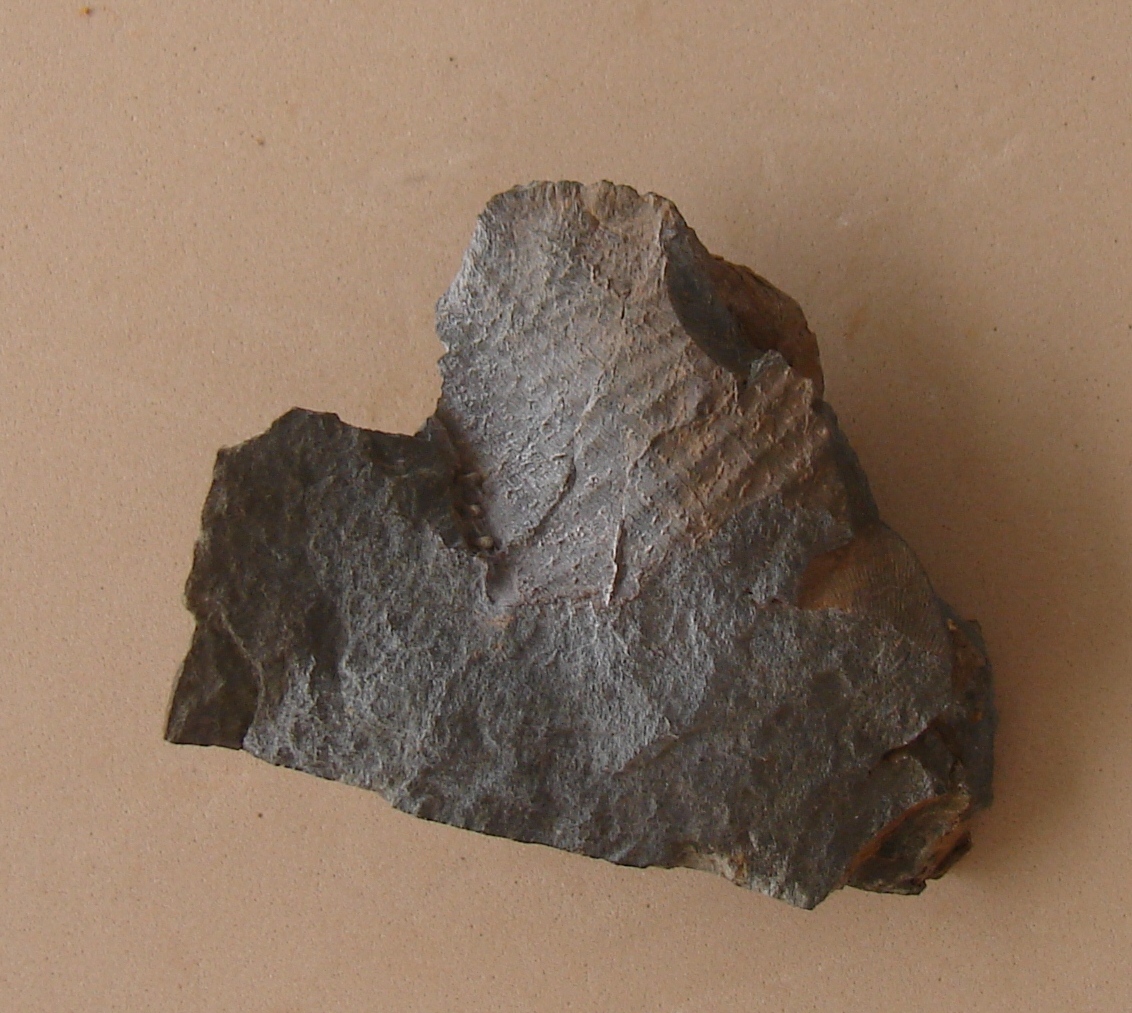
Daniel Watrinelle · CC0 · via GBIF. May be a photograph of a specimen, or an artist’s reconstruction — an interpretation of a skeleton, since colour and soft tissue are almost never preserved.
On record
Recorded, not inferred- Sits inside
- ClionaidaePBDB
- Diet
- suspension feederPBDB, for Clionaidae
- Life habit
- boringPBDB
- Motility
- stationaryPBDB, for Clionaidae
- Vision
- blindPBDB, for Porifera
Time the record covers
At least 340 million years on record.
The record covers at least 413.02 Mya to 72.2 Mya. No occurrence read is dated outside 419.62 Mya to 66 Mya.
34 occurrences of Clionolithes on record, most of them in the Devonian. Bar height is expected occurrences, not a count: each fossil is spread across the span it is dated to, so a tall narrow bar means tight dating and a low wide one means loose.
When
34 occurrencesThese are dates about fossils, not the animal: the record can only begin after it arose and end before it died out, so either end may reach further. Shares are expected occurrences: a fossil dated to a span is counted partly in each period it straddles. More on what this infers.
Found in
11 formations
- Jagüel Formation · Malargüe Group14
- Mount Ida Formation3
- Heath Formation2
- McIvor Formation2
- Schistes de Beaulieu Formation2
- Tabberabbera Formation · Wentworth Group2
Loading coastlines…
The named rock units Clionolithes has been recovered from, largest first. Drawn where the rock is now, not where it formed. 3 occurrences have no formation on record, which is common for older literature.
Clionolithes and its relatives
DevonianWhere Clionolithes and its relatives were recorded in the Devonian.
Found in the same rock
510 taxa- Fenestella9 sites
- Gastropoda9 sites
- Rugosa8 sites
- Bivalvia7 sites
- Crinoidea7 sites
- Cyrtina7 sites
- Favosites7 sites
- Atrypa6 sites
- Bryozoa6 sites
- Chonetes6 sites
- Howellella6 sites
- Pleurodictyum6 sites
- Rhynchonellidae6 sites
- Trilobita6 sites
- Aulopora5 sites
- Cladochonus5 sites
- Isorthis5 sites
- Spirorbis5 sites
- Thamnopora5 sites
- Ambocoelia4 sites
- Amphissites4 sites
- Athyris concentrica4 sites
- Brachiopoda4 sites
- Cypricardella4 sites
The Paleobiology Database records 22 sites for Clionolithes, and this reads all of them. The number is how many of those sites it was catalogued from too. The 24 sharing the most are listed.
This is not a list of everything alive at the time. It is only what has come out of the same ground as this animal and been written down.
Entered from
11 references- Boring polychaetes associated with Pycnodonte (Phygraea) vesicularis (Lamarck) from the upper Cretaceous of Patagonia. A case of commensalism?14
- The Silurian and Early Devonian Faunas of the Heathcote District, Victoria5
- Oekologie und Fazies des juengsten Ober-Devon von Velbert (Rheinisches Schiefergebirge)3
- Middle Devonian brachiopod-hosted sclerobiont assemblage from the northern shelf of Gondwana (Mader Basin, Morocco): Diversity, colonization patterns and relation to coeval palaeocommunities2
- The sedimentology and palaeoecology of the Devonian of the Ferques inlier, northern France2
- The Devonian of the Mitchell and Wentworth Rivers2
- Carboniferous formations and faunas of central Montana2
- The Garra Formation (Early Devonian: Late Lochkovian) between Cumnock and Larras Lee, New South Wales, Australia: stratigraphic and structural setting, faunas, and community sequence1
- The Occurrence and Paleoecology of Echinoderm Asseblages in the Ludlowville Shales (Middle Devonian) of western Erie County, New York1
- The brachiopods of the Lower Devonian Maradana Shale, New South Wales1
- Late Mississippian fauna from the Redoak Hollow Formation of southern Oklahoma, Part I1
Each of the 34 occurrences read was entered from one of these publications, ordered by how many each accounts for. This is not a search for papers mentioning the name. Entries link to doi.org where the Paleobiology Database holds an identifier, and to its own record where it does not. Relayed as the Paleobiology Database holds them, not checked against what they resolve to.
Media and terms
Media content1
Picture of Clionolithes
- Source
- GBIF
- Credit
- Daniel Watrinelle
- Licence
- CC0
- Commercial use
- the licence allows it
No 3D scan was found. Smithsonian Open Access, MorphoSource and Sketchfab were all searched.
This is what the site found, which is not the same as what exists.
Keep going
What may have been alongside itClionaidae through timeFormations of the DevonianThe world it lived on
Occurrence data from the Paleobiology Database, CC BY 4.0. Clark 1908