Enchodontoidei
The Enchodontoidei are an extinct superorder of aulopiform fish known from the Early Cretaceous to the Eocene. They were among the dominant predatory marine fish groups in the Late Cretaceous, achieving a worldwide distribution. They were an extremely diverse group, with some developing fusiform body plans whereas others evolved elongated body plans with long beaks, superficially similar to eels and needlefish. They could also grow to very large sizes, as seen with Cimolichthys and Stratodus, the latter of which is the largest aulopiform known. Their most famous member is the widespread, abundant, and long-lasting genus Enchodus.

Vassil · CC0 · via Wikipedia/Commons. May be a photograph of a specimen, or an artist’s reconstruction — an interpretation of a skeleton, since colour and soft tissue are almost never preserved.
On record
Recorded, not inferred- Sits inside
- AulopiformesPBDB
- Diet
- carnivorePBDB, for Aulopiformes
- Life habit
- nektonicPBDB, for Aulopiformes
- Motility
- actively mobilePBDB, for Aulopiformes
Time the record covers
At least 41 million years on record.
The record covers at least 113.2 Mya to 72.2 Mya. No occurrence read is dated outside 121.4 Mya to 66 Mya.
25 occurrences of Enchodontoidei on record, most of them in the Late Cretaceous. The Paleobiology Database records this as a living group, and the chart stops with its fossils rather than at the present. Bar height is expected occurrences, not a count: each fossil is spread across the span it is dated to, so a tall narrow bar means tight dating and a low wide one means loose.
When
25 occurrencesThese are dates about fossils, not the animal: the record can only begin after it arose and end before it died out, so either end may reach further. Shares are expected occurrences: a fossil dated to a span is counted partly in each period it straddles. More on what this infers.
Found in
9 formations
- Sannine Formation5
- Bet Meir or Amminadav Formation3
- Zig Zag Chalk Formation · Chalk Group2
- Khodzhakul Formation1
- Akrabou Formation1
- Muwaddar Chalk Marl Formation1
Loading coastlines…
The named rock units Enchodontoidei has been recovered from, largest first. Drawn where the rock is now, not where it formed. 9 occurrences have no formation on record, which is common for older literature.
Enchodontoidei and its relatives
Late CretaceousWhere Enchodontoidei and its relatives were recorded in the Late Cretaceous.
Found in the same rock
371 taxa- Eurypholis boissieri6 sites
- Aipichthys minor3 sites
- Aspidopleurus cataphractus3 sites
- Bivalvia3 sites
- Eurypholis3 sites
- Eurypholis pulchellus3 sites
- Ornategulum sardinioides3 sites
- Saurorhamphus3 sites
- Abisaadia hakelensis2 sites
- Acanthomorphata2 sites
- Armigatus brevissimus2 sites
- Batoidea2 sites
- Belonostomus2 sites
- Carpopenaeus callirostris2 sites
- Cretalamna2 sites
- Crocodylia2 sites
- Ctenothrissa radians2 sites
- Ctenothrissa vexillifer2 sites
- Cyclobatis oligodactylus2 sites
- Diplomystus2 sites
- Enchodontidae2 sites
- Enchodus2 sites
- Enchodus lewesiensis2 sites
- Hastichthys gracilis2 sites
The Paleobiology Database records 20 sites for Enchodontoidei, and this reads all of them. The number is how many of those sites it was catalogued from too. The 24 sharing the most are listed.
This is not a list of everything alive at the time. It is only what has come out of the same ground as this animal and been written down.
Entered from
17 references- Fossil fishes from the Cenomanian (Upper Cretaceous) of Namoura, Lebanon3
- The fossil fishes from the Sierra Madre Formation, Ocozocoautla, Chiapas, Southern Mexico2
- Yabrudichthys and serrilepis, two new genera of Enchodontoids (Teleostei) from Lower cenomanian beds of ‘ein-yabrūd, israel2
- The relationships of certain Upper Cretaceous teleosts with special reference to the Myctophoids2
- The fossil fishes of the English Chalk. Part II2
- Pictet and Humbert, 18662
- Pictet, 18502
- New enchodontoid fish (Teleostei: Aulopiformes) from the Late Cretaceous of Lebanon1
- The English Chalk and London Clay: two remarkable British bony fish Lagerstatten1
- A new Plattenkalk Konservat Lagerstätte in the Upper Cretaceous of Gara Sbaa, south-eastern Morocco1
- A new genus and species of gigantic marine turtles (Chelonioidea: Cheloniidae) from the Maastrichtian of the Harrana Fauna-Jordan1
- New species of the Cenomanian Eurypterygii (Pisces, Teleostei) from Lebanon1
Each of the 25 occurrences read was entered from one of these publications, ordered by how many each accounts for. This is not a search for papers mentioning the name. 5 further references are not listed. Entries link to doi.org where the Paleobiology Database holds an identifier, and to its own record where it does not. Relayed as the Paleobiology Database holds them, not checked against what they resolve to.
Media and terms
Media content1
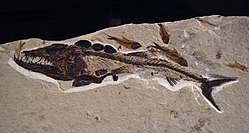
Picture of Enchodontoidei
- Source
- Wikipedia/Commons
- Credit
- Vassil
- Licence
- CC0
- Commercial use
- the licence allows it
No 3D scan of Enchodontoidei was found in Sketchfab.
Smithsonian Open Access and MorphoSource were not reached for this taxon, so this list is what the others held rather than everything there is.
The description on this site
- Licence
- CC BY-SA 4.0
This is what the site found, which is not the same as what exists.
Keep going
What may have been alongside itAulopiformes through timeFormations of the Late CretaceousThe world it lived on
Occurrence data from the Paleobiology Database, CC BY 4.0. (Berg 1937)