Echinoida
Echinoida is an order of sea urchins in the class Echinoidea. They are distinguished from other sea urchins by simultaneously possessing both an un-sculpted test and a feeding lantern with large plates fused across the top of each pyramid.

Marco Busdraghi · CC BY 3.0 · via Wikipedia/Commons. May be a photograph of a specimen, or an artist’s reconstruction — an interpretation of a skeleton, since colour and soft tissue are almost never preserved.
On record
Recorded, not inferred- Sits inside
- EchinoideaPBDB
- Diet
- grazerPBDB
- Life habit
- low-level epifaunalPBDB
- Motility
- slow-movingPBDB
- Vision
- limitedPBDB, for Echinoidea
- Environment
- marinePBDB, for Echinodermata
Time the record covers
At least 306 million years on record.
The record covers at least 307 Mya to 11.7 ka. No occurrence read is dated outside 313.8 Mya to 0 Mya.
48 occurrences of Echinoida on record, most of them in the Late Cretaceous. The Paleobiology Database records this as a living group. Bar height is expected occurrences, not a count: each fossil is spread across the span it is dated to, so a tall narrow bar means tight dating and a low wide one means loose.
When
48 occurrences- Carboniferous4%
- Permian2%
- Middle Triassic2%
- Late Triassic2%
- Early Jurassic4%
- Middle Jurassic13%
- Late Jurassic9%
- Early Cretaceous8%
- Late Cretaceous29%
- Paleocene13%
- Oligocene1%
- Miocene9%
- Pleistocene2%
- Holocene2%
These are dates about fossils, not the animal: the record can only begin after it arose and end before it died out, so either end may reach further. Shares are expected occurrences: a fossil dated to a span is counted partly in each period it straddles. More on what this infers.
Found in
18 formations
- Jagüel Formation · Malargüe Group10
- Roca Formation · Malargüe Group5
- Chari Formation4
- Lefipán Formation3
- Spence Harbour Conglomerate Formation1
- San Lorenzo Formation1
Loading coastlines…
The named rock units Echinoida has been recovered from, largest first. Drawn where the rock is now, not where it formed. 12 occurrences have no formation on record, which is common for older literature.
Echinoida and its relatives
Late CretaceousWhere Echinoida and its relatives were recorded in the Late Cretaceous.
Found in the same rock
556 taxa- Bivalvia13 sites
- Gastropoda12 sites
- Pseudolimea8 sites
- Camptonectes tutorae7 sites
- Serpulidae7 sites
- Mesocallista6 sites
- Pycnodonte vesicularis6 sites
- Lyriochlamys5 sites
- Anomia4 sites
- Bryozoa4 sites
- Cryptorhytis4 sites
- Entolium membranaceum4 sites
- Modiolus4 sites
- Ostracoda4 sites
- Panopea clausa4 sites
- Phelopteria4 sites
- Struthioptera4 sites
- Amphidonte mendozana3 sites
- Aphrodina (Tikia)3 sites
- Balanus3 sites
- Chaetetidae3 sites
- Crinoidea3 sites
- Disparilia3 sites
- Etea carolinensis3 sites
The Paleobiology Database records 35 sites for Echinoida, and this reads all of them. The number is how many of those sites it was catalogued from too. The 24 sharing the most are listed.
This is not a list of everything alive at the time. It is only what has come out of the same ground as this animal and been written down.
Entered from
25 references- Molluscs at the K/Pg boundary in Argentina: Extinction and recovery patterns. unpublished Ph.D. thesis18
- Unpublished data from Kachchh4
- Les formations recifales coralliennes du Miocene superieur d'Algerie et du Maroc [Upper Miocene coral reef formations from Algeria and Morocco]3
- A cored Jurassic sequence from north Lincolnshire, England: stratigraphy, facies analysis and regional context.2
- Holocene coral reef development under windward and leeward locations at Ishigaki Island, Ryukyu Islands, Japan1
- Unpublished census data from Atlantic coastal plain and circum-Caribbean Neogene assemblages and taxonomic opinions1
- A new species of Gervillia Defrance (Bivalvia, Bakevelliidae) from the Aptian-Albian transition of Sergipe, Brazil1
- Early Valanginian brachiopods from the Mecsek Mts. (southern Hungary) and their palaeobiogeographical significance1
- A marine invertebrate fauna from the upper part of the Panther Seep Formation (earliest Wolfcampian) near Hembrillo Pass, San Andres Mountains, south-central New Mexico1
- Carbonate facies dominated by syndepositional cements: a key component of Middle Triassic platforms. The Marmolada case history (Dolomites, Italy)1
- Early Jurassic Bivalvia of western Canada. Part I. Subclasses Palaeotaxodonta, Pteriomorpha, and Isofilibranchia1
- Norian serpulid and microbial bioconstructions: implications for the platform evolution in the Lombardy Basin (Southern Alps, Italy)1
Each of the 48 occurrences read was entered from one of these publications, ordered by how many each accounts for. This is not a search for papers mentioning the name. 13 further references are not listed. Entries link to doi.org where the Paleobiology Database holds an identifier, and to its own record where it does not. Relayed as the Paleobiology Database holds them, not checked against what they resolve to.
Media and terms
Media content1
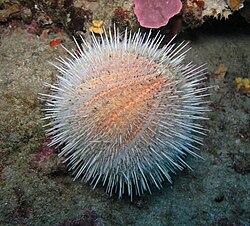
Picture of Echinoida
- Source
- Wikipedia/Commons
- Credit
- Marco Busdraghi
- Licence
- CC BY 3.0
- Commercial use
- the licence allows it
No 3D scan was found. Smithsonian Open Access, MorphoSource and Sketchfab were all searched.
The description on this site
- Source
- Wikipedia, “Echinoida”
- Licence
- CC BY-SA 4.0
This is what the site found, which is not the same as what exists.
Keep going
What may have been alongside itEchinoidea through timeFormations of the Late CretaceousThe world it lived on
Occurrence data from the Paleobiology Database, CC BY 4.0. Troschel 1872