Disphyllum

via iDigBio · CC0 · via iDigBio. May be a photograph of a specimen, or an artist’s reconstruction — an interpretation of a skeleton, since colour and soft tissue are almost never preserved.
On record
Recorded, not inferred- Sits inside
- DisphyllinaePBDB
- Diet
- suspension feederPBDB, for Rugosa
- Life habit
- epifaunalPBDB, for Rugosa
- Motility
- stationary, attachedPBDB, for Rugosa
- Vision
- blindPBDB, for Anthozoa
- Environment
- marinePBDB, for Rugosa
Time the record covers
At least 54 million years on record.
The record covers at least 426.7 Mya to 372.15 Mya. No occurrence read is dated outside 443.1 Mya to 358.86 Mya.
257 occurrences of Disphyllum on record, most of them in the Devonian. Bar height is expected occurrences, not a count: each fossil is spread across the span it is dated to, so a tall narrow bar means tight dating and a low wide one means loose.
When
257 occurrencesThese are dates about fossils, not the animal: the record can only begin after it arose and end before it died out, so either end may reach further. Shares are expected occurrences: a fossil dated to a span is counted partly in each period it straddles. More on what this infers.
Found in
85 formations
- Pillara Formation22
- Sadler Limestone Formation13
- Horn Plateau Formation7
- Combe Martin Slates Formation · Infracombe Slates Group7
- Schistes de Beaulieu Formation7
- Kowala Formation7
Loading coastlines…
The named rock units Disphyllum has been recovered from, largest first. Drawn where the rock is now, not where it formed. 61 further formations hold fewer occurrences each and are not listed. 28 occurrences have no formation on record, which is common for older literature.
Disphyllum and its relatives
DevonianWhere Disphyllum and its relatives were recorded in the Devonian.
Found in the same rock
876 taxa- Thamnopora62 sites
- Hexagonaria37 sites
- Alveolites36 sites
- Thamnophyllum29 sites
- Tabulophyllum26 sites
- Aulopora24 sites
- Favosites22 sites
- Phillipsastrea22 sites
- Stromatoporoidea22 sites
- Crinoidea21 sites
- Stachyodes20 sites
- Amphipora19 sites
- Temnophyllum19 sites
- Macgeea15 sites
- Rugosa15 sites
- Spinatrypa15 sites
- Stromatopora15 sites
- Cyrtospirifer14 sites
- Peneckiella14 sites
- Syringopora14 sites
- Ostracoda13 sites
- Alveolites suborbicularis12 sites
- Athyris12 sites
- Atrypa12 sites
The Paleobiology Database records 142 sites for Disphyllum, and this reads all of them. The number is how many of those sites it was catalogued from too. The 24 sharing the most are listed.
This is not a list of everything alive at the time. It is only what has come out of the same ground as this animal and been written down.
Entered from
75 references- Ordovician, Silurian, and Devonian corals of Alaska21
- The distribution of rugose corals in Frasnian outcrop sequences of North America17
- Middle and Upper Devonian rugose corals from the Canning Basin, Western Australia15
- Devonian corals from the Canning Basin, Western Australia14
- Die devonischen Riffe im Rheinischen Schiefergebirge [The Devonian reefs of the Rheinisches Schiefergebirge]11
- Drowning, extinction, and subsequent facies development of the Devonian Hönne Valley Reef (northern Rhenish Massif, Germany)10
- Stratigraphie und Systematik rugoser Korallen aus dem Givetium und Unter-Frasnium des Rheinischen Schiefergebirges (Sauerland/Bergisches Land) [Stratigraphy and systematics of rugose corals from the Givetian and Lower Frasnian of the Rheinisches Schiefergebirge (Sauerland/Bergisches Land)]7
- Middle Devonian rugose coral faunas in northeastern British Columbia and District of Mackenzie, western Canada7
- The history of Devonian-Carboniferous reef communities: extinctions, effects, recovery7
- Rugose corals from the Devonian Kowala Formation of the Holy Cross Mountains7
- Edmonds et al., 19857
- Rugose corals of the Lower-Middle and Middle-Upper Devonian boundary beds of the Cantabrian Mountains (NW Spain)7
Each of the 257 occurrences read was entered from one of these publications, ordered by how many each accounts for. This is not a search for papers mentioning the name. 63 further references are not listed. Entries link to doi.org where the Paleobiology Database holds an identifier, and to its own record where it does not. Relayed as the Paleobiology Database holds them, not checked against what they resolve to.
Media and terms
Media content2
Picture of Disphyllum
- Source
- iDigBio
- Credit
- via iDigBio
- Licence
- CC0
- Commercial use
- the licence allows it
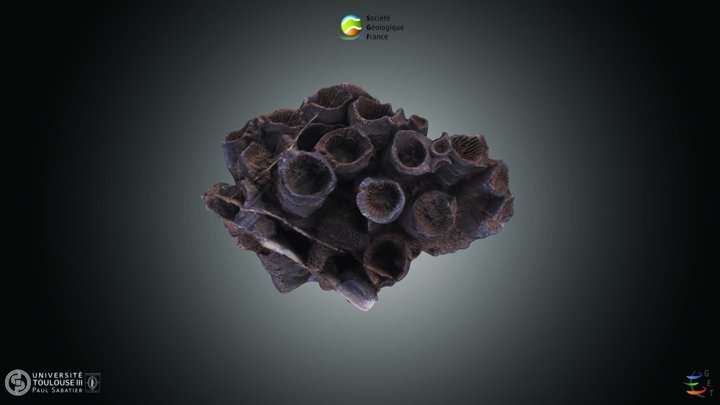
3D model
- Source
- Sketchfab
- Licence
- CC Attribution-NonCommercial-ShareAlike
- Commercial use
- the licence does not allow it
This is what the site found, which is not the same as what exists.
Keep going
What may have been alongside itDisphyllinae through timeFormations of the DevonianThe world it lived on
Occurrence data from the Paleobiology Database, CC BY 4.0. Fromentel 1861